
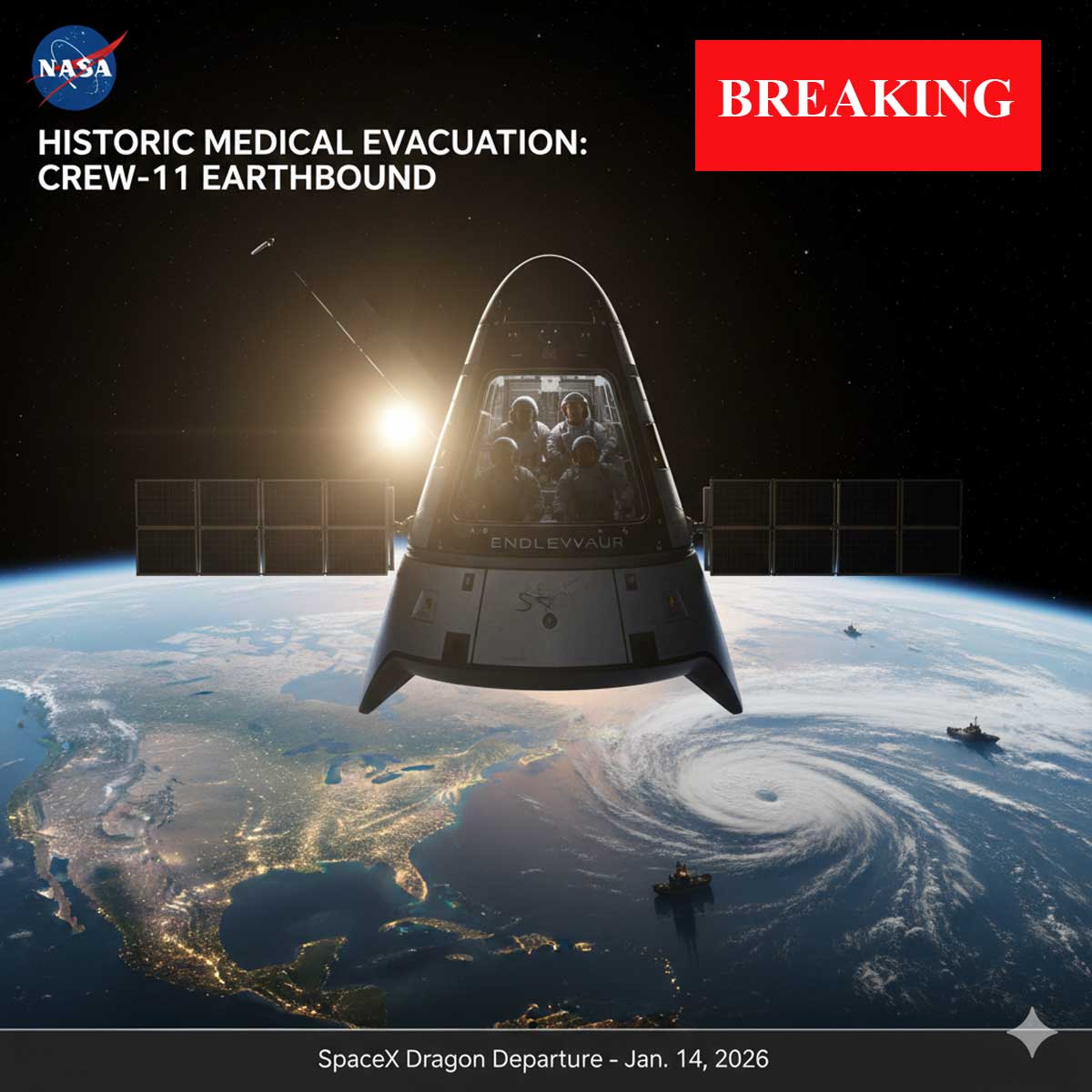
Historic First: NASA Initiates Medical Evacuation from ISS as Crew-11 Prepares for SpaceX Dragon Homecoming
STATION HARMONY, Low Earth Orbit — For the first time in the quarter-century history of the International Space Station (ISS), NASA has officially initiated a “controlled medical evacuation.” On Wednesday, January 14, 2026, the four astronauts of SpaceX Crew-11 will shutter the hatches of their Dragon Endeavour spacecraft and begin an expedited journey back to Earth, cutting their six-month mission short due to a persistent medical concern with one crew member.
The decision, which NASA officials describe as “precautionary but necessary,” marks a significant moment in space medicine. While the orbiting laboratory has seen its share of minor injuries and illnesses since permanent occupancy began in 2000, this is the first time a full crew rotation has been triggered early to address a specific health risk that requires Earth-based diagnostics.
The Departure Timeline: A Midnight Descent
Mission managers at Johnson Space Center in Houston gave the final “go” for undocking on Tuesday after reviewing favorable weather forecasts for the recovery zones. The return sequence is a high-stakes ballet of physics and logistics:
| Event | Date (PST/EST) | Time (EST) |
| Hatch Closure | Wednesday, Jan. 14 | 3:30 PM |
| Undocking from ISS | Wednesday, Jan. 14 | 5:05 PM |
| Deorbit Burn | Thursday, Jan. 15 | 2:50 AM |
| Pacific Splashdown | Thursday, Jan. 15 | 3:41 AM |
The crew returning includes NASA’s Zena Cardman (Mission Commander) and Mike Fincke (Pilot), along with Kimiya Yui of JAXA and Oleg Platonov of Roscosmos. After nearly six months in space, their return transition will take approximately 11 hours from undocking to splashdown.
“Lingering Risk”: Why NASA Chose Evacuation
The catalyst for this historic evacuation was a “medical concern” that first surfaced on Wednesday, January 7, leading to the immediate postponement of a planned spacewalk (US EVA-94). During a press briefing, Dr. J.D. Polk, NASA’s Chief Health and Medical Officer, clarified that the condition was not an injury sustained during operations but rather a clinical issue made complex by the environment of space.
“The astronaut is stable, but we are dealing with a medical issue in the difficult area of microgravity with a limited suite of hardware for a definitive diagnosis,” Dr. Polk explained. “It leaves a lingering risk and a lingering question. We always err on the side of the astronaut’s health.”
NASA Administrator Jared Isaacman—the billionaire adventurer who now leads the agency—echoed this sentiment, noting that while the station is equipped with advanced medical kits and telemedicine capabilities, the full range of diagnostic tools available on Earth is irreplaceable.
A “Skeleton Crew” Remains
On Monday, January 12, a “bittersweet” change-of-command ceremony took place in the Japanese Kibo laboratory. Mike Fincke, who had been serving as the station’s commander, handed over the symbolic “key to the station” to Russian cosmonaut Sergey Kud-Sverchkov.
With the departure of Crew-11, the ISS will be left with only three occupants:
- Sergey Kud-Sverchkov (Roscosmos) – Expedition 74 Commander
- Sergey Mikaev (Roscosmos)
- Christopher Williams (NASA)
This marks a return to the “skeleton crew” operations common in the station’s early years. Christopher Williams, who launched in late 2025, will now be the sole American on board, tasked with maintaining the U.S. Orbital Segment until the arrival of Crew-12, which NASA is attempting to move up from its original mid-February launch date.
The Impact on Artemis and Beyond
Despite the logistical hurdle, NASA has assured the public that the Crew-11 evacuation will not impact the upcoming Artemis 2 moon mission, currently targeted for February 2026. The two campaigns use different launch architectures and recovery teams, allowing the agency to handle the ISS medical situation without stalling its deep-space ambitions.
The medical evacuation serves as a stark reminder of the “human element” in space exploration. As humans push further toward Mars, these real-world scenarios provide invaluable data on how to manage health emergencies when Earth is not just hours, but months away.
How to Watch the Return
NASA will provide live, continuous coverage of the Crew-11 homecoming on NASA+ and the agency’s official social media channels.
- 3:00 PM EST Today: Coverage of hatch closure.
- 4:45 PM EST Today: Coverage of undocking.
- 2:15 AM EST Tomorrow: Coverage of reentry and splashdown.