
Wyoming’s $4.6 Million “Virtual Getaway Car”: How Scammers Are Using Crypto ATMs to Drain the Cowboy State
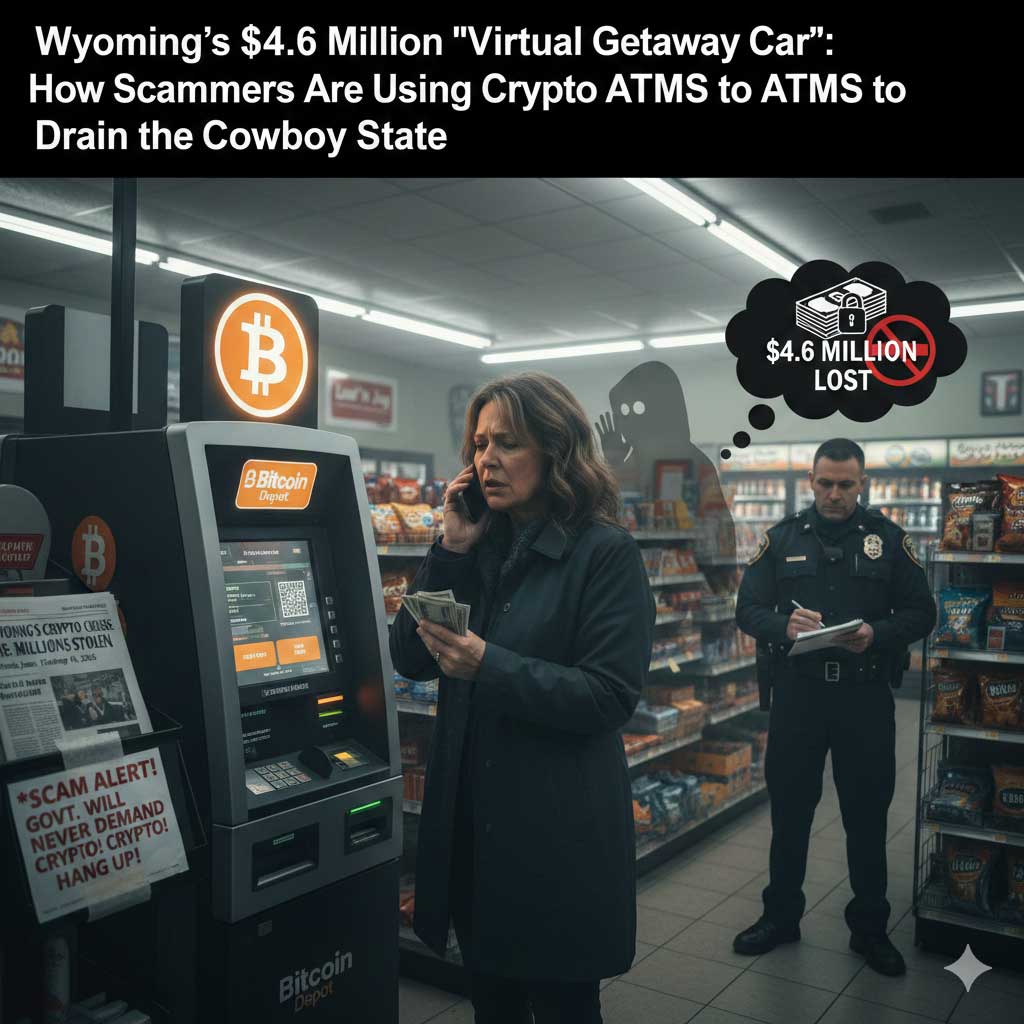
CHEYENNE — In the corner of a Loaf ‘N Jug in Cheyenne, an unassuming machine stands next to the snacks and soda fountains. To the casual observer, it looks like a standard bank ATM. But to law enforcement officials across Wyoming, these “Crypto ATMs” have become a preferred tool for international organized crime—a “virtual getaway car” that has siphoned over $4.6 million from the state’s three largest cities in the last year alone.
The scale of the theft is staggering. Of that $4.6 million, approximately $3 million was stolen from residents in Gillette and Campbell County alone. Cheyenne reports losses exceeding $650,000, while Sheridan officials have tracked over $1.5 million in similar fraud over the past two years.
“This has become the new frontier for scammers,” says Cheyenne Police Sgt. Kevin Malatesta. “A decade ago, we saw victims directed to prepaid gift cards or money orders. Now, the currency has shifted to Bitcoin, and the results are devastating.”
The Anatomy of a “Crypto Kiosk” Scam
The machines, often branded under names like Bitcoin Depot or CoinFlip, allow users to insert cash and instantly convert it into digital currency, which is then sent to a specific “wallet” address. While the machines themselves are legal, they lack the human gatekeepers—tellers or cashiers—who are trained to spot the signs of a panicked victim.
The scams typically follow a well-worn script designed to induce immediate fear:
- The Government Impersonator: A caller claims to be from the IRS, the Social Security Administration, or a local utility company, demanding immediate payment for a “past due bill.”
- The Law Enforcement Threat: Scammers pose as local deputies or court officials, telling victims they have an active warrant for missing jury duty or an unpaid fine.
- The “Grandparent” or Romance Scam: Emotional manipulation is used to convince victims that a loved one is in jail or that an online romantic partner needs emergency funds.
In almost every case, the scammer stays on the phone with the victim, directing them to their bank to withdraw cash and then guiding them step-by-step to the nearest Crypto ATM.
“They keep them on the line to ensure compliance and prevent them from seeking advice from anyone else,” Malatesta explains. “By the time the victim hangs up, the money is gone.”
A Forensic Smoke Screen
Once the cash enters the machine, it is converted to Bitcoin and sent to a wallet controlled by the criminal. From there, the money moves with lightning speed.
“They instantly move it to another wallet, then split and subdivide it across dozens of accounts,” says local law enforcement. “It creates a virtual smokescreen that is nearly impossible to track without hours of forensic accounting.”
For detectives like Alan Stuber in Gillette, the trail often ends at the water’s edge. Much of the stolen capital is traced back to organized crime syndicates in Nigeria, India, and Burma. “Once it’s out of the country, I’m done,” one investigator noted. “I have no jurisdiction in Jamaica or Lagos.”
The Financial Impact on Seniors
While scammers are expanding their reach to younger demographics, Wyoming’s older population remains the primary target. FBI data and AARP estimates suggest that nearly 85% of the money lost through crypto kiosks comes from adults aged 60 and older.
In Cheyenne, a 74-year-old woman recently lost $70,000, while another resident was defrauded of $80,000. These aren’t just statistics; they are life savings and retirement funds disappearing in a matter of minutes.
Legislative Solutions on the Horizon
The “Wild West” era of unregulated crypto kiosks in Wyoming may be coming to an end. State Representative Ken Clouston (R-Campbell) has proposed legislation to bring these machines under the oversight of the Wyoming Division of Banking.
The proposed law includes several critical safeguards:
- Daily Transaction Limits: Capping transactions at $1,000 per day to prevent victims from losing their entire life savings in one go.
- Mandatory Warnings: High-visibility signs on the machines alerting users that law enforcement and government agencies will never demand payment via crypto.
- Refund Policies: Requiring operators to use blockchain analytics to block known scam wallets and potentially issuing refunds for fraudulent transactions.
- Licensing: Treating kiosk operators as money transmitters, subject to regular reporting and “Know Your Customer” (KYC) protocols.
How to Protect Yourself
Law enforcement and AARP Wyoming offer a simple rule of thumb: No legitimate government agency or business will ever demand payment via a Crypto ATM.
| Red Flag | What to Do |
| Sense of Urgency | Hang up. Legitimate agencies communicate via mail and provide time to respond. |
| Stay on the Phone | Scammers stay on the line to control you. End the call immediately. |
| Direction to an ATM | If someone tells you to go to a “Bitcoin machine” to pay a fine, it is 100% a scam. |
| Secrecy | Scammers will tell you not to talk to bank tellers or family. This is a major warning sign. |
There is no need to be embarrassed,” says Tom Lacock of AARP Wyoming. “These are professional thieves. Reporting the crime, even if the money can’t be recovered, helps us alert the community and push for the regulations needed to shut these ‘portals’ down.”
As the Wyoming Legislature prepares for its next session, the focus remains clear: protecting the Cowboy State’s most vulnerable citizens from a digital threat that is hiding in plain sight at the local gas station.