
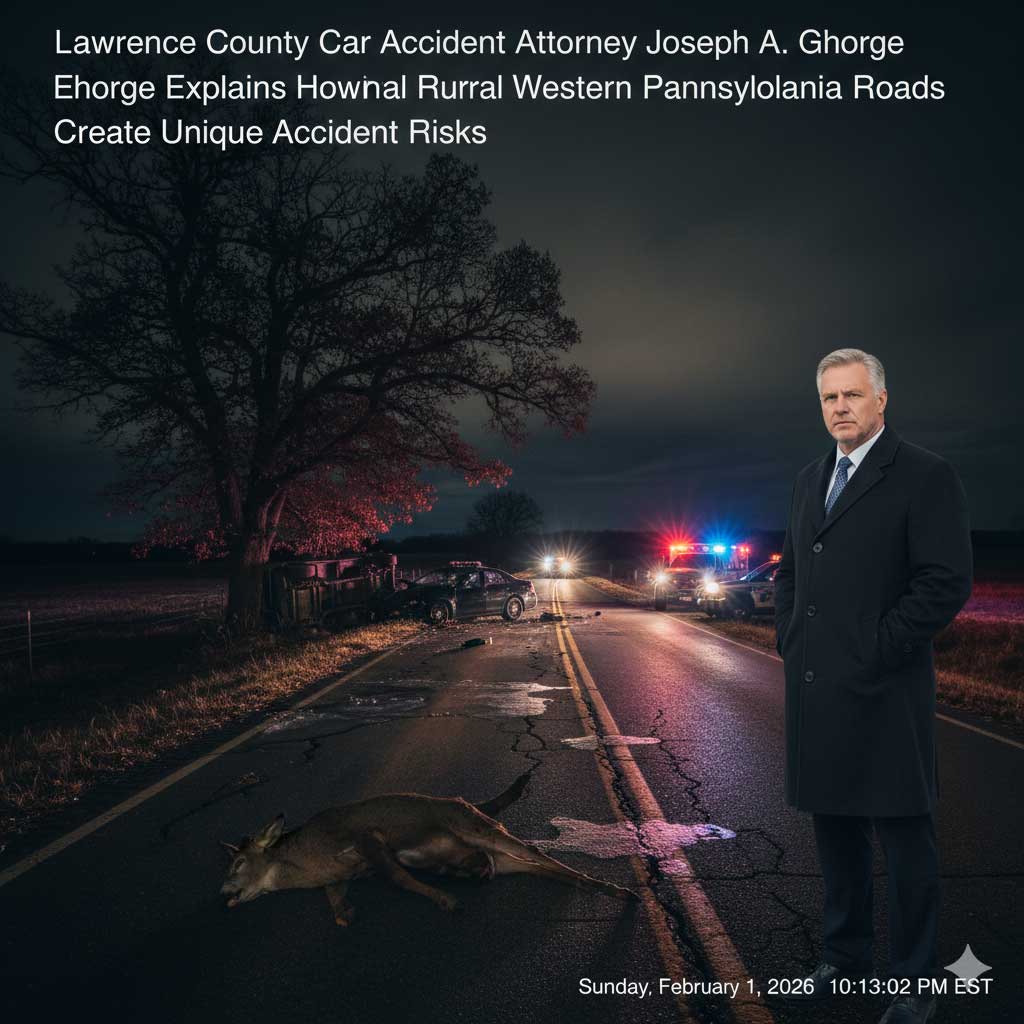
Lawrence County Car Accident Attorney Joseph A. George Explains How Rural Western Pennsylvania Roads Create Unique Accident Risks
NEW CASTLE, PA – Motorists traveling on the picturesque, winding rural roads of Western Pennsylvania often enjoy a sense of serenity that is missing from the congested, high-stress corridors of downtown Pittsburgh. However, that tranquility can be deceptive. In reality, the backroads of Lawrence County and its neighbors present a lethal set of hazards that differ fundamentally from urban traffic risks.
Lawrence County car accident attorney Joseph A. George, of the law firm Luxenberg Garbett Kelly & George, P.C., is speaking out to highlight these unique dangers. From the “deadly speed differential” of farm machinery to the “golden hour” crisis caused by delayed emergency response times, Attorney George explains why a drive through the countryside can be statistically more dangerous than a commute through a major city.
The Statistical Reality: Rural vs. Urban Danger
While urban areas like Pittsburgh see a higher total volume of fender-benders and minor collisions due to traffic density, rural roads are where the most severe and fatal accidents occur.
“There is a common misconception that fewer cars mean more safety,” says Attorney George. “The data tells a much darker story. Rural roads are statistically the deadliest places to drive in America.”
According to the Insurance Institute for Highway Safety (IIHS), rural areas account for approximately 41 percent of all traffic deaths nationwide, despite representing only about 31 percent of total vehicle miles traveled. In terms of risk per mile, the fatality rate in rural settings is 1.65 per 100 million miles, compared to just 1.07 in urban areas—a staggering 54 percent higher fatality rate.
In Western Pennsylvania, this trend is acutely visible. Local routes such as Harlansburg Road, Shenango Road, and Old Plank Road frequently serve as the sites of catastrophic collisions. Unlike the modern, multi-lane highways found in Allegheny County, many Lawrence County roads—including stretches of Route 168, Route 388, and Route 956—were engineered decades ago for far lower speeds and smaller vehicles.
Infrastructure: The “No Margin for Error” Design
One of the primary factors contributing to rural road danger is the outdated infrastructure of Western Pennsylvania’s secondary routes.
1. Narrow Shoulders and “Fixed Object” Hazards
Many rural roads lack adequate shoulders. In an urban environment, a momentary distraction or a swerve to avoid a pothole might result in a driver landing on a paved shoulder or a curb. On a rural New Castle backroad, however, there is often nowhere to go but into a ditch, an embankment, or a century-old oak tree.
“When a road is narrow and lacks a shoulder, it leaves zero margin for error,” George explains. “If a driver drifts just a few inches off the pavement, the tires can catch in soft mud or a steep drop-off, leading to a ‘trip’ that causes a rollover or sends the vehicle head-on into a fixed object.”
2. Limited Lighting and Faded Signage
Urban streets benefit from consistent municipal lighting, but rural Pennsylvania relies almost entirely on vehicle headlights. This lack of ambient light makes it difficult for drivers to anticipate sharp curves or sudden dips in the elevation. Furthermore, warning signs for hazards are often missing, obstructed by summer foliage, or so faded by years of Western PA winters that they are unreadable at night.
3. High Speed Limits on Two-Lane Roads
A significant portion of rural fatalities—nearly 72 percent—occur on roads with speed limits of 55 mph or higher. In contrast, only 29 percent of urban fatalities happen at these speeds. “On a two-lane highway with no median barrier, you have vehicles passing each other just feet apart at high speeds,” says George. “If one driver crosses the center line due to fatigue or distraction, the result is a head-on collision with a combined closing speed of over 100 mph. At those speeds, even the best modern safety features like airbags and crumple zones are often not enough to prevent a fatality.”
The Wildlife Factor: Pennsylvania’s “Deer Season” Risks
Pennsylvania consistently ranks as one of the most dangerous states in the nation for animal-vehicle collisions. According to data from State Farm Insurance, Pennsylvanians filed over 153,000 animal collision claims between mid-2022 and mid-2023.
PennDOT statistics for 2022 recorded nearly 6,000 accidents specifically caused by deer, resulting in over 1,200 injuries and nine deaths. “In Lawrence County, the risk of hitting a deer is a year-round reality, but it peaks during the fall ‘rut’ or mating season,” George notes. “Drivers often instinctually swerve to avoid an animal, which is often more dangerous than the impact itself. Swerving can lead to a head-on collision with oncoming traffic or a high-speed departure from the roadway.”
Slow-Moving Vehicles and Farm Equipment
As an agricultural hub, Western Pennsylvania’s roads are shared by passenger cars and heavy farm machinery. During planting and harvest seasons, the “speed differential” becomes a major hazard.
A tractor or combine typically moves at speeds between 15 and 25 mph, while the passenger cars behind them are traveling at 55 mph. “An impatient driver may attempt to pass a slow-moving tractor on a blind curve or a hill, not realizing that the equipment is wider than the lane or that an oncoming car is just seconds away,” George observes. “We also see accidents where drivers simply fail to realize how quickly they are closing the gap between themselves and a piece of machinery, leading to devastating rear-end collisions.”
The Medical Crisis: Delayed Emergency Response
Perhaps the most critical difference between an accident in downtown Pittsburgh and one in rural Lawrence County is what happens after the crash. In trauma medicine, the “Golden Hour” refers to the first 60 minutes after a traumatic injury; receiving surgical intervention within this window is the single greatest predictor of survival.
In urban and suburban areas, EMS units average about seven minutes from the 911 call to arrival on the scene. In rural settings, that median time doubles to 14 minutes, and in one out of every ten rural accidents, victims wait nearly 30 minutes for help to arrive.
Research from The Center for Rural Pennsylvania found that crash sites located more than 31 minutes from a trauma center have significantly higher fatality percentages than those closer to medical hubs. “In a rural accident, you aren’t just dealing with the physics of the crash; you are dealing with the geography of the rescue,” says George. “By the time a life-flight helicopter or an ambulance reaches a remote stretch of Route 956, a treatable injury like internal bleeding can become a fatal one.”
Legal Recourse for Victims: Understanding Pennsylvania Law
When an accident occurs on these hazardous roads, the legal landscape is as complex as the geography. Under the Pennsylvania Vehicle Code (75 Pa.C.S.), a driver who fails to maintain their lane, speeds, or drives distracted is considered negligent.
Damages and Compensation
Victims of rural accidents can pursue two types of damages:
- Economic Damages: These cover tangible costs such as hospital stays, surgeries, physical therapy, long-term medications, and both past and future lost wages.
- Non-Economic Damages: These compensate for “pain and suffering.” Attorney George reminds drivers to review their insurance policies regarding Full Tort vs. Limited Tort coverage, as this choice significantly impacts a victim’s ability to recover for non-monetary losses unless a “serious injury” threshold is met.
The Statute of Limitations
In Pennsylvania, injured parties generally have two years from the date of the accident to file a lawsuit. However, Attorney George emphasizes that waiting is dangerous. “In rural cases, evidence can disappear quickly. Skid marks wash away with the rain, and faded signs might be replaced by the township before they can be documented. Early investigation is key to proving liability.”
About Joseph A. George and Luxenberg Garbett Kelly & George, P.C.
Attorney Joseph A. George and his team at Luxenberg Garbett Kelly & George, P.C. have spent decades representing the residents of New Castle, Lawrence County, and the broader Western Pennsylvania region. The firm is dedicated to helping victims of car, truck, and motorcycle accidents navigate the physical and financial aftermath of a crash.
Recognized by prestigious organizations such as The National Trial Lawyers Top 100 and the Pennsylvania Association for Justice, the firm brings a “hometown” understanding of local roads combined with the aggressive legal resources of a top-tier personal injury practice.