
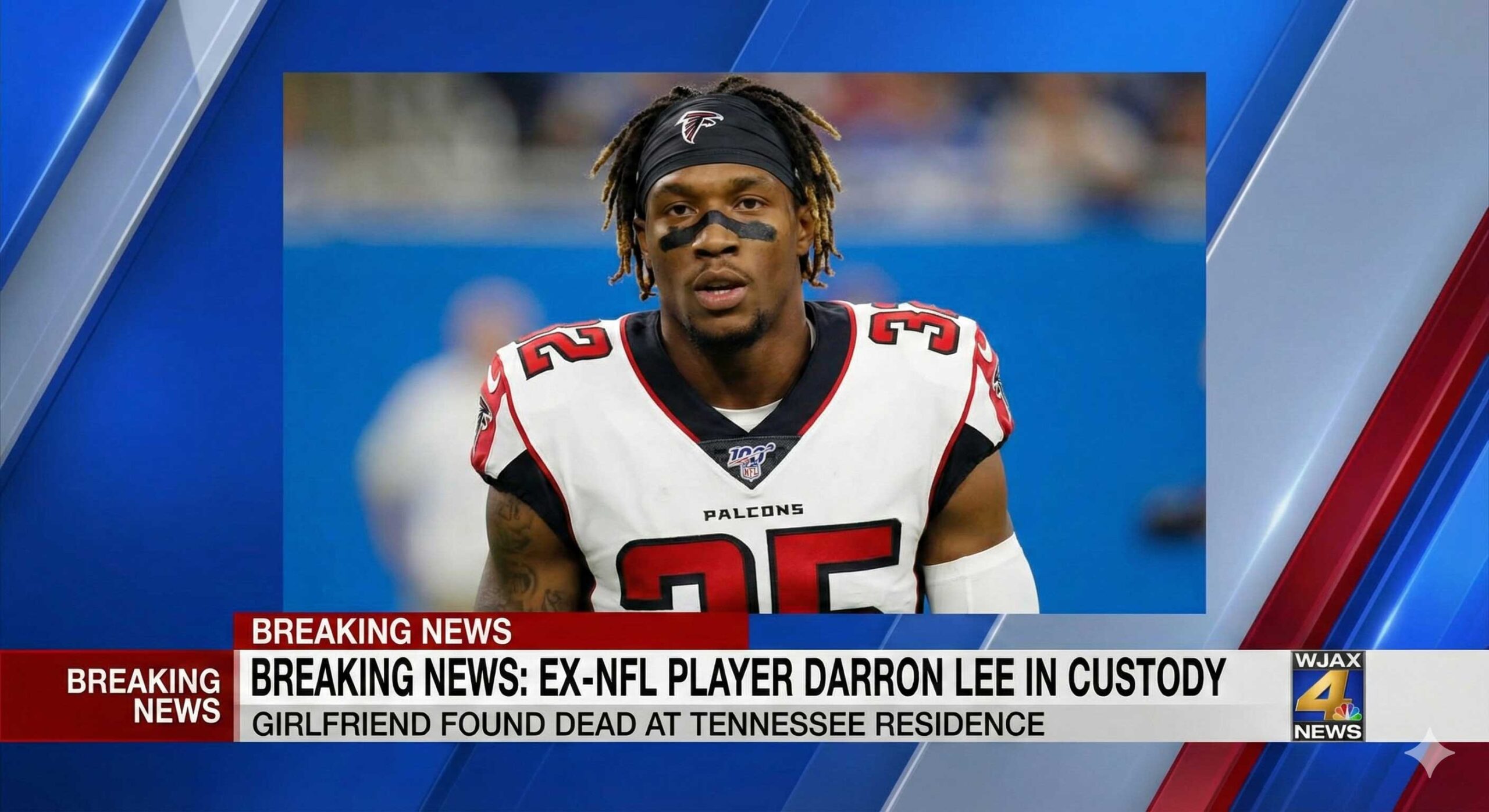
Horror in Tennessee: Ex-NFL Linebacker Darron Lee Accused of Murdering Girlfriend
FALLEN STAR: The Tragic Descent of Darron Lee from NFL First-Rounder to Murder Suspect
OOLTEWAH, Tennessee — The trajectory of a professional athlete’s life is often plotted on a graph of ascending glory: the high school phenom, the college superstar, the draft-day millionaire, the gridiron legend. It is a story American culture devours with insatiable appetite. But there is an inverse to that arc, a darker, steeper decline that is less celebrated but no less riveted by the public gaze. On a cold Saturday in February 2026, that dark trajectory reached a nadir for Darron Lee, the former New York Jets linebacker and Ohio State national champion.
In a quiet, upscale enclave near Ooltewah, Tennessee—a town that sits in the rolling hills about two and a half hours southeast of Nashville—the flashing lights of police cruisers shattered the suburban peace. The scene that unfolded behind the doors of a private residence was not one of athletic triumph, but of profound human tragedy. By the time the sun had set, a woman was dead, a former NFL star was in handcuffs, and a narrative of promise had been irrevocably replaced by a grim headline of first-degree murder.
Darron Lee, 31, a man once tasked with hunting down quarterbacks and patrolling the middle of the field for some of the most storied franchises in football, now sits in a Tennessee county jail cell, held without bond. The charge is the most severe the justice system can levy: first-degree murder. Alongside it, a charge of tampering with evidence suggests a frantic, perhaps desperate, attempt to conceal the reality of what transpired in those final, fatal moments.
This is not merely a story of a celebrity in legal trouble. It is a harrowing chapter in the ongoing, often painful conversation about domestic violence, the post-career volatility of contact sport athletes, and the devastating consequences when red flags are ignored.
The Incident in Ooltewah
The sequence of events that led to Lee’s arrest began with a frantic call to emergency services. According to the Hamilton County Sheriff’s Office, dispatchers received a request for medical assistance at a residence in Ooltewah. The nature of the call was dire: CPR was in progress.
Ooltewah is known less for violent crime and more for its scenic landscapes and proximity to Chattanooga. It is a place where people move to find quiet. When deputies and emergency medical technicians arrived at the scene, they found a chaotic and distressing tableau. A woman, identified later as Lee’s girlfriend, was unresponsive. First responders, whose daily routine involves the thin line between life and death, worked feverishly to revive her. The mechanical rhythm of chest compressions, the urgent communication between paramedics, the desperate hope that often permeates such scenes—all of it ultimately proved in vain.
The woman was transported to a local hospital, but her injuries were too severe. She was pronounced dead shortly after arrival.
For the responding officers, the focus quickly shifted from rescue to investigation. The atmosphere in the home, the condition of the victim, and the initial statements—or perhaps the silence—of those present raised immediate alarms. What began as a medical emergency was reclassified as a crime scene. Detectives from the homicide unit were summoned.
Forensic investigators began the meticulous work of combing the property. Every disturbed item, every biological trace, every inconsistency in the physical environment was cataloged. It was during this preliminary sweep that the suspicion solidified. Police have not released the specific details of the cause of death, protecting the integrity of the ongoing investigation and the dignity of the victim’s family, but the conclusion was swift. This was not an accident. This was a homicide.
Darron Lee, the man who had once heard his name called by Roger Goodell on the stage of the NFL Draft, was identified as the suspect at the scene. He was taken into custody without incident, a stark contrast to the violence that authorities allege occurred prior to their arrival. The additional charge of tampering with evidence offers a chilling hint into the post-incident moments—alleging that actions were taken to alter, destroy, or conceal items relevant to the investigation.
The Legal Quagmire
Lee now faces a legal battle that carries the weight of a life sentence. In Tennessee, first-degree murder is defined as the premeditated and intentional killing of another person. It is a charge that requires the prosecution to prove that the act was not a crime of passion in the heat of the moment, but a calculated action. Alternatively, it can be charged under the “felony murder” rule, though early reports suggest a direct accusation of intentional homicide.
The denial of bond is a significant indicator of the court’s view on the severity of the crime and the potential flight risk Lee poses. A first court appearance is scheduled for Wednesday, where the initial layers of the state’s case will be peeled back. Prosecutors will likely begin to outline the timeline of the alleged murder, the motive, and the evidence that led to such a swift arrest.
For Lee’s defense team, the challenge will be monumental. They will be tasked with deconstructing the state’s narrative, perhaps looking at forensic ambiguities or, as is common in high-profile athlete cases, examining the neurological and psychological history of the defendant. However, the presence of the “tampering with evidence” charge complicates any potential defense of accidental death or self-defense. It implies a consciousness of guilt—a realization that a crime had been committed and an attempt to cover it up.
A Star is Born: The Ohio State Glory
To understand the magnitude of this fall, one must rewind to the days when Darron Lee was the embodiment of athletic potential. A native of New Albany, Ohio, Lee was a high school quarterback and safety who transformed himself into one of the most electric linebackers in college football.
Arriving at Ohio State University, he was initially an undersized athlete, a “tweener” who didn’t quite fit the traditional mold of a bruising linebacker. But under the tutelage of Urban Meyer and Luke Fickell, Lee reshaped his body and his game. By his redshirt freshman season in 2014, he was a revelation.
The 2014 Ohio State Buckeyes were a team of destiny, and Darron Lee was their defensive heartbeat. He possessed a rare combination of speed and power, capable of dropping into coverage against slot receivers and blitzing quarterbacks with the ferocity of a defensive end.
His breakout performance came on the biggest stages. In the Sugar Bowl against heavily favored Alabama, Lee was a force of nature. He recorded seven tackles and two sacks, tormenting the Crimson Tide’s offense and announcing himself to the national audience. He was named the Defensive MVP of the game, a sophomore standing tall among giants.
Weeks later, in the inaugural College Football Playoff National Championship against Oregon, Lee was instrumental in stifling the Ducks’ high-octane offense. When the confetti rained down in Arlington, Texas, Lee was a national champion. He was 20 years old, a local hero, and seemingly destined for greatness. He was the prototype of the modern NFL linebacker: fast, agile, and instinctive.
The New York Pressure Cooker
The NFL, desperate for linebackers who could run with tight ends and running backs in the passing game, saw Darron Lee as a blue-chip prospect. In the 2016 NFL Draft, the New York Jets selected him with the 20th overall pick. It was a life-changing moment. Lee held up the green jersey, smiling broadly, the future sprawling out before him like an open field.
But New York is a merciless city for athletes who do not immediately transcend. The expectations for a first-round pick are crushing. Lee’s tenure with the Jets was marked by flashes of his collegiate brilliance, but also by inconsistency and off-field questions.
He spent three seasons in New Jersey. Statistically, he was productive—totaling 241 tackles and four sacks. But he struggled to anchor the defense in the way the franchise had hoped. He was often criticized for being undersized against the run and for lapses in coverage. The media market, notorious for eating its young, began to label him a “bust.”
There were early warning signs of volatility. In 2017, an incident at the Governors Ball Music Festival drew headlines. Leonard Williams, his teammate, was seen physically restraining Lee, reportedly pulling him away from an altercation. It was dismissed by many as a young man blowing off steam, a minor blip. In hindsight, it is being re-examined as a tile in a mosaic of instability.
The Jets declined his fifth-year option, a signal that they were ready to move on. In 2019, he was traded to the Kansas City Chiefs.
The Slow Fade
Lee’s time in Kansas City offered a chance for redemption. He was joining a contender, a team with a high-powered offense where he could simply focus on being a role player. In the 2019 season, he appeared in 16 games, recording 31 tackles.
That season ended with the Chiefs winning Super Bowl LIV. Lee received a ring, the pinnacle of professional success. Yet, his contribution to that championship run was minimal. He was inactive for the Super Bowl itself, watching from the sidelines as his teammates bathed in glory. It is a peculiar purgatory for an elite athlete—to be adjacent to the summit but not standing upon it.
Following the championship, his career entered a rapid freefall. He signed with the Buffalo Bills but played in only two games. He had stints on practice squads, tryouts that went nowhere, and the silence of a phone that stopped ringing. By 2021, essentially, his NFL career was over. He was 26 years old.
The transition from the regimented, adrenaline-fueled life of an NFL player to the quiet anonymity of retirement is difficult for many. The structure vanishes. The adulation fades. The identity crisis sets in. For Lee, this period seems to have been marked by a turbulent personal life.
The Precursor: 2023
The arrest in Tennessee was not Darron Lee’s first significant brush with the law. In April 2023, the warning bells rang loudly. Lee was arrested in Dublin, Ohio, following a domestic disturbance.
The details of that incident were disturbing. Police alleged that Lee had assaulted two women: his own mother and the mother of his child. According to reports from the time, Lee’s mother told dispatchers that her son was “killing everyone” and that he had shoved her against a wall and thrown her to the ground. The mother of his child reportedly hid in a bedroom, terrified.
Lee was charged with domestic violence and assault. He eventually pleaded guilty as part of a plea agreement. The justice system, as it often does for first-time offenders or those with resources, offered a path of leniency—probation, suspended sentences, anger management classes.
It is a pattern seen all too often. Domestic violence is frequently a progressive crime. It begins with emotional abuse, escalates to physical intimidation, moves to assault, and, in the most tragic cases, ends in homicide. The 2023 incident was a neon sign flashing “Danger.” Whether the interventions mandated by the court were insufficient, or whether Lee’s personal demons were too entrenched to be exorcised by a plea deal, is a question that will now haunt those who knew him.
The Victim and the Silence
Amidst the biographies of the perpetrator, the victim often runs the risk of becoming a footnote. In this case, the woman who lost her life in Ooltewah is the central figure of the tragedy. While her name is currently withheld pending full family notifications and police releases, her death is the irreversible reality of this story.
She was someone’s daughter, perhaps someone’s sister or mother. She was a woman who, presumably, trusted Lee enough to share a home with him. The “girlfriend” label in news reports sanitizes the intimacy of the violence. Domestic homicide is a betrayal of the highest order—the person who is supposed to be a source of love becomes the agent of death.
Her death adds to the grim statistics of intimate partner violence in the United States. According to the CDC, nearly half of all female homicide victims are killed by a current or former male intimate partner. It is a pandemic of its own, often played out behind closed doors in quiet neighborhoods like Ooltewah, shattering families and leaving communities asking “Why?”
The CTE Conversation
Whenever an NFL player, particularly a linebacker who spent years engaging in high-velocity collisions, is involved in violent crime, the specter of Chronic Traumatic Encephalopathy (CTE) is raised. It happened with Aaron Hernandez. It happened with Junior Seau (though his violence was self-inflicted). It happened with Phillip Adams.
CTE, a degenerative brain disease caused by repeated head trauma, has been linked to symptoms including aggression, impulse control problems, depression, and paranoia. Darron Lee played a position that requires physical violence. He played at the highest levels for years.
There is, currently, no evidence to confirm Lee suffers from CTE—it can only be diagnosed posthumously. However, the erratic behavior described in 2023 and the alleged explosion of violence in 2026 fit a profile that neurologists and sociologists of sport have come to recognize with dread.
This does not absolve Lee of legal or moral responsibility. The law judges intent and action. But in the court of public opinion, and in the analysis of how a national champion becomes a murder suspect, the question of brain health is an inevitable, uncomfortable variable. Did the game that gave him everything also take away his ability to control himself? Or is this simply the case of a man with a violent streak who happened to play football?
The Aftermath and Reaction
The news of Lee’s arrest has sent shockwaves through the football community, though perhaps the shock is tempered by the grim familiarity of such headlines.
In Columbus, Ohio, where Lee is remembered as the ecstatic kid holding the national championship trophy, the mood is somber. The Ohio State football program, a machine of excellence, prides itself on building “men of character.” When an alumnus commits such a heinous act, it casts a shadow, however brief, over the brotherhood. Fans on message boards and social media are expressing a mix of disbelief and anger. The memory of his Sugar Bowl sacks is now tainted, impossible to view without the overlay of his mugshot.
In New York, the reaction is more cynical. Jets fans, accustomed to disappointment, see this as a tragic post-script to a draft pick that didn’t work out. But for his former teammates, men who shared a locker room and a huddle with him, the news is personal. They are left to reconcile the teammate they knew—perhaps a jokester, perhaps a quiet professional—with the man accused of murder.
The NFL as an institution generally distances itself quickly from such events. Lee has been out of the league for years. He is not a current employee. There will be no suspension, no commissioner’s exempt list. He is now a private citizen with a famous past. Yet, the league cannot fully escape the association. Every time “Former NFL Linebacker” is in the headline, it is a bruise on the shield.
Conclusion: The End of the Line
As Wednesday’s court date approaches, Darron Lee sits in a cell, stripped of his jersey, his accolades, and his freedom. The “tampering” charge suggests a man who realized, perhaps too late, that he had destroyed his life, and tried futilely to undo the reality.
The investigation in Tennessee will proceed. Forensics will be analyzed. Witnesses will be deposed. A trial will likely ensue. But the outcome, in many ways, is already written. Two lives have been destroyed. One has ended in a premature, violent death. The other has been effectively erased, replaced by a prisoner number and a legacy of infamy.
Darron Lee’s story was supposed to be one of success—the kid from Ohio who conquered the football world. Instead, it has become a cautionary tale of the darkest variety. It is a reminder that athletic prowess is no inoculant against personal demons, and that the violence celebrated on the field can, tragically, follow a player home.
For now, Ooltewah remains quiet, the police tape removed, but the stain of the event lingering. And in the record books of Ohio State and the New York Jets, Darron Lee’s name remains, but it will never again be spoken without a wince, a sigh, and the heavy knowledge of what happened on February 7, 2026.