
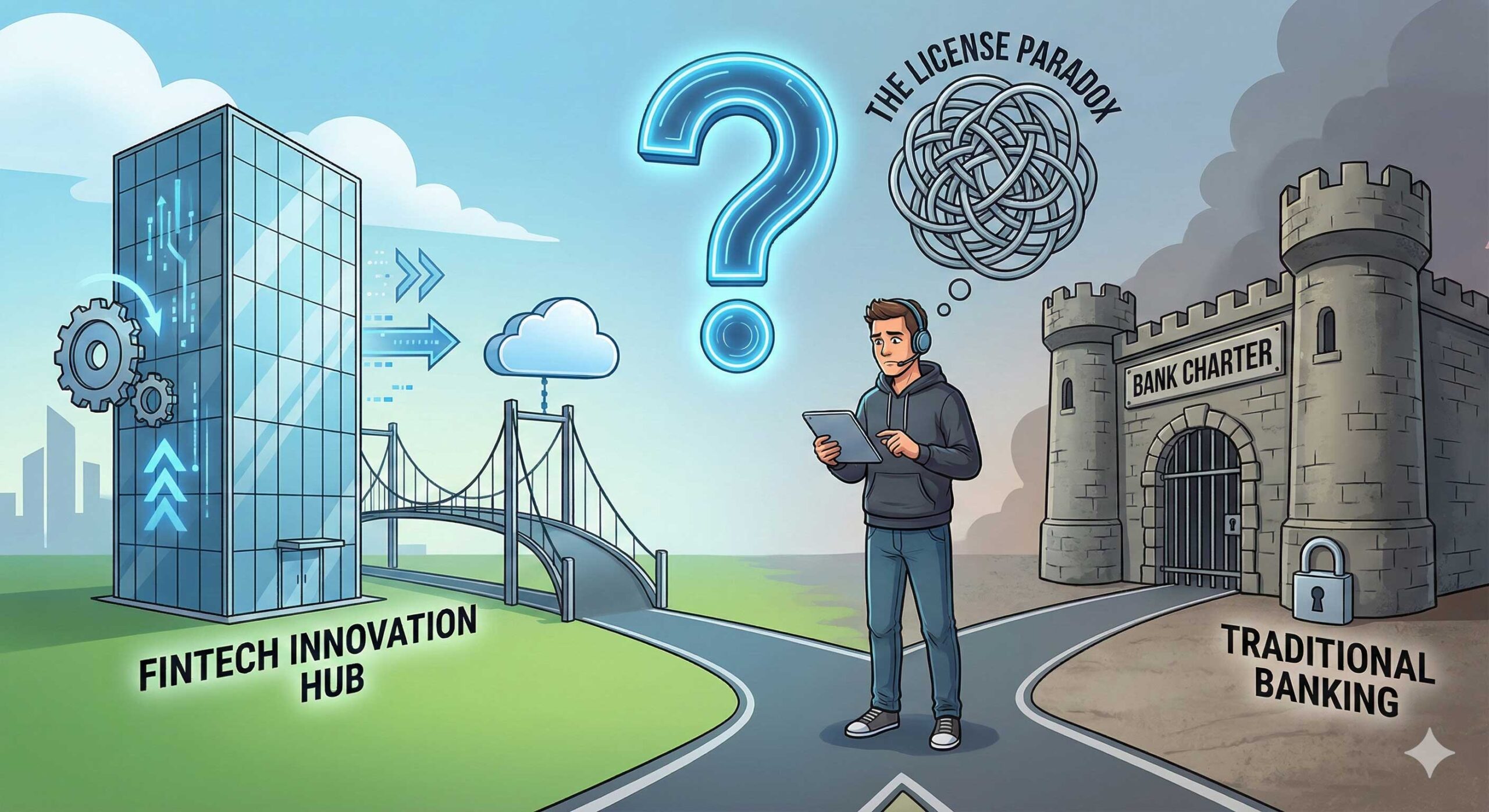
The License Paradox: Why Fintech innovation Are Rethinking the ‘Bank Charter’ Dream
TECH AI NEWS
In the high-octane world of financial technology, the ultimate status symbol has long been the “Charter.” For a decade, neobanks and payment processors have looked at traditional banking licenses as the final graduation ceremony—the moment they transform from scrappy disruptors into masters of their own destiny.
The narrative was simple: Get a charter, ditch the sponsor bank, stop splitting the revenue, and own the customer stack from top to bottom.
But as we settle into 2026, that narrative is fracturing. Even as global juggernauts like Revolut and Nubank inch closer to becoming standalone banks in the U.S. and beyond, a counter-current is forming. A growing cohort of unicorn-status fintechs are looking at the regulatory landscape, the crushing capital requirements, and the brutal stock market penalties for banks, and asking a heretical question: Why would we ever want to be a bank?
The “Bank Sponsor” model—often dismissed as a set of training wheels for startups—is not dying. It is evolving into a sophisticated, high-stakes strategic layer of the global financial system. And for many tech giants, it remains the only firewall between innovation and institutional paralysis.
The Allure and the Trap
To understand why the partnership model endures, one must first understand the seduction of the charter.
For a fintech CEO, the math initially looks compelling. In the sponsor model (often called Banking-as-a-Service or BaaS), a fintech partners with a regulated bank (like Fifth Third, Cross River, or Sutton Bank) to hold deposits and issue cards. The fintech owns the user experience; the bank owns the regulatory license. In exchange, the revenue—interchange fees and net interest margin—is split.
By obtaining their own charter, a fintech theoretically captures 100% of that economics. They gain access to cheap capital (customer deposits) to fund lending, rather than relying on expensive warehouse lines of credit or venture debt.
However, in 2026, the “hidden costs” of this transition have moved from theoretical risks to balance-sheet realities.
The Valuation Compression
The most immediate danger is not regulatory, but financial. Technology companies and banks are valued by vastly different metrics.
“Tech investors pay for growth; bank investors pay for safety,” explains a senior analyst at Goldman Sachs. “A high-growth fintech might trade at 10x to 20x revenue. A bank, even a well-run one, typically trades at 1x to 2x book value.”
When a fintech gets a charter, the market often stops viewing it as a technology platform and starts viewing it as a bank. The capital requirements—the cash that regulators force banks to keep in reserve—act as a drag on return on equity (ROE).
“If you are Stripe or Chime, do you really want to be valued like Citigroup?” asks the analyst. “The moment you become a bank, your ability to reinvest cash into rapid product iteration is hamstrung by capital adequacy ratios. You trade agility for margin, and in the tech world, that is often a bad trade.”
The Regulatory Sledgehammer of 2026
The regulatory environment of 2026 is unrecognizable compared to the “move fast and break things” era of the early 2020s.
Following the BaaS crisis of 2024—where a wave of consent orders from the FDIC and OCC hit sponsor banks for lax oversight of their fintech partners—regulators have tightened the screws. The days of “rent-a-charter” are over.
Today, obtaining a de novo charter in the U.S. is a multi-year, multi-hundred-million-dollar slog. Regulators are demanding that new banks have seasoned (read: expensive and conservative) executive teams, massive compliance departments, and profitability timelines that don’t align with the “blitzscaling” mentality of Silicon Valley.
For a global player like Revolut, the pursuit of a U.S. license has been a saga of endurance. While they have successfully navigated the waters in Europe and the UK, the fragmented and hostile US regulatory system creates a unique barrier.
This hostility has inadvertently strengthened the case for partners. Banks that have survived the regulatory culls of the mid-2020s have emerged as “Fortress Sponsors.” They are no longer passive pipes; they are active compliance partners.
The “Newline” Perspective: Why Partnership is a Power Move
In a recent conversation, Tom Bianco, General Manager of Newline by Fifth Third, offered a counter-narrative to the “charter or bust” mentality. Newline represents the new breed of sponsor: a top-tier regional bank building a dedicated, tech-forward stack specifically for sophisticated fintechs.
“The binary choice between ‘renting’ and ‘owning’ is a false dichotomy,” Bianco suggests. “The most successful fintechs in 2026 are realizing that banking is not a feature; it is a regulated utility. You don’t build your own power plant just to light up your office. You plug into the grid.”
According to Bianco, the modern partnership model allows fintechs to focus on their “superpower”—customer acquisition, data analytics, and user interface—while offloading the “commodity” of compliance, payment rail access, and custody to a partner who specializes in it.
“When a fintech applies for a charter, they often underestimate the cultural shift,” Bianco notes. “You have to hire hundreds of people whose sole job is to say ‘no.’ Compliance officers, risk managers, internal auditors. That changes the DNA of a creative tech firm. It slows you down. Partnering with a bank that has already built that infrastructure allows you to move at the speed of software, not the speed of regulation.”
The Rise of “Middleware” and Embedded Finance
The persistence of the sponsor model is also driven by the explosion of Embedded Finance.
In 2026, it is not just “fintechs” that need banking. It is everyone.
- Vertical SaaS: Software for yoga studios now offers checking accounts.
- Logistics: Trucking dispatch software issues fuel cards and working capital loans.
- E-commerce: Marketplaces offer instant merchant payouts and insurance.
These companies—Toast, Uber, Shopify—have zero interest in becoming banks. They want banking functions embedded inside their software. For this massive segment of the economy, the bank sponsor is the only viable path. They need partners like Fifth Third or Cross River to provide the plumbing while they build the house.
This has created a “flight to quality.” In the early days, fintechs partnered with tiny community banks (often solely to bypass the Durbin Amendment’s interchange caps). Now, as scale and stability become paramount, giants are partnering with giants.
The Hybrid Future
So, is the charter dream dead? Not entirely.
We are seeing the emergence of a Hybrid Model. Some mega-fintechs are obtaining charters for specific, narrow purposes—such as an Industrial Loan Company (ILC) charter to hold some assets—while keeping the majority of their business on sponsor partner rails to maintain agility.
Others are acquiring small banks not to become the bank, but to acquire a license they can “quarantine” in a subsidiary, allowing the parent company to remain a tech firm in the eyes of investors.
Conclusion: The Maturity of the Ecosystem
The headline “Fintech Applies for Bank Charter” will always grab clicks. It sounds like a declaration of independence. But the reality on the ground in 2026 is far more nuanced.
The ecosystem has matured. The relationship between fintechs and banks has moved from parasitic to symbiotic. Fintechs provide the digital distribution that banks desperately need; banks provide the regulatory fortress and balance sheet that fintechs cannot replicate without destroying their own valuations.
As competition among sponsor banks heats up, the winners will not be the fintechs that go it alone, but the ones that find the perfect dance partner—allowing them to walz through the minefield of global finance without blowing up their business model.
In the end, the customer doesn’t care who holds the charter. They care about who solves their problem. And for the foreseeable future, the best way to solve that problem is often with a tech company in the front, and a bank in the back.
Deep Dive: The Economics of the “Sponsor” vs. “Charter”
To fully grasp the stakes, we must look at the unit economics that drive these decisions in 2026.
1. Cost of Funds vs. Cost of Compliance The primary economic argument for a charter is the “Cost of Funds.” A non-bank fintech usually funds its loans by borrowing money from Wall Street (warehouse facilities) at, say, 6-7%. A bank funds its loans using customer deposits, which might cost them 2-3% (or near 0% for checking accounts). That 4% spread is massive pure profit. However, the “Cost of Compliance” eats into that spread. Running a compliant bank in 2026 costs tens of millions annually in staffing, software, and audits. For a fintech with a $1 billion loan book, the math might work. For a fintech with a $100 million book, the charter cost exceeds the interest savings.
2. Interchange Economics The “Durbin Amendment” in the US caps the interchange fees (swipe fees) that large banks (over $10 billion in assets) can charge merchants. Small banks are exempt. This creates a perverse incentive. If a giant fintech becomes a bank and grows past $10 billion in assets, their revenue from every card swipe gets cut by ~50%. By partnering with a smaller sponsor bank (or a network of them), they can often preserve that higher revenue stream. This is a “golden handcuff” that keeps many fintechs in the partnership model.
3. The “Reciprocity” of Data Modern sponsor banks like Newline are not just holding cash; they are data conduits. By processing the payments for a fintech, the bank gains visibility into flows that help it underwrite risk elsewhere. This reciprocal data sharing is creating new revenue models where the bank and fintech split the upside of cross-selling products, making the partnership more lucrative than going solo.
The Global Context: US vs. Europe
The tension described here is uniquely American.
- In the UK/Europe: Regulators created “e-money licenses” and specialized banking tiers decades ago. It is much easier and cheaper to become a “neobank” in London than in New York. This is why Revolut and Monzo have been banks in Europe for years but struggled to crack the US code.
- In the US: The binary nature of the system—you are either a bank or you are not—forces this difficult choice.
As we move through 2026, expect to see US regulators potentially introducing “fintech charters” again (a concept floated and killed multiple times in the past decade) to bridge this gap. Until then, the bank sponsor remains the essential bridge over the regulatory moat.
Final Thoughts for Investors
If you are holding stock in a major fintech or a forward-thinking bank, look at their partnership strategy.
- Bullish Signal: A fintech that announces a deep, strategic integration with a Tier 1 sponsor bank to launch new, complex products (like mortgage or wealth management).
- Bearish Signal: A mid-sized fintech announcing they are “applying for a charter” without a clear path to profitability. This is often a vanity project that precedes a cash crunch.
The “Bank Sponsor” is not a relic. In the AI-driven, hyper-regulated financial world of 2026, it is the bedrock.