
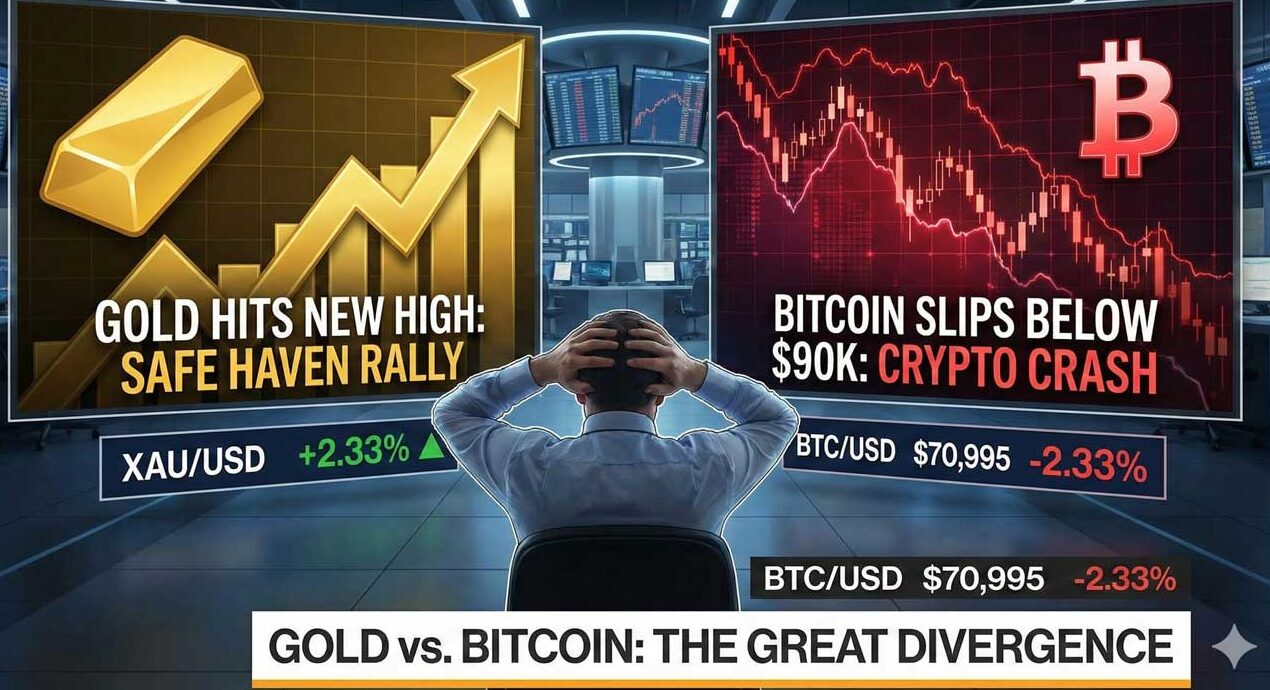
Crypto Crisis 2026: Why Wall Street Is Dumping Bitcoin for Gold and AI Stocks
By The Editors Published: February 8, 2026 | 2:00 PM EST
In the high-stakes theater of global finance, narratives are often as powerful as the assets themselves. For the better part of a decade, a singular, seductive story has dominated the cryptocurrency markets: Bitcoin is “Digital Gold.” It was promised as the millennial answer to the ancient metal—a store of value for the digital age, immune to government debasement, and a safe harbor in stormy economic seas.
On Sunday, February 8, 2026, that narrative is facing an existential stress test.
As markets digest a tumultuous week of trading, a stark divergence has emerged that is forcing investors to rethink their portfolios. Gold, the barbarous relic, is soaring, finding renewed life amidst geopolitical fractures and the inflationary pressures of the new “Trump Tariffs.” Meanwhile, Bitcoin, the purported future of money, is bleeding. Having slipped below the psychological fortress of $90,000, the leading cryptocurrency is currently languishing near $70,995—a staggering drop from its all-time high of nearly $126,000 just months ago.
The question haunting Wall Street and Main Street alike is no longer just about price action; it is about identity. If Bitcoin crashes when the world gets scary, can it truly claim to be a store of wealth?
Part I: The Monday Morning Hangover
To understand the gravity of the current moment, one must look at the carnage of the last quarter. The crypto winter of early 2026 has arrived with a biting frost.
As of this morning, Bitcoin is trading at $70,995.00, marking a painful 2.33% daily gain that does little to mask the broader hemorrhage. The asset is now down roughly 44% from its October 2025 peak. The trading volume remains high at $42 billion, but the sentiment has shifted from “buy the dip” to “liquidation panic.”
Technically, the loss of the $90,000 support level was a watershed moment. For institutional investors who entered the market during the ETF boom of 2024 and 2025, $90,000 represented a breakeven point. When that floor gave way to the selling pressure triggered by the new year’s economic reality, the floodgates opened.
“We are seeing a classic ‘risk-off’ rotation,” says Reuben Gregg Brewer, a market analyst for The Motley Fool. “Investors are waking up to the reality that Bitcoin is not a non-correlated asset. It behaves like a high-beta tech stock. When the Nasdaq sneezes, Bitcoin catches a cold. And right now, the tech sector is battling its own demons.”
In sharp contrast, gold is behaving exactly as traditionalists predicted it would. The yellow metal has broken out of its multi-year consolidation, pushing toward new highs. It is not offering the explosive, 1000% returns that crypto speculators crave, but it is offering something far more valuable in February 2026: stability.
The Physical Reality
The core of Brewer’s analysis rests on a distinction that many digital natives have tried to ignore: tangibility.
“Gold is a physical asset,” Brewer notes. “If you buy a gold coin, it will still be a gold coin 100 years from now. That means you can use it to buy things in a worst-case scenario, no matter what happens on Wall Street or Main Street.”
This argument, often dismissed as “boomer logic” during the crypto bull runs, is resonating with a new urgency. The global economy in 2026 is fragile. Supply chains are being rewritten by protectionist policies, and the safety of digital infrastructure is under constant threat from state-sponsored cyber actors. In this environment, the ability to physically hold wealth is a feature, not a bug.
Part II: The Macro-Economic Storm
Why now? Why has the decoupling happened in February 2026?
The answer lies in the White House. The reimplementation of aggressive trade tariffs by the Trump administration has upended the “soft landing” narrative that the Federal Reserve had hoped to engineer.
The Inflationary Boomerang
The “Trump Tariffs,” aimed at protecting American manufacturing, have had a predictable side effect: inflation. The cost of imported goods—from electronics to raw materials—has spiked. In previous cycles, inflation was good for Bitcoin. The “hard money” thesis argued that as the dollar weakened, Bitcoin’s fixed supply of 21 million coins would shine.
However, the 2026 inflation dynamic is different. It is accompanied by rising interest rates and a strengthening U.S. dollar against emerging market currencies. When the dollar is strong and yields on Treasury bonds are high, non-yielding assets usually suffer.
Gold is bucking this trend because central banks are buying it. From Beijing to New Delhi, central banks are diversifying their reserves away from the weaponized U.S. dollar and into gold. They are not, notably, diversifying into Bitcoin.
“Central banks vote with their balance sheets,” notes a recent report from the World Gold Council. “In 2026, we are seeing the highest level of sovereign gold accumulation since the 1960s. This provides a price floor for gold that Bitcoin simply does not have.”
The “Unproven” Asset
This leads to the most damning critique of Bitcoin’s current performance: its lack of history.
As Brewer points out, “Bitcoin has been around for a few years, but compared to gold, it is still a brand-new asset class. It’s largely untested as a store of wealth.”
Bitcoin was born in 2009, amidst the ashes of the Global Financial Crisis. It grew up during a decade of historic monetary expansion (QE) and near-zero interest rates. It has never truly weathered a stagflationary recession—the specific economic nightmare of high inflation and slowing growth that threatens 2026.
Until Bitcoin proves it can hold its value when the S&P 500 is down 20% and bond yields are spiking, the “Digital Gold” label remains aspirational, not factual.
Part III: The AI Gold Rush – The New Competitor
There is another factor draining liquidity from the crypto markets, one that few maximalists saw coming: Artificial Intelligence.
In 2021, speculative capital flowed into NFTs and Altcoins. In 2026, that capital is flowing into “real” infrastructure—data centers, energy grids, and semiconductor fabrication.
The Motley Fool’s promotional material accompanying Brewer’s analysis highlights a “$1.5 Trillion AI Gold Rush.” This is not hyperbole. The demand for compute power to run Large Language Models (LLMs) and autonomous agents has created an insatiable appetite for energy and hardware.
The Energy Pivot
Investors are realizing that the companies building the physical backbone of AI—the “pick and shovel” plays—offer the exponential growth potential of crypto with the tangible cash flows of traditional equity.
Consider the dilemma of a growth-oriented investor in Feb 2026:
- Option A: Buy Bitcoin, an asset that produces nothing, consumes massive amounts of electricity, and is currently in a regulatory crosshair.
- Option B: Buy a stake in a nuclear energy firm or a specialized chip manufacturer that has signed 10-year contracts with OpenAI and Google.
The money is choosing Option B.
“We are seeing a rotation out of ‘theoretical value’ assets like crypto and into ‘productive value’ assets like AI infrastructure,” explains a portfolio manager at BlackRock. “Bitcoin competes for the same risk capital as AI tech stocks. Right now, AI has the earnings growth. Bitcoin has the volatility.”
Part IV: The Bull Case – Is This the Ultimate Buying Opportunity?
Despite the gloom, not everyone is fleeing. For the hardened crypto veteran, the drop to $70,000 is not a funeral; it’s a fire sale.
JPMorgan strategists, in a note released just days ago, argued that Bitcoin might actually be more attractive than gold over the long term, precisely because of this volatility. Their model suggests that once the speculative froth washes out, Bitcoin’s scarcity will assert itself.
The “Halving” Echo
Market historians also point to the “four-year cycle.” Following the 2024 halving, a post-peak correction in 2026 was statistically probable. In previous cycles (2018, 2022), Bitcoin shed 80% of its value before finding a bottom. A 44% drop to $70k, while painful, is actually quite mild by historical standards.
“If you liked Bitcoin at $126,000, you have to love it at $70,000,” argues Cathie Wood of ARK Invest, who remains a vocal proponent of the asset. “The fundamentals haven’t changed. The network hash rate is at an all-time high. Adoption in emerging markets is accelerating. What we are seeing is a shakeout of the tourists.”
Furthermore, the “store of value” argument is relative. While Bitcoin is losing against the U.S. dollar and Gold this month, it is still vastly outperforming the currencies of failing states. In Argentina, Turkey, and Nigeria, Bitcoin remains a lifeline against hyperinflation, fulfilling its original promise even as Wall Street dumps it.
Part V: What Should Investors Do?
So, where does this leave the average investor? The Motley Fool analyst team offers a sober assessment: Diversify.
The days of going “all in” on Bitcoin as a retirement plan are over. Brewer advises that “Only the most aggressive investors should own Bitcoin, thinking that it is a store of wealth like gold.”
The 1% Rule
Most financial advisors in 2026 are recommending a “1% to 5%” allocation rule.
- Gold: 5-10% of a portfolio. It’s the insurance policy. You hope you never need it, but you’re glad it’s there when the house catches fire.
- Bitcoin: 1-2% of a portfolio. It’s the venture capital bet. It might go to zero, or it might go to $1 million. But it shouldn’t be the mortgage money.
- Equities: The bulk of the portfolio. Specifically, high-quality companies with pricing power that can pass on the costs of tariffs to consumers.
The “Stock Advisor” Picks
The Motley Fool article explicitly pivots away from Bitcoin toward equity opportunities. They highlight companies like CrowdStrike (up 312%) and Tesla (up 19,000% since recommendation). The implication is clear: The stock market, despite its flaws, is a regulated, earnings-driven machine that has created more millionaires than any cryptocurrency.
In the current environment, they are pointing toward the “AI Gold Rush” stocks—companies 1/100th the size of Nvidia that are building the secret infrastructure of the future. These are the companies that will thrive regardless of whether Bitcoin is at $50k or $150k.
Conclusion: The Maturation of a Market
As Sunday evening falls on February 8, 2026, the crypto market remains on edge. The slide below $90,000 was a psychological blow, breaking the aura of invincibility that surrounded the asset during the heady days of 2025.
But perhaps this is exactly what Bitcoin needs.
For years, Bitcoin has been trapped in a crisis of identity. Is it a currency? Is it a tech stock? Is it digital gold? The current bear market is forcing an answer. If Bitcoin is to survive, it must decouple from the Nasdaq. It must prove that it can stand on its own two feet without the crutch of zero-interest-rate liquidity.
Gold has spent 5,000 years earning its reputation. It has survived empires, wars, and currency collapses. Bitcoin has been around for 17 years. It is a teenager in the world of finance—full of potential, prone to mood swings, and currently learning a very hard lesson about the real world.
Should fans of the leading crypto be worried? Yes. Worry is a healthy emotion in investing. It prevents complacency. But worry should not morph into panic.
The divergence between gold and Bitcoin is not necessarily the end of the crypto experiment. It is a clarification. Gold is for preserving wealth you have already made. Bitcoin is for taking a risk to make wealth you don’t yet have. In February 2026, the market is simply reminding us that you cannot have the reward without the risk.
For now, the glitter of physical gold is outshining the digital glow of the blockchain. But as any seasoned trader will tell you: in markets, nothing lasts forever. The pendulum will swing again. The only question is how low Bitcoin must go before the momentum turns.
Disclaimer: This article is for informational purposes only. It does not constitute financial advice. The author has no position in any of the stocks or cryptocurrencies mentioned.