
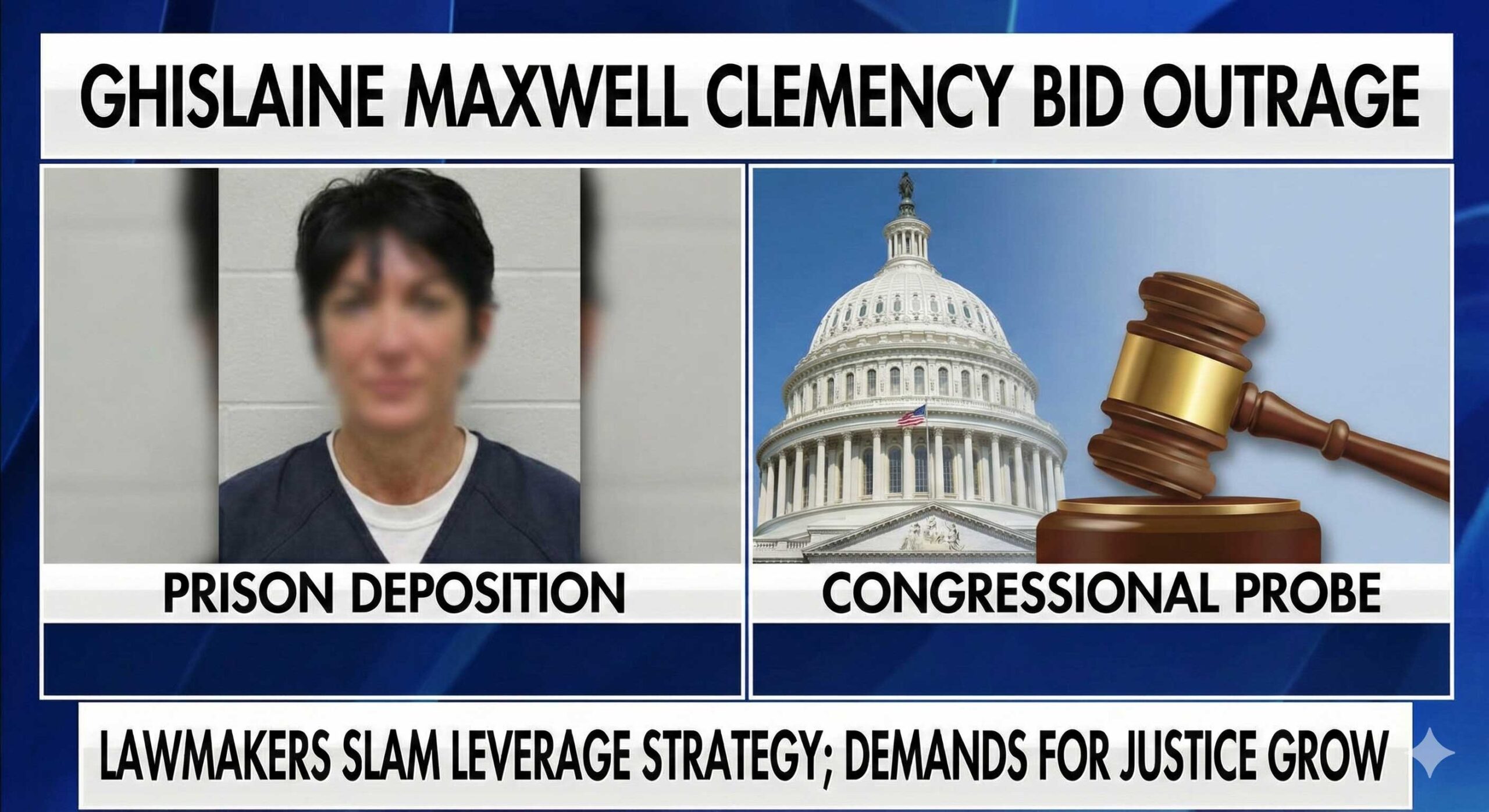
Ghislaine Maxwell Leverage Strategy: Clemency Bid Sparks Outrage Amidst Congressional Probe
WASHINGTON — In a dramatic turn of events within the ongoing investigation into the sex trafficking network of Jeffrey Epstein, Ghislaine Maxwell has officially declined to answer questions from House lawmakers, issuing a conditional offer that has ignited a political firestorm. During a closed-door deposition on Monday, the disgraced socialite and former confidante of Epstein invoked her Fifth Amendment rights, refusing to cooperate with the House Oversight Committee unless granted executive clemency by President Donald Trump.
The deposition, which took place via video call from a federal prison camp in Texas where Maxwell is currently serving a 20-year sentence, was intended to shed light on the facilitators behind Epstein’s decades of abuse. However, instead of providing testimony, Maxwell and her legal team presented a transactional proposition: she is willing to testify that neither President Trump nor former President Bill Clinton committed any wrongdoing in their associations with Epstein, but only if her prison sentence is effectively ended through presidential pardon.
The Clemency Gambit
Maxwell’s refusal to testify without a guarantee of freedom has been characterized by legal experts and lawmakers as a high-stakes strategic maneuver. Throughout the deposition, Maxwell, dressed in a brown prison-issued shirt and seated beside a bottle of water, repeatedly stated she was invoking her “Fifth Amendment right to silence” to avoid self-incrimination.
It was her attorney, David Oscar Markus, who delivered the caveat that shifted the focus of the proceedings. In a statement provided to the committee, Markus declared that “Maxwell is prepared to speak fully and honestly if granted clemency by President Trump”. He further asserted that while both Trump and Clinton “are innocent of any wrongdoing,” the public is “entitled to that explanation,” implying that only Maxwell possesses the specific exonerating details required to clear the air surrounding the two former presidents.
Bipartisan Pushback and Political Fallout
The suggestion of a pardon for a convicted sex trafficker has drawn immediate and sharp condemnation from both sides of the aisle. Democrats on the committee wasted no time in labeling the move as a calculated political campaign. Rep. Melanie Stansbury, a Democrat from New Mexico, described the tactic as “brazen,” stating, “It’s very clear she’s campaigning for clemency”.
Republicans were equally quick to dismiss the notion of a deal. Rep. Anna Paulina Luna took to social media to voice her vehement opposition, writing, “NO CLEMENCY. You comply or face punishment”. Addressing Maxwell directly, Luna added, “You deserve JUSTICE for what you did you monster”.
The White House, when pressed on Monday regarding the appeal, referred to previous remarks by President Trump suggesting that a pardon for Maxwell was not currently under consideration. Despite the offer to provide favorable testimony for the President, the administration has publicly distanced itself from the possibility of intervening in her sentence.
Investigating the Epstein Network
The deposition was part of a broader effort by the House Oversight Committee to investigate how Jeffrey Epstein, a financier with deep connections to the global elite, was able to operate a sex trafficking ring involving underage girls for years without consequence. The inquiry aims to identify individuals who may have facilitated or ignored the abuse.
The investigation has inevitably touched upon Epstein’s high-profile associations. Revelations have confirmed that both Donald Trump and Bill Clinton spent time with Epstein during the 1990s and early 2000s. However, despite these social connections, neither former president has been credibly accused of active wrongdoing regarding Epstein’s crimes. Maxwell’s legal team appears to be leveraging this ambiguity, offering definitive exoneration in exchange for her freedom—a trade lawmakers seem unwilling to make.
Legal Battles and Constitutional Appeals
Beyond the congressional deposition, Maxwell continues to fight her conviction on multiple legal fronts. She is currently serving a 20-year sentence for sex trafficking, a conviction she argues was wrongful. Although the Supreme Court rejected her appeal last year, her defense team remains active.
In December, her attorneys filed a request with a federal judge in New York to consider what they describe as “substantial new evidence”. They allege that her original trial was compromised by constitutional violations. It was this pending petition that Maxwell’s attorney cited as the legal justification for her decision to invoke her Fifth Amendment rights during the Monday deposition. By refusing to speak to Congress, she avoids creating a record that could potentially complicate her ongoing efforts to overturn her conviction in federal court.
Victim Impact and Public Scrutiny
As Maxwell attempts to negotiate her release, the victims of the Epstein ring continue to advocate for accountability. Family members of the late Virginia Giuffre, one of the most vocal survivors of Epstein’s abuse, released a letter to Maxwell in conjunction with the deposition. The letter made it explicitly clear that the victims and their families do not view Maxwell as merely “a bystander” to the crimes, but as an active participant.
As the House Oversight Committee continues its work, the standoff with Maxwell highlights the difficulties in extracting the full truth behind the Epstein network. For now, Maxwell remains in her Texas prison cell, her offer of testimony on the table, but with no takers in Washington.