
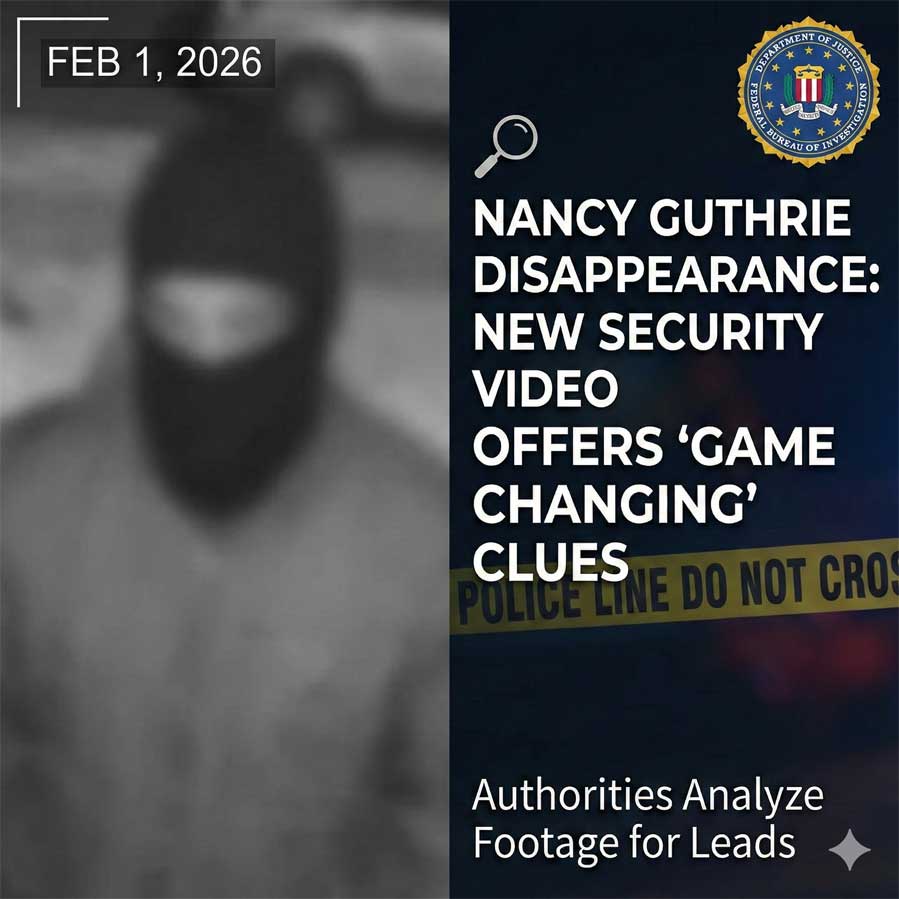
Nancy Guthrie Disappearance: New Security Video Offers “Game Changing” Clues for FBI
By February 11, 2026 Category: Crime & Safety News
In a significant development that policing experts are calling a “game changer,” investigators have released crucial security video footage in the disappearance of Nancy Guthrie. After ten agonizing days of searching for the 84-year-old mother of TODAY co-anchor Savannah Guthrie, the FBI and Pima County Sheriff’s Department have finally secured what could be the lead that breaks the case wide open.
The black-and-white doorbell camera footage, released to the public on Tuesday, depicts a masked individual on Guthrie’s doorstep the morning she vanished. While the identity of the person remains obscured, forensic experts and retired detectives believe the video contains a treasure trove of subtle details—from the suspect’s gait to their specific handling of a firearm—that could lead directly to an arrest.
The “Game Changer” Evidence
For over a week, the case seemed to be cold, with few leads explaining how Nancy Guthrie disappeared from her Tucson, Arizona home around noon on February 1. She had missed virtual church services, alerting her family, but signs of forced entry or a struggle were initially unclear to the public.
That changed Tuesday. The newly released video shows a figure clad in a dark jacket, light pants, gloves, and a ski mask approaching the home. The individual is wearing a backpack with distinct reflective strips and is armed with a handgun holstered in the front of their waistband.
“When you get video, it opens up many new avenues and details,” explained Eric Draeger, a former Milwaukee police detective specializing in high-tech investigation tools. “Detectives hope to get something like this in a case like this.”
Bryanna Fox, a criminology professor at the University of South Florida, echoed this sentiment, telling NBC News, “This is the game changer we were waiting for.”
Analyzing the Suspect: Not a “Ninja”
One of the most compelling aspects of the video for investigators is what it reveals about the suspect’s proficiency—or lack thereof.
In the footage, the suspect does not immediately disable the camera. Instead, they approach the door, look around, and then attempt to tamper with the device using a gloved hand. When that fails to fully obscure the lens, the suspect walks back to the yard, tears up a handful of plants, and attempts to cover the camera with the foliage.
To the trained eye, this behavior screams “amateur.”
“He’s trying to conceal his identity, but he’s not exactly a ninja here,” Draeger noted. The improvisation with the plants suggests a lack of sophisticated planning. A professional or highly experienced criminal would likely have known the camera’s location and avoided it entirely or disabled it immediately upon approach.
Christian Quinn, former deputy chief of the Fairfax County Police Department, agreed, noting that the suspect’s nonchalant approach to the front door suggests the operation was “not well thought-through.”
The “Appendix Carry” and Tactical Gear
Perhaps the most identifiable trait captured on video is the suspect’s firearm. The gun is holstered in the front of the waistband, a style known in the firearms community as an “appendix carry.”
Jim Cavanaugh, a retired ATF special agent and NBC News law enforcement analyst, pointed out that this specific carry style is a massive clue. “This is a very, very, very popular way to carry guns in the concealed carry world,” Cavanaugh said.
This detail does two things for investigators:
- Profiles the Suspect: It suggests the individual is comfortable with firearms, potentially a gun enthusiast, or someone who frequents shooting ranges where this carry style is practiced.
- Triggers Memory: As former detective Jim Bueermann noted, this specific habit might “give somebody pause.” A friend, spouse, or fellow gun-range patron might recognize the stance or the holster setup.
Furthermore, the backpack is a critical piece of evidence. With its specific stitching, pocket layout, and reflective strips, it is a tangible item that can be traced to a manufacturer or retailer. Investigators are banking on the hope that someone watching the news will say, “I know who owns that bag.”
Forensic Video Enhancement and Facial Recognition
While the ski mask obscures the face, modern forensic video enhancement technology can work wonders. Howard Ryan, a former New Jersey State Police crime scene investigator, anticipates that authorities are currently breaking down the footage frame-by-frame.
Even with a mask, facial recognition technology can sometimes utilize measurements of the eyes and mouth—features often left exposed—to generate potential matches against criminal databases. Additionally, the suspect’s biomechanics are unique. Michael Alcazar, a retired NYPD detective, emphasized that “the way he walks, his gait, how he’s hunched over—all of these things are invaluable.”
We may not recognize the face, but a close relative or partner would instantly recognize the posture and walk.
The Current Status of the Investigation
The release of the video has already yielded results. FBI sources confirmed that tips have “dramatically increased” since the footage went public.
In a rapidly developing update, NBC News reported that law enforcement began questioning a man in the Tucson area just hours after the video dropped. While it is not yet confirmed if this individual is the person in the video or merely a person of interest, the timing suggests the investigation is accelerating.
Savannah Guthrie took to Instagram to plead for the public’s help, reposting the clip with the caption: “Someone out there recognizes this person. We believe she is still out there. Bring her home.”
The Vital Role of Home Security Systems
This case underscores the critical importance of home security camera systems in modern criminal investigations. In an era where doorbell cameras are ubiquitous, they serve as silent witnesses that can provide the “break” families desperately need.
For the Guthrie family, this technology has provided the first tangible lead in ten days. For the public, it is a reminder that in high-profile investigations, the difference between a cold case and a solved one often comes down to a single tip from a vigilant citizen.
Authorities are urging anyone with information—specifically regarding the backpack, the clothing, or the individual’s distinct walk—to contact the FBI or the Pima County Sheriff’s Department immediately.
RELATED NEWS
Attorney’s Take: Legal Implications of the New Evidence in the Guthrie Disappearance
The release of security footage in the Nancy Guthrie disappearance case has shifted the investigation from a missing person search to a potential criminal inquiry. From a legal perspective, the introduction of this video evidence and the subsequent questioning of a “person of interest” triggers several critical constitutional and procedural mechanisms. Here is an analysis of the current legal landscape of the case.
1. “Person of Interest” vs. Suspect: The Legal Distinction
Reports indicate that law enforcement is questioning a man in the Tucson area. Legally, the term “person of interest” has no formal definition; it is a law enforcement designation used to indicate someone who might have information or involvement but has not yet been charged.
At this stage, Fourth and Fifth Amendment rights are paramount. If this individual is being questioned voluntarily, they are free to leave at any time. However, if the questioning becomes “custodial”—meaning a reasonable person would not feel free to leave—police must read the individual their Miranda rights. If the police have detained this individual based on the video, they must have “reasonable suspicion” that he is connected to the criminal activity. To elevate this to a full arrest, they will need “probable cause”—a higher bar that requires concrete evidence linking him to the crime, not just a resemblance to a masked figure.
2. The Video as Probable Cause for Search Warrants
The video is a goldmine for establishing probable cause to obtain search warrants. The distinct “appendix carry” of the firearm and the specific tactical backpack are unique identifiers.
Prosecutors and investigators will likely use these details to draft affidavits for search warrants. They will argue that finding a backpack with reflective strips, a specific caliber handgun, or the clothing seen in the video within a suspect’s home or vehicle would constitute material evidence. If the individual currently being questioned possesses these items, the case for an arrest becomes significantly stronger. The “improvisation” with the plants mentioned by experts might also yield DNA or fingerprint evidence, which would be irrefutable grounds for a warrant.
3. Admissibility and Identification Issues
From a defense attorney’s perspective, the video presents challenges. If an arrest is made, the defense will likely file motions to suppress identification evidence.
- The Mask Issue: Since the suspect’s face is covered, any identification is circumstantial. A defense lawyer would argue that “gait analysis” or “posture recognition” is subjective and insufficient for a conviction beyond a reasonable doubt without corroborating DNA or forensic evidence.
- Chain of Custody: The defense will scrutinize how the video was obtained from the doorbell camera to ensure it hasn’t been altered.
- The “Gun Enthusiast” Profile: While the “appendix carry” suggests familiarity with firearms, a defense attorney would argue that this is a common practice among millions of law-abiding gun owners and does not inherently criminalize the subject.
4. Potential Charges
Based on the video alone, prosecutors could already be building a case for Burglary (unlawful entry with intent to commit a felony) or Attempted Kidnapping, depending on what other unseen evidence exists. If the individual in the video is identified and linked to Nancy Guthrie’s disappearance, the charges would escalate to Kidnapping or worse.
Conclusion
We are currently in the most fragile phase of the legal process. The police must tread carefully to ensure any evidence gathered now—statements, physical items, or DNA—is obtained constitutionally to prevent it from being thrown out in court later. As the situation develops, expect a battle over the specificity of the search warrants and the reliability of the video identification.