
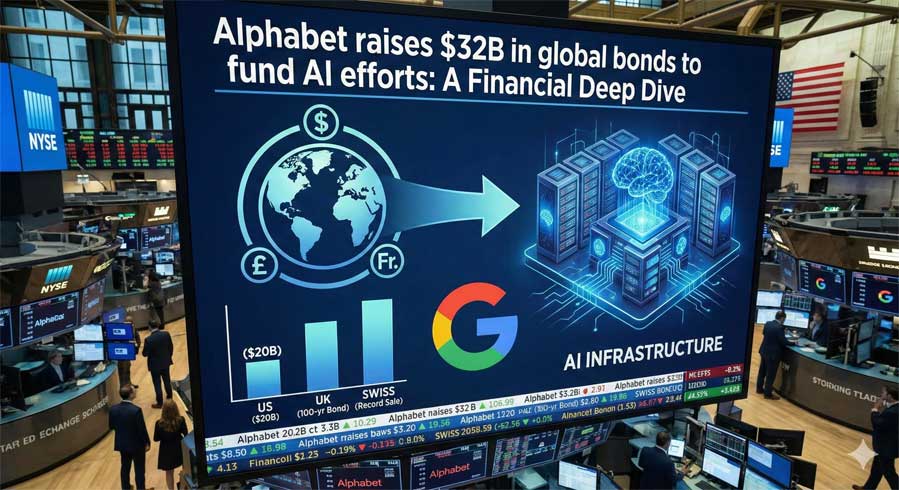
Alphabet raises $32B in global bonds to fund AI efforts: A Financial Deep Dive
USA NEWS NOW : In a financial maneuver that underscores the sheer scale of the artificial intelligence arms race, Alphabet Inc. has executed one of the most ambitious debt raises in corporate history. Over a span of just 24 hours, Google’s parent company secured approximately $32 billion in global capital, tapping into markets in the United States, the United Kingdom, and Switzerland.
The bond sale, which includes an “ultra-rare” 100-year bond issuance in the U.K., is a direct response to the company’s skyrocketing capital needs. As the battle for AI dominance intensifies against rivals like Microsoft and Amazon, Alphabet has signaled that its checkbook is wide open. This massive influx of liquidity is earmarked to fund a capital expenditure (CapEx) plan that could hit a staggering $185 billion this year—a figure that has rattled some investors while reassuring others of Google’s commitment to winning the AI century.
This article dissects the details of this historic raise, the strategic logic behind the 100-year bond, and the broader implications for corporate bonds investment and the AI infrastructure landscape.
The Breakdown: A $32 Billion Global Blitz
Alphabet’s return to the debt markets was not merely a dip; it was a cannonball. The $32 billion raise was executed in three strategic tranches, capitalizing on voracious investor appetite for high-grade tech debt.
1. The U.S. Dollar Sale ($20 Billion)
The centerpiece of the raise was a $20 billion corporate bond sale in the United States, finalized on Monday, February 9. Originally targeted at a lower figure, the offering was upsized after order books swelled to over $100 billion. This 5x oversubscription rate allowed Alphabet to tighten its borrowing costs, securing significantly favorable terms despite the massive volume.
- Structure: The U.S. sale was split into seven tranches with maturities ranging from 5 to 40 years.
- Yields: The 40-year tranche priced at spreads that were tighter than initial guidance, reflecting the market’s view of Alphabet as a “quasi-sovereign” issuer—a company with a balance sheet as robust as many G7 nations.
2. The Historic Sterling “Century Bond”
Perhaps the most headline-grabbing component of the deal was Alphabet’s entry into the British pound sterling market. The company issued a 100-year bond, a financial instrument that will not mature until the year 2126.
- Rarity: This is the first time a technology firm has issued a century bond since the dot-com era (specifically Motorola in 1997).
- Significance: Issuing debt with a 100-year horizon is a massive flex of corporate longevity. It signals to the market that Alphabet expects to not only exist but remain solvent and creditworthy for the next century.
- Investor Base: This tranche was specifically targeted at U.K. pension funds and insurers, who have an insatiable need for “long-duration” assets to match their long-term liabilities (like paying out pensions in 2060).
3. The Swiss Franc Record
Simultaneously, Alphabet tapped the Swiss market, raising billions in Swiss francs. This offering reportedly set a new record for the largest corporate bond sale in Switzerland, further diversifying the company’s currency exposure and debt profile.
The $185 Billion CapEx Reality
Why does a company with over $100 billion in cash on hand need to raise $32 billion in debt? The answer lies in the sheer cost of AI infrastructure investing.
Last week, during its earnings call, Alphabet stunned Wall Street by estimating that its capital spending could hit $185 billion this year. To put that number in perspective:
- It is roughly double Alphabet’s CapEx in 2024.
- It exceeds the annual GDP of countries like Hungary or Kuwait.
- It dwarfs the cost of the Apollo moon landing program (adjusted for inflation).
This spending is not going toward swanky offices or employee perks. It is being poured into concrete, copper, and silicon.
Where is the money going?
- Custom Silicon (TPUs): Alphabet is aggressively scaling its Tensor Processing Units (TPUs) to reduce reliance on Nvidia and train its Gemini models more efficiently.
- Next-Gen Data Centers: The power density required for AI training clusters is forcing a complete redesign of data center architecture. Alphabet is securing land and power contracts globally to support gigawatt-scale facilities.
- Energy Infrastructure: With AI’s voracious energy appetite, Alphabet is increasingly investing in green energy projects and grid modernization to ensure its servers can run 24/7 without tripping local utility grids.
The Logic of Debt: Why Borrow Now?
For retail investors and tech stock analysis enthusiasts, the move to take on debt might seem counterintuitive for a cash-rich company. However, corporate finance strategy dictates that this is the optimal move for three reasons:
1. Capital Efficiency and Tax Shields
Interest payments on corporate debt are tax-deductible. By using debt to fund expansion rather than repatriating overseas cash (which might incur taxes) or depleting reserves, Alphabet lowers its overall cost of capital.
2. “Quasi-Sovereign” Status
Alphabet is rated AA+ by S&P and Aa2 by Moody’s. This elite credit rating allows it to borrow at rates only slightly higher than the U.S. Treasury. In a world where interest rates are stabilizing, locking in low-cost capital for 40 or 100 years is a defensive moat. If inflation rises in the future, paying back this fixed-rate debt becomes cheaper in real terms.
3. Preserving Cash for M&A and Buybacks
By funding infrastructure with long-term debt, Alphabet keeps its massive cash pile free for other strategic maneuvers, such as potential acquisitions (regulatory hurdles notwithstanding) or continuing its share repurchase program to support the stock price.
The “Century Bond” Signal: Hubris or Vision?
The 100-year bond is a polarizing instrument. In institutional investing strategies, it is often viewed as a bet on the “immortality” of the issuer.
- The Bull Case: Investors buying a 2126 bond believe that Google Search, Cloud, and AI will remain fundamental utilities of the global economy for generations. It is a vote of confidence that Alphabet is not the next Kodak or Nokia.
- The Bear Case: Technology is inherently disruptive. Betting on a tech company to survive—let alone thrive—for 100 years is historically risky. A century ago, the dominant companies were railroads and steel mills. Today, many are gone.
However, the demand for this bond was reportedly 10x oversubscribed. This suggests that the market is currently less concerned with 100-year risks and more desperate for high-quality yield in a global economy where safe returns are hard to find.
The Hyperscaler Debt Trend
Alphabet is not alone. We are witnessing a broader trend of hyperscalers selling debt to fund their AI ambitions.
- Oracle: Recently raised $25 billion to fund its own data center expansion.
- Meta & Amazon: Have also been active in debt markets, signaling that the “AI Arms Race” is shifting from a software battle to a capital-intensive infrastructure war.
This creates a new paradigm in tech stock analysis. These companies are transitioning from “capital-light” software businesses (high margins, low asset base) to “capital-heavy” utility-like entities (massive physical assets, depreciation, and maintenance costs).
This shift changes how analysts value these stocks. Free Cash Flow (FCF)—a favorite metric for investors—will likely be compressed for years as CapEx eats up revenue. The bet is that this massive upfront spending will result in an unassailable monopoly on AI intelligence in the 2030s.
Risks: The “AI Bubble” Shadow
While the bond sale was a success, the context is fraught with risk. The $185 billion CapEx figure has reignited fears of an AI bubble.
The “Over-Building” Risk:
History is littered with examples of infrastructure overbuilds—fiber optics in the late 90s being the prime example. If Alphabet spends $185 billion on data centers and the demand for Generative AI flattens, or if monetization lags (i.e., people don’t pay enough for Gemini subscriptions to cover the electricity bill), the company could be left with billions in depreciating assets.
Bond Yields 2026 Context:
Investors are also watching bond yields closely. If inflation spikes again, the value of these long-term bonds will crash (since yields and prices move inversely). For the buyers of the 100-year bond, the risk is not just that Alphabet fails, but that interest rates rise, locking them into a below-market return for a century.
Conclusion: A $32 Billion Bet on the Future
Alphabet’s $32 billion bond raise is more than a financial transaction; it is a declaration of intent. By issuing a century bond, the company is effectively telling the world that it intends to be the architect of the next 100 years of human technology.
For investors, the message is double-edged. The successful raise proves that the market has unwavering faith in Alphabet’s creditworthiness. However, the staggering $185 billion spending plan it funds is a stark reminder that the AI revolution will be incredibly expensive, and the payoff is far from guaranteed.
As the global debt markets digest this issuance, all eyes will be on how efficiently Alphabet can deploy this capital. In the high-stakes game of AI, cash is ammunition, and Alphabet just reloaded its clip with $32 billion.
Related Video Analysis
For a critical perspective on how this massive borrowing by tech giants might impact the broader economy, this video offers an in-depth analysis of the debt-fueled AI boom.
Big Tech’s AI Debt Will Crash the Economy
This video is relevant because it explores the potential systemic risks of hyperscalers like Alphabet taking on massive debt loads to fund AI infrastructure, providing a counter-narrative to the bullish bond market reception.