
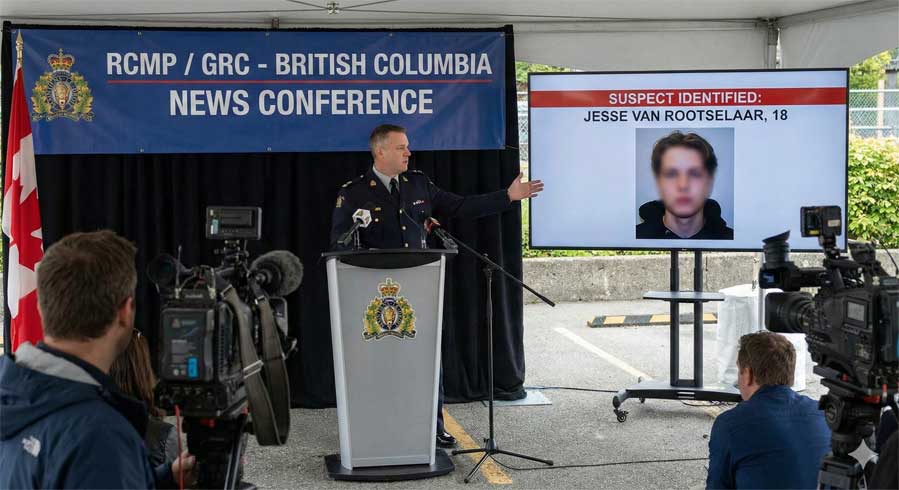
Police identify 18-year-old Jesse Van Rootselaar as suspect in deadly BC school shooting.
Canada Mourns: Police Identify 18-Year-Old Suspect Behind Tumbler Ridge School Massacre
TUMBLER RIDGE, B.C. — In a week that has irrevocably shattered the peace of a remote community in the foothills of the Canadian Rockies, police have identified the perpetrator behind one of the deadliest school shootings in Canadian history.
The Royal Canadian Mounted Police (RCMP) confirmed on Wednesday that 18-year-old Jesse Van Rootselaar was the lone gunman responsible for the rampage that claimed eight innocent lives before she turned the weapon on herself. The massacre, which unfolded on a quiet Tuesday afternoon in Tumbler Ridge, British Columbia, has plunged the nation into a state of shock and mourning, drawing comparisons to the country’s darkest days of violence.
Authorities have revised the death toll to nine, a figure that includes the shooter. Among the dead are Van Rootselaar’s mother and young stepbrother, killed in their home, and a teacher and five students gunned down within the halls of Tumbler Ridge Secondary School.
As flags across the country were lowered to half-mast on the orders of Prime Minister Mark Carney, investigators, community leaders, and a grieving public are left grappling with the same agonizing question: Why?
The Suspect: A Troubled History
In a sombre press conference held less than 24 hours after the violence ceased, RCMP Deputy Commissioner Dwayne McDonald provided the first detailed profile of the suspect.
Police identified the shooter as Jesse Van Rootselaar, an 18-year-old resident of Tumbler Ridge who had previously attended the very school she attacked. According to McDonald, Van Rootselaar had a history of mental health struggles and was known to police.
“We have a history of police attendance at the family residence,” McDonald told reporters, flanked by grim-faced officers. “Some of those calls are related to mental health issues.”
McDonald clarified the suspect’s gender identity, a detail that had circulated in unverified reports prior to the official statement. “The suspect was born as a biological male but began to identify as a female six years ago,” he said, noting that police would refer to her as she identified publicly and socially.
Van Rootselaar had dropped out of Tumbler Ridge Secondary School approximately four years ago, around 2022. While investigators have not yet pinpointed a specific motive, they confirmed that there is currently no evidence to suggest she was bullied during her time at the school, nor was there a manifesto or suicide note found at the scene.
However, the red flags were present. Police revealed that officers had visited the Van Rootselaar home multiple times over the years, including incidents involving weapons. In one instance, firearms were seized from the home but were later returned to their lawful owner—likely a parent—after a petition process. Van Rootselaar herself had held a minor’s firearms licence, which allows young people to borrow non-restricted rifles for hunting, but it had expired in 2024.
Timeline of Terror
The violence began not in the school corridors, but in the domestic quiet of the Van Rootselaar family home.
Investigators believe the 18-year-old first opened fire on her own family, killing her 39-year-old mother and her 11-year-old stepbrother. The discovery of these bodies would come later, only after the horror had migrated to the devastatingly public setting of the high school.
Leaving the scene of the domestic killings, Van Rootselaar traveled approximately two kilometers to Tumbler Ridge Secondary School. It was shortly after 1:20 p.m. local time when the first reports of an active shooter reached the RCMP.
Armed with a long gun and a modified handgun, the shooter entered the school—a facility that serves roughly 160 students in grades 7 through 12.
The police response was rapid. Members of the local Tumbler Ridge detachment arrived within two minutes of the initial 911 call. “Upon arrival, there was active gunfire, and as officers approached the school, rounds were fired in their direction,” McDonald described.
Despite the swift intervention, the shooter had already exacted a heavy toll. One victim was found lifeless in a stairwell. Five others—students who had likely barricaded themselves or huddled for safety—were discovered in the school library, a site that has now become the focal point of the tragedy.
As officers breached the building to neutralize the threat, they found Van Rootselaar dead from a self-inflicted gunshot wound. The rampage was over, but the devastation was absolute.
The Victims: Lives Cut Short
The scale of the loss is difficult to comprehend for a town of just 2,400 people, where “every child’s name is known and every family is a neighbour,” as King Charles noted in a statement of condolence.
The victims at the school were heartbreakingly young. They included three 12-year-old girls and two boys, aged 12 and 13. A 39-year-old female teacher, whose name has not yet been released pending full family notifications, was also killed, likely while trying to protect her students.
“These children and their teachers bore witness to unheard-of cruelty,” Prime Minister Carney said in an emotional address to the House of Commons. “Children who should have been thinking about homework and hockey were instead thrown into terror, grief, and unbearable uncertainty.”
In addition to the deceased, approximately 25 to 27 people were injured. While many suffered non-life-threatening injuries—some sustained during the chaotic evacuation—two victims remain in critical condition after being airlifted to hospitals in larger urban centres.
The initial confusion of the event led to a revision in the death toll. Early reports suggested ten dead, but police clarified on Wednesday that one victim, thought to have died en route to the hospital, had been revived and remains in critical care.
A Nation in Mourning
The shockwaves of the Tumbler Ridge massacre have reached the highest levels of government, disrupting national affairs and prompting a unified outpouring of grief.
Prime Minister Mark Carney, visibly shaken, addressed the media on Tuesday evening and again in Parliament on Wednesday. The Prime Minister, who had been scheduled to fly to Halifax for a defence announcement and then to Munich for a security conference, cancelled his trip immediately.
“We will get through this. We will learn from this,” Carney told reporters, his voice thick with emotion. “But right now, it’s a time to come together, as Canadians always do in these situations, these terrible situations, to support each other, to mourn together and to grow together.”
Carney ordered flags on all federal buildings, including the Peace Tower in Ottawa, to be flown at half-mast for seven days—one day for each of the innocent lives taken.
“Parents, grandparents, sisters, brothers in Tumbler Ridge will wake up without someone they love,” Carney said. “The nation mourns with you, and Canada stands by you.”
Opposition leaders echoed the Prime Minister’s sentiments, setting aside partisan differences to offer condolences. The tragedy has temporarily silenced the usual roar of Question Period, replaced by a sombre reflection on the vulnerability of the nation’s youth.
The Shadow of History
For Canadians, the events in Tumbler Ridge reopen wounds that never fully healed. Mass shootings are relatively rare in Canada compared to the United States, thanks to stricter gun control laws, but when they occur, they leave a deep psychological scar on the national psyche.
This shooting ranks among the deadliest in Canadian history. It is the worst mass killing since April 2020, when a gunman disguised as a police officer murdered 22 people across rural Nova Scotia in a 13-hour rampage.
The targeting of a school specifically evokes the painful memory of the 1989 École Polytechnique massacre in Montreal, where a gunman killed 14 women before taking his own life. For over three decades, that event has defined the Canadian conversation on gun violence and violence against women. Now, Tumbler Ridge joins that tragic lineage.
“There’s not a word in the English language that’s strong enough to describe the level of devastation that this community has experienced,” said Larry Neufeld, a local provincial legislator, capturing the feeling of helplessness that pervades the region.
A Community Broken
Tumbler Ridge is a “town of miners, teachers, construction workers,” as the Prime Minister described—a tight-knit enclave carved out of the wilderness. It is a place where doors are often left unlocked and neighbours rely on one another for survival against the harsh northern elements.
Today, that sense of security has been obliterated.
The school remains closed, its perimeter taped off as forensic teams continue their grim work inside. A makeshift memorial has begun to form near the police cordon, with residents leaving flowers, teddy bears, and hockey sticks in the snow—a quintessentially Canadian tribute to lost youth.
Mental health support teams and crisis counsellors have been deployed to the town, but the road to recovery will be long. “It’s going to take a significant amount of effort and a significant amount of courage to repair that terror,” Neufeld told CBC News.
Questions regarding the weapon used will likely dominate the coming days. Canada has tightened its gun laws significantly in recent years, including a freeze on handgun sales and bans on many types of “assault-style” firearms. The revelation that Van Rootselaar used a “modified handgun” and a long gun will likely reignite debates about the efficacy of these bans and the prevalence of illegal or modified weapons.
However, for the residents of Tumbler Ridge, the politics are distant noise. Their reality is the empty chair at the dinner table, the silence in the hallways, and the inexplicable loss of a generation of children who went to school on a Tuesday and never came home.
As the investigation continues, police have emphasized that they believe the threat has passed. “We do believe the suspect acted alone,” Deputy Commissioner McDonald reiterated.
But while the physical danger is over, the emotional toll is just beginning to be tallied. In the words of Prime Minister Carney, the country has been left in “shock and mourning,” staring into the void left by nine lives extinguished too soon.
If you or anyone you know needs help:
- Suicide Call Back Service: 1300 659 467
- Lifeline: 13 11 14
- Kids Helpline: 1800 551 800
- Beyond Blue: 1300 224 636
- Talk Suicide Canada: 1-833-456-4566