
The Retail Revolution: How MEXC Shattered the Status Quo to Become the World’s Third-Largest Exchange
VICTORIA, Seychelles — In an industry often defined by volatility and the dominance of entrenched giants, the crypto exchange landscape has undergone a seismic shift. MEXC, a platform once seen as a challenger brand, has officially disrupted the global hierarchy, surging to become the third-largest centralized exchange in the world.
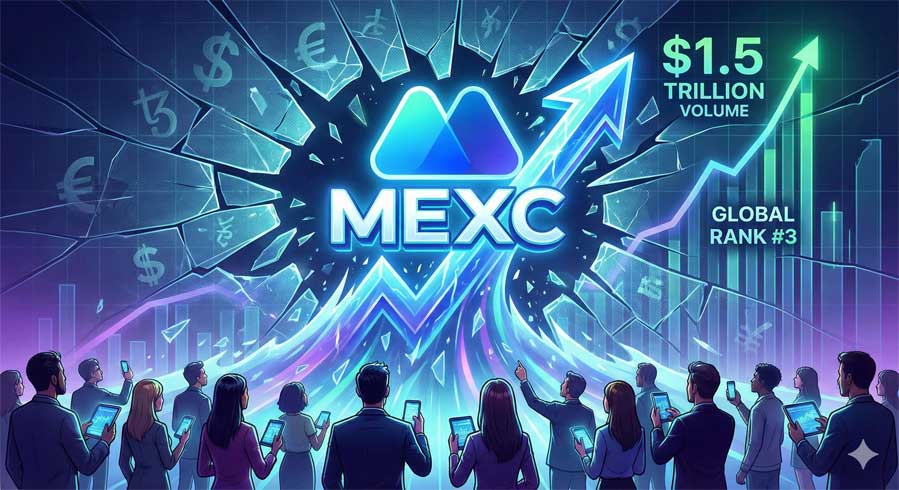
According to new data released this week, MEXC recorded a staggering $1.5 trillion in spot trading volume throughout 2025, capturing 7.8% of the global market share. But the raw volume tells only half the story. In a year where industry stalwarts faced stagnation or contraction, MEXC delivered a blistering 90.9% year-over-year growth rate—more than doubling its previous trading activity and significantly outpacing the industry average of just 7.6%.
The news, confirmed by data aggregator CoinGecko, signals a changing of the guard in the cryptocurrency sector. It marks the moment where a “user-first” philosophy, underpinned by an aggressive zero-fee structure, successfully dismantled the moats of legacy competitors.
A Meteoric Rise in a Stagnant Market
To understand the magnitude of MEXC’s achievement, one must look at the broader context of the 2025 crypto market. It was a year characterized by consolidation and institutional maneuvering, yet overall spot trading expansion was sluggish. The top 10 exchanges collectively processed $18.7 trillion in trading volume, a massive figure, but one that revealed deep fissures in the dominance of traditional leaders.
While the broader market struggled to find new momentum, MEXC was operating in a league of its own.
“We are proud to stand among the top three fastest-growing exchanges in a year when much of the industry struggled to expand,” said Vugar Usi, Chief Operating Officer of MEXC.
Usi’s comment highlights a critical divergence in strategy. While many top-tier exchanges spent 2025 chasing institutional capital—courting hedge funds, family offices, and ETFs—MEXC doubled down on the retail trader. The result was a platform that felt alive and accessible to the everyday user, while competitors increasingly felt gated and corporate.
The data supports this narrative brutally. Binance, long the undisputed king of crypto volume, saw its volumes contract by 0.5% in 2025. Bybit, the second-largest player known for its derivatives engine, saw an even sharper decline of 13.7%. In contrast, MEXC’s growth trajectory rocketed upward, positioning it alongside other risers like Bitget (+45.5%) and Gate (+39.7%), but leaving them behind in terms of pure velocity.
By the end of December 2025, MEXC was processing $86.0 billion in monthly spot trading volume alone, a figure that would have been unthinkable for the platform just two years prior.
The Zero-Fee Weapon
The catalyst for this explosive growth is no secret: fees matter.
For years, crypto exchanges have operated on a fee structure that punishes high-frequency trading and eats into the margins of retail investors. Maker and taker fees, often ranging from 0.1% to 0.5%, create friction. In a bull market, these fees are tolerated; in a sideways or bear market, they are prohibitive.
MEXC identified this friction point and removed it entirely. The platform’s “true zero-fee” policy was not just a promotional gimmick; it became a core tenet of their infrastructure.
“Our goal is simple: challenge the status quo by pushing barriers to entry as close to zero as possible, so both high-frequency traders and retail users can participate without compromise,” Usi explained.
This strategy resonated deeply with the crypto community. For the day trader executing hundreds of transactions, the savings on fees can equate to a significant percentage of their annual profit. For the retail investor dollar-cost averaging into positions, the absence of fees means more capital actually goes into the asset.
While competitors maintained traditional fee structures to protect their revenue lines, MEXC bet that volume would trump margin. The bet paid off. The zero-fee environment attracted a diverse swarm of trading activity, from algorithmic bot traders seeking efficiency to new retail entrants looking for a low-cost entry point into the market.
The “Gem Hunter” Ecosystem
Beyond the fee structure, MEXC has cultivated a reputation as the premier destination for “gem hunters”—traders looking for early access to high-potential tokens before they list on more conservative platforms.
Founded in 2018 with the motto “Your Easiest Way to Crypto,” MEXC has aggressively listed trending tokens and facilitated everyday airdrop opportunities. This agility has allowed them to capture the zeitgeist of the crypto market faster than their larger, slower-moving rivals.
In 2025, as meme coins, AI-driven tokens, and decentralized physical infrastructure networks (DePIN) surged in popularity, traders found that MEXC was often the first centralized exchange to provide liquidity for these assets. This created a flywheel effect: traders came for the exotic pairs and the zero fees, but they stayed for the deep liquidity and the user-friendly interface.
With over 40 million users now spread across 170+ countries, the platform has achieved critical mass. The interface, designed to be intuitive for beginners yet powerful enough for veterans, has successfully bridged the gap between the “degen” culture of on-chain trading and the safety and ease of a centralized exchange (CEX).
Challenging the Oligopoly
The rise of MEXC to the number three spot is more than just a corporate win; it is a restructuring of the crypto oligopoly.
For the better part of the last five years, the top of the crypto exchange leaderboard has been static. Binance held the crown, with Coinbase, OKX, and Bybit shuffling for the remaining podium spots. The entry of MEXC into the top three disrupts this predictability.
With $1.5 trillion in spot volume, MEXC is now processing volume comparable to Bybit. However, the momentum creates a stark contrast. One exchange is shedding volume while the other is doubling it. If the current trend lines continue into 2026, MEXC is not just looking to secure third place—it is actively threatening the runner-up position.
This shift suggests that the “sticky” nature of liquidity is not as permanent as market analysts once believed. Traders are mercenary; they will migrate to platforms that offer better conditions, faster execution, and lower costs. The loyalty to legacy brands is eroding in the face of superior utility.
Infrastructure and Innovation
Handling $1.5 trillion in volume requires more than just good marketing; it requires robust infrastructure. A 90% increase in traffic can crush a platform that isn’t prepared to scale.
MEXC’s ability to maintain 100% uptime and fast execution speeds during the high-volatility events of 2025 was a crucial factor in its retention of new users. The exchange has invested heavily in its matching engine and security protocols, ensuring that the influx of 40 million users did not compromise the integrity of the platform.
Looking ahead, the company has signaled that it will not rest on its laurels. The press release indicates a continued focus on “enhancing platform infrastructure and user experience.” In the world of crypto, this likely means deeper integration of Web3 features, enhanced mobile capabilities, and potentially new financial products that bridge the gap between spot trading and yield generation.
“While many competitors leaned heavily on institutional flows, we built our platform around retail users,” Usi noted. “That focus allowed us to attract new traders, boost activity, and capture meaningful market share.”
The Road Ahead: 2026 and Beyond
As the crypto market moves deeper into 2026, the battle for dominance will likely intensify. The “Big Three” status paints a target on MEXC’s back. Competitors who have seen their market share erode will likely respond. We may see fee wars erupt across the industry as other exchanges try to match MEXC’s zero-fee value proposition. We may see aggressive marketing campaigns or new product innovations from Binance and Bybit to stem the bleeding.
However, MEXC has the advantage of momentum. In markets, momentum is a powerful force. The perception of being the “fastest-growing” platform creates a self-fulfilling prophecy, attracting more liquidity, which in turn attracts more traders.
Furthermore, regulatory landscapes are shifting. As a global exchange based in Victoria, Seychelles, MEXC has navigated the complex geopolitical waters of crypto regulation with agility. Their ability to serve users in 170+ countries suggests a robust compliance framework that is flexible enough to adapt to local requirements while maintaining a global standard of service.
Conclusion
The story of 2025 in the crypto exchange world was supposed to be one of institutional adoption and regulatory crackdown. Instead, the headline story became the resurgence of the retail trader and the rise of the platform that championed them.
MEXC’s surge to third place is a vindication of a strategy that prioritized accessibility and affordability over exclusivity. By eliminating fees and focusing on the assets that retail traders actually care about, they have doubled their size in a single year and carved out a massive slice of the $18.7 trillion pie.
As Vugar Usi and his team look toward the future, their challenge will be to manage this newfound scale. But for now, the message to the industry is clear: The old guard can no longer rest easy. The barriers to entry have been smashed, and a new heavyweight has entered the ring.