
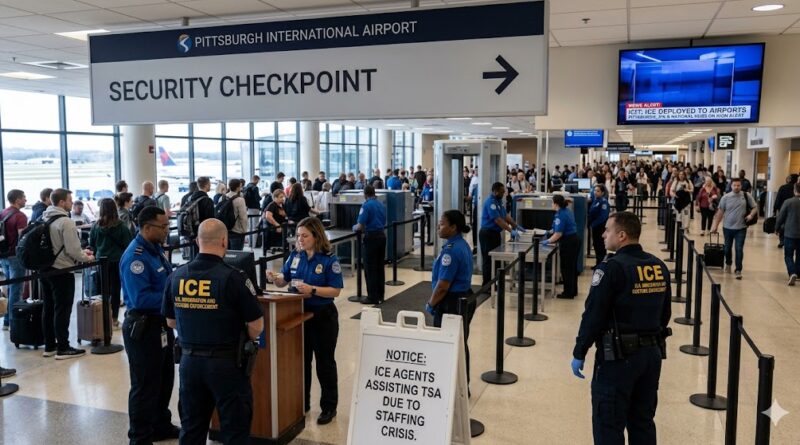
ICE Agents Deployed to Pittsburgh International Airport Amid TSA Staffing Crisis: JFK and National Hubs on High Alert
In a dramatic escalation of the ongoing partial Department of Homeland Security (DHS) shutdown, U.S. Immigration and Customs Enforcement (ICE) agents are expected to begin operations at Pittsburgh International Airport (PIT) today. The move follows a weekend of record-breaking “call-outs” by Transportation Security Administration (TSA) officers who have now surpassed five weeks of working without a paycheck.
While the initial deployment centers on Pittsburgh, the ripple effects are being felt across the nation’s aviation infrastructure, putting massive international gateways like New York’s JFK Airport on high alert as travel disruptions threaten to reach a breaking point.
The Breaking Point in Pittsburgh
The situation at PIT reached a critical threshold this past Sunday. According to DHS Acting Assistant Secretary Lauren Bis, the airport saw a staggering 24.7% call-out rate among its TSA staff—more than double the national average of 11.8%. Nationwide, over 3,400 TSA agents failed to show up for their shifts, citing financial hardship caused by the prolonged government shutdown.
“We do expect ICE at PIT at some point today,” confirmed airport spokesperson Bob Kerlik.
In response to the staffing vacuum, President Trump announced via Truth Social that he is redirecting hundreds of ICE officers—whose funding remains intact through separate Congressional appropriations—to assist the TSA. The administration frames this as a necessary “action to bolster safety” and ensure that American skies remain secure despite the legislative gridlock in Washington.
The Shadow Over JFK Airport
While Pittsburgh serves as the immediate testing ground for this inter-agency collaboration, all eyes are turning toward JFK Airport in New York. As one of the world’s busiest international hubs, JFK relies on a massive, highly trained TSA workforce to process tens of thousands of passengers daily.
Industry analysts warn that if JFK Airport experiences a call-out rate similar to Pittsburgh’s 24%, the resulting congestion could paralyze North Atlantic air travel. Unlike smaller regional airports, JFK‘s complex security protocols for international flights require specialized certification that ICE agents currently lack.
Local law enforcement at JFK and the Port Authority of New York and New Jersey are reportedly in “constant communication” with federal partners. The prospect of ICE agents checking IDs or guarding exit lanes at JFK has sparked both relief regarding shorter lines and concern over the optics of immigration enforcement officers operating in such a high-profile civilian space.
Roles and Responsibilities: What ICE Will (and Won’t) Do
White House border czar Tom Homan clarified the scope of the deployment in a recent interview. It is important to note that ICE agents are not a one-to-one replacement for TSA officers.
- No Technical Screening: ICE agents are not trained to operate X-ray machines or conduct high-tech baggage screening. That certification takes four to six months—a process these agents have not undergone.
- Logistical Support: Agents will primarily be used to guard exit lanes, monitor security perimeters, and verify passenger IDs.
- Freeing Up Resources: By taking over these “non-technical” roles, the remaining TSA officers at JFK and PIT can focus exclusively on the screening lanes, hopefully reducing the “peak-time” congestion that has already plagued airports in Houston and New Orleans.
In a notable directive, the President specified that agents deployed to airports should not wear masks—a departure from the tactical gear often seen during standard ICE operations.
The Humanitarian Crisis Behind the Scenes
The shutdown’s toll isn’t just measured in wait times; it’s measured in the welfare of federal employees. In Pittsburgh, the airport has partnered with the Greater Pittsburgh Community Food Bank to open an on-site food pantry for unpaid TSA workers.
Similar “pop-up” support centers are being discussed for workers at JFK Airport, where the high cost of living in New York City has made five weeks without pay especially devastating for junior officers.
Looking Ahead: A Volatile Week for Travel
As of Monday afternoon, PIT and other regional hubs are monitoring the situation hour by hour. “Safety and security are always the top priority,” Kerlik stated, noting that local police are prepared to assist if tensions rise in long security lines.
For travelers heading to JFK Airport or PIT this week, the advice remains consistent: arrive at least four hours early for international flights and three hours for domestic travel. The presence of ICE agents may help move the lines, but the underlying instability of the federal workforce remains a significant variable.
Would you like me to check the current TSA wait times for JFK Airport or provide the latest flight delay statistics for Pittsburgh?