
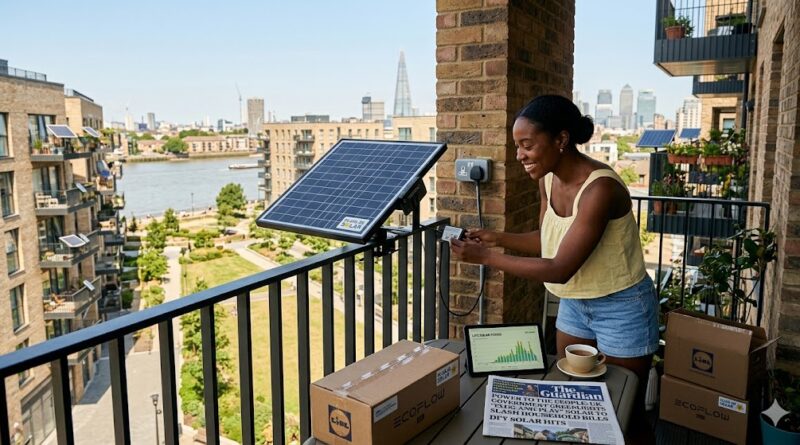
Power to the People: UK Government Greenlights ” plug in solar panels ” to Slash Household Bills
UK plug-in solar panels News update : In a landmark move to help families escape the “fossil fuel rollercoaster,” the UK government has announced that portable, “plug-in” solar panels will hit high street shops within months. This DIY energy revolution is part of a massive new drive to secure British energy independence and lower the cost of living as global markets remain volatile due to the ongoing conflict in the Middle East.
From this summer, residents—including renters and those living in flats—will be able to buy compact solar kits from major retailers like Lidl and Amazon. These “plug-and-play” systems, already a common sight on balconies across Germany, allow households to generate their own clean electricity and feed it directly into a standard mains socket without the need for a professional electrician or expensive installation fees.
The “Plug-and-Play” Revolution
The Department for Energy Security and Net Zero confirmed it is slashing the red tape that previously made small-scale solar difficult for the average person to access. By updating safety standards and wiring regulations, the government is making it legal to connect systems under 800W directly to the home.
“We are determined to fight for the consumer,” said Energy Secretary Ed Miliband. “The war in Iran has shown us that the only way to truly protect British families is to stop relying on gas markets we don’t control. Whether it’s solar on every new rooftop or panels you can buy in a shop and plug in yourself, we are putting the power back into the hands of the people.”
New Homes, New Standards
The announcement coincides with the launch of the Future Homes Standard, a rigorous set of new rules ensuring that from today, the vast majority of new houses built in England will come equipped with solar panels and low-carbon heating, such as heat pumps, as standard.
These “future-proofed” homes are expected to:
- Save families up to £830 a year on energy bills compared to older properties.
- Reduce carbon emissions by 75% compared to homes built just a decade ago.
- Increase property value by safeguarding against future energy price spikes.
Housing Secretary Steve Reed emphasized that building 1.5 million new homes isn’t just about quantity, but quality. “We want homes that are warm to live in and cheap to run,” he noted. “Today’s standard is what the future of British housing looks like.”
“Wasted Wind”: Cheaper Power on Blustery Days
In a separate, innovative trial launching this winter, households in Scotland and the East of England will finally benefit from “wasted wind.” Currently, wind farms are often paid to switch off when the grid is too full to carry the power they produce.
Under the new plans, energy suppliers will instead offer deeply discounted rates to local residents on windy days, encouraging people to run appliances like washing machines or charge electric vehicles when green energy is most abundant. This turns a technical “constraint” into a direct financial win for families.
Industry Voices: A “Landmark Moment”
The move has been met with widespread praise from industry leaders and environmental groups.
- Lidl GB welcomed the modernisation of regulations, stating they are committed to making sustainable living affordable.
- Octopus Energy CEO Greg Jackson noted that interest in solar has surged by 50% since the Middle East conflict began. “Every panel and battery boosts Britain’s independence,” he said.
- EcoFlow, a leading manufacturer of portable power, called it a “major win” for renters and those in urban spaces who have previously been locked out of the solar market.
Frequently Asked Questions (FAQs)
Q: Do I need an electrician to install plug-in solar?
A: No. Under the new regulations for systems under 800W, these are designed to be “plug-and-play.” You simply place the panel in a sunny spot (balcony, garden, or terrace) and plug the lead into a normal indoor or outdoor socket.
Q: Can I use this if I rent my home?
A: Yes. Because these systems are portable and do not require permanent alterations to the building’s structure or wiring, they are an ideal solution for renters and flat-dwellers.
Q: Will it really make a difference to my bill?
A: While a small plug-in kit won’t power an entire house, it can significantly offset the “base load”—the electricity used by “always-on” appliances like fridges, routers, and standby devices—potentially saving households over £100 a year.
Reference Links & Official Resources
- Department for Energy Security: Official Guidance on Plug-in Solar Safety
- Future Homes Hub: Timeline for the 2028 Zero-Carbon Deadline
- Energy Networks Association: Updates on the G98 Distribution Code