
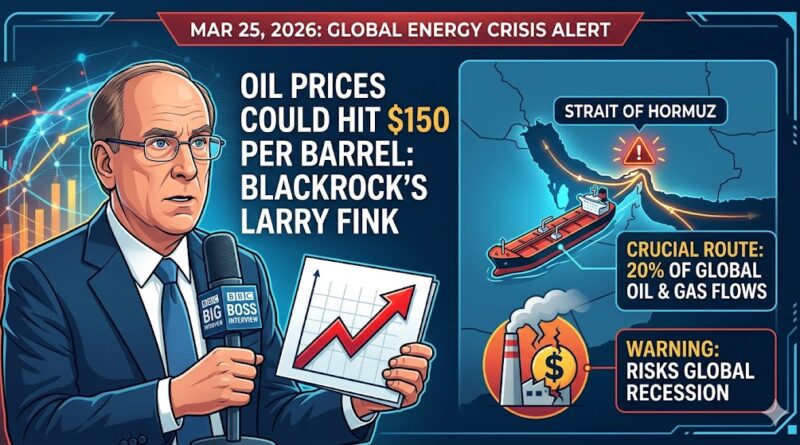
Global Energy Crisis 2026: BlackRock’s Larry Fink Warns Oil Could Surge to $150 Amid Escalating Iran Tensions
NEW YORK — The global economy is standing on the precipice of a significant energy shock. Larry Fink, the Chairman and CEO of BlackRock, issued a stark warning on Wednesday, March 25, 2026, stating that crude oil prices could skyrocket to $150 per barrel.
Speaking during a high-profile appearance on the BBC’s Big Boss Interview podcast, Fink highlighted the volatile intersection of geopolitics and energy markets. He noted that if the current tensions involving Iran continue to escalate, the resulting supply chain disruptions could be enough to tip a fragile global economy into a deep recession.
The “Strait” Reality: Why Iran Holds the Key
The core of Fink’s concern lies in the geography of global energy transport. Iran possesses significant influence over the Strait of Hormuz, a narrow but vital waterway that serves as the world’s most important oil transit chokepoint.
- The 20% Rule: Approximately 20% of the world’s total petroleum liquids consumption passes through the Strait daily.
- Infrastructure Sensitivity: Because there are few viable alternative routes for oil leaving the Persian Gulf, any military or political interference in the Strait immediately creates a global shortage.
- Market Psychology: Fink pointed out that even the threat of a blockade or increased hostilities is enough to send speculative prices soaring long before a single barrel is actually lost.
“We are looking at one of the biggest supply disruptions in recent history,” Fink told the BBC. “The ongoing conflict is fundamentally altering how oil and gas are shipped, and despite hopes for a ceasefire, the risk premium remains at an all-time high.”
Recessionary Risks and the Global Ripple Effect
The jump to $150 per barrel would represent a nearly 80% increase from the price stability seen in early 2025. For the average consumer and the broader industrial complex, the implications are severe:
- Inflationary Pressure: Higher oil prices act as a “tax” on consumers, raising the cost of everything from commuting to plastic-based consumer goods and food transport.
- Central Bank Dilemma: With inflation already a concern in 2026, central banks may be forced to keep interest rates high to combat energy-driven price hikes, further stifling economic growth.
- Manufacturing Slowdown: Industries reliant on heavy transport and petrochemicals—such as aviation and construction—could face a “freeze” in operations as fuel costs become unsustainable.
Fink’s warning suggests that the “soft landing” many economists hoped for in 2026 is now in jeopardy.
The Geopolitical Context
The escalation comes at a time when global energy markets were already strained by shifting alliances and the transition toward green energy. While BlackRock has been a proponent of the energy transition, Fink was clear that the world remains dangerously dependent on traditional fossil fuels for its immediate stability.
“We cannot ignore the reality of the present while building the future,” Fink noted, suggesting that energy security has now become the primary concern for global investors, surpassing even ESG (Environmental, Social, and Governance) metrics in the short term.
Frequently Asked Questions (FAQ)
1. Why is $150 per barrel considered a “danger zone”?
Historically, when oil prices sustain levels above $120-$130 for an extended period, it significantly reduces discretionary spending and increases production costs, which has almost always preceded a global recession.
2. What is the Strait of Hormuz and why is it so important?
It is a narrow waterway between the Persian Gulf and the Gulf of Oman. It is the only sea passage from the Persian Gulf to the open ocean, making it a critical “chokepoint” for oil tankers from Saudi Arabia, the UAE, Kuwait, Iraq, and Iran.
3. Has oil ever reached $150 before?
Oil prices approached $150 in the summer of 2008, peaking at roughly $147. That spike was followed by a massive global economic downturn, though other factors like the subprime mortgage crisis were also at play.
4. How does this impact the transition to renewable energy?
Ironically, high oil prices often accelerate the adoption of Electric Vehicles (EVs) and renewable energy as they become more cost-competitive. However, the short-term shock of $150 oil can cause economic damage that makes the capital investment needed for the green transition harder to come by.
Reference Links & Sources
To follow this story as it develops through 2026, please consult the following resources:
- BBC News: Larry Fink: The Big Boss Interview Podcast (Latest episodes and transcripts)
- U.S. Energy Information Administration (EIA): World Oil Transit Chokepoints
- BlackRock Investor Relations: CEO Letters and Market Outlooks
- Bloomberg Energy: Real-time Crude Oil Price Tracking
- International Energy Agency (IEA): Monthly Oil Market Report