
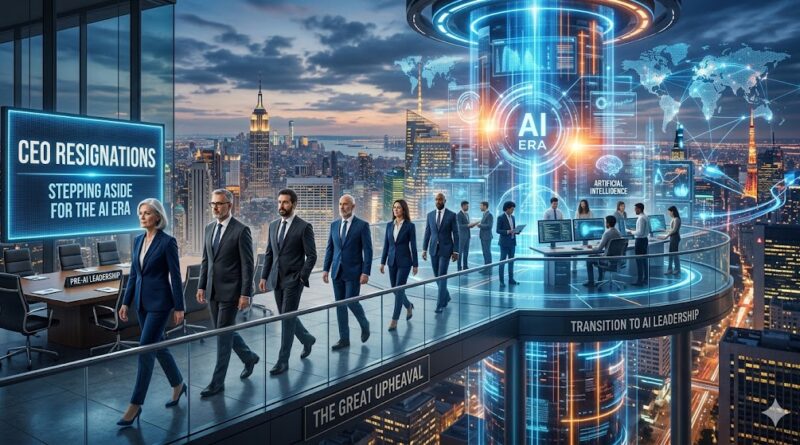
The Great Upheaval: The Surprising Reason Why the Coca-Cola CEO is Stepping Aside for the AI Era
USA — In a seismic shift that has sent shockwaves through the global C-suite, the leaders of the world’s most iconic retail and beverage giants have signaled that the “AI Revolution” is no longer just a threat to the factory floor—it is coming for the corner office.
In a series of candid revelations that mark a turning point in corporate history, Coca-Cola CEO James Quincey and former Walmart CEO Doug McMillon have identified the rapid, relentless evolution of Artificial Intelligence as the primary catalyst for their departures. Their message is clear: the transition to an AI-driven economy requires a “new breed” of leadership that many veteran executives feel they cannot—or should not—oversee.
The Coca-Cola Catalyst: Stepping Aside for the “Next Wave”
James Quincey, who has steered the Coca-Cola Company through a period of massive digitalization and brand diversification since 2017, surprised the industry by confirming his transition. Quincey will be succeeded by current COO Henrique Braun at the end of March 2026.
In an interview with CNBC, Quincey didn’t cite burnout or a desire for a quiet retirement. Instead, he spoke of a fundamental shift in the “energy” required to lead a multinational in the age of Generative AI.
“My job is to think about who the best team is to put on the field to get the next wave done,” Quincey remarked. “I concluded that it was time to put someone else on the field for the next wave of growth.”
Quincey admitted that while the company flourished under a “pre-AI mode” of operation, the “huge new shift” currently underway demands a leadership tenure that can see a decade-long transformation through to its conclusion. He described the need for a leader with the specific vitality to pursue a “completely new transformation of the enterprise.”
Walmart’s Vision: The Era of “Agentic Commerce”
The sentiment was echoed by Doug McMillon, the longtime architect of Walmart’s modern dominance, who retired in January. McMillon’s departure was framed not as a failure to adapt, but as a strategic realization that the timeline of the AI revolution exceeded his own professional horizon.
McMillon pointed to the rise of “Agentic Commerce”—a future where AI agents, not just human clicks, drive the shopping experience—as the moment he knew it was time to hand over the reins.
“I could start this next big set of transformations with AI, but I couldn’t finish,” McMillon confessed. “About a year ago, I really started feeling like this next run… it really caused me to think that now was the right time to step down.”
For McMillon, the vision of AI shopping is so radical that it requires a CEO who can commit to the next 10 to 15 years of implementation. By stepping down, these titans are effectively admitting that the learning curve and the stamina required for the “AI Decade” belong to a different generation of digital natives.
The “Godfather” and the “Grave”: A Bleak Outlook for Workers
While the CEOs are exiting with grace and golden parachutes, the “AI Transformation” they describe is casting a long, dark shadow over the global workforce. The departure of these leaders confirms what many “Doomsday” tech experts have been predicting: AI is not an incremental change; it is an extinction event for traditional roles.
The Death of Entry-Level Professionalism
Dario Amodei, CEO of AI powerhouse Anthropic, has issued a chilling warning that matches the timing of these resignations. Amodei predicts that AI could eliminate up to 50% of entry-level white-collar jobs within the next five years.
He specifically cited industries that have long been the bedrock of the middle class:
- Law Firms: Document review and first-year associate tasks are being automated at lightning speed.
- Finance & Consulting: Repetitive-but-variable data analysis is now the domain of LLMs.
- Administration: The “repetitive” nature of corporate bureaucracy is being streamlined out of existence.
Amodei was blunt about the motivation behind the move: “A large fraction of [CEOs] would like to be able to use it to cut costs to employ fewer people.”
Hinton’s Warning: Profit vs. People
Geoffrey Hinton, the so-called “Godfather of AI” who famously left Google to speak freely about the technology’s dangers, warns that while companies like Coca-Cola and Walmart will become “more profitable than ever,” the social cost will be staggering. Hinton anticipates unemployment rising to “catastrophic levels” as the efficiency gains of AI are captured by capital rather than labor.
A New Era of Leadership—Or a New Era of Displacement?
The resignations of Quincey and McMillon represent a “changing of the guard” that is fundamentally different from those of the past. Traditionally, a CEO leaves when a company is failing or when they have “done their time.” Here, two highly successful leaders are leaving because the nature of the work has changed so fundamentally that they no longer feel like the right tools for the job.
As Henrique Braun prepares to take over Coca-Cola, he inherits a company that is no longer just a beverage manufacturer, but a data-processing engine that happens to sell soda.
The Key Takeaways from the “AI CEO Exit”:
- Longevity is the New Liability: Veteran CEOs are realizing they cannot “see through” the 10-year implementation cycle of Agentic AI.
- The “Next Wave” is Total: This isn’t just about chatbots; it’s about a “completely new transformation of the enterprise.”
- The Human Cost: As leadership resets, the rank-and-file are facing a reality where “repetitive-but-variable” work is no longer a viable career path.
Conclusion: The Future is Agentic
The world is watching to see if this “CEO Exodus” is the beginning of a larger trend. If the leaders of the world’s largest employers feel they are not equipped to lead the AI transition, what does that mean for the millions of employees beneath them?
For now, the message from the top is clear: The AI Revolution is here, and it’s so powerful that even the people at the very top of the food chain are deciding it’s safer—and smarter—to watch it from the sidelines.