
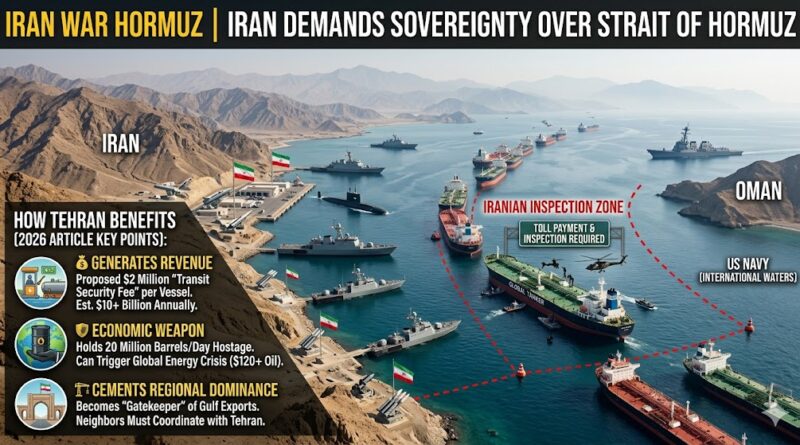
IRAN WAR HORMUZ | Iran demands sovereignty over Strait of Hormuz: How will it benefit Tehran? Here’s all you need to know
TEHRAN / LAS VEGAS — In a dramatic escalation of the ongoing conflict that has paralysed global energy markets, the Islamic Republic of Iran has officially issued a high-stakes ultimatum to the United States and Israel. At the centre of this geopolitical storm is a single, narrow waterway: the Strait of Hormuz.
On Sunday, March 29, 2026, Tehran confirmed it is demanding full, formal sovereignty over the Strait as a non-negotiable condition for ending the month-long war. This demand serves as the centrepiece of a five-point counter-proposal delivered via Pakistani intermediaries, flatly rejecting a 15-point “excessive” peace plan recently floated by U.S. President Donald Trump.
The shift in Tehran’s strategy marks a pivotal realisation: the Strait of Hormuz is no longer just a defensive barrier—it is a “potent weapon” capable of generating billions in annual revenue and holding the global economy hostage.
The Five Conditions: Iran’s Path to Peace
According to reports from state media agency Press TV and senior Iranian officials, the Islamic Republic has transitioned from a defensive posture to an assertive list of demands. The five conditions required to halt Iranian retaliatory strikes across the Middle East are:
- Recognition of Sovereignty over the Strait of Hormuz: Tehran demands the international community recognize the waterway as Iran’s “natural and legal right.”
- Guaranteed War Reparations: A clearly defined and enforceable payment mechanism for damages caused by U.S. and Israeli strikes since late February.
- Halt to All Aggressions: A permanent end to military strikes and “assassinations” against Iranian personnel and regional resistance groups.
- Enforceable Guarantees: The establishment of concrete international mechanisms to ensure the war is not “re-imposed” by Washington or Tel Aviv.
- Comprehensive Regional Ceasefire: The conclusion of the war across all fronts, including an end to hostilities against allied groups in Lebanon, Iraq, and Yemen.
The “Toll Booth” Strategy: Monetizing a Chokepoint
For decades, Iran threatened to close the Strait of Hormuz in the event of war. In 2026, they finally did it—and the results have “taken Tehran aback” by their sheer effectiveness.
Industry analysts and Middle East experts, including Dina Esfandiary of Bloomberg Economics, suggest that Iran has discovered just how “cheap and easy” it is to exert leverage over the global economy. Consequently, Tehran is moving to formalize this control through a “Toll Booth” Regime.
The Economic Mathematics of Control
Under normal conditions, roughly 20 million barrels of crude oil and liquefied natural gas (LNG) pass through the Strait daily. Iran’s Parliament is currently considering legislation to institutionalize a “security tax” or transit fee for all vessels:
- Per-Tanker Fees: Internal reports suggest a proposed $2 million fee per tanker for safe passage.
- Monthly Revenue: Based on current traffic volumes, this could generate nearly $600 million per month from oil alone.
- Total Potential: Including LNG and cargo shipments, the figure is expected to exceed $10 billion annually, providing a massive lifeline to an economy battered by years of sanctions.
Shifting the Shipping Lanes
In a tactical move to cement this sovereignty, the Islamic Revolutionary Guard Corps (IRGC) has begun rerouting vessels. Rather than using the traditional central international shipping lanes, tankers are being funneled through a designated corridor between the islands of Qeshm and Larak. This route places ships firmly within Iranian territorial waters, making them subject to physical inspections and the newly proposed “transit tolls.”
A Global Economic Emergency
The impact of Iran’s “sovereignty” demand has been felt instantly in every corner of the globe. As of late March 2026, the situation remains dire:
- Oil Prices: Brent crude has surged past $120 per barrel, with some analysts warning of a spike to $150 if the blockade persists through April.
- Supply Chain Collapse: Nearly 2,000 vessels remain stranded or anchored outside the Gulf, unable to enter or exit.
- Force Majeure: Major energy producers, including Saudi Arabia, Kuwait, and Qatar, have been forced to cut production or declare force majeure as storage facilities hit capacity.
U.S. Secretary of State Marco Rubio has called the tolling plan “illegal and unacceptable,” warning G7 leaders that restoring “toll-free freedom of navigation” is the absolute priority of the post-war era.
The Political Stakes: Trump vs. Mojtaba Khamenei
The war has also become a clash of wills between two leaders. President Trump, who recently extended a deadline for Iran to open the Strait to April 6, claimed on Truth Social that talks are “going very well.”
However, Tehran’s new Supreme Leader, Mojtaba Khamenei, used his first major address to strike a defiant tone. He stressed that the “leverage of Hormuz” must be continued and that Iran will end the war only “at a time of its own choosing.”
The assassination of the previous Supreme Leader earlier this year was intended to destabilize the regime; instead, it appears to have unified the political and military establishment around a strategy of “maximum economic pressure” via the Strait.
How Sovereignty Benefits Tehran: All You Need to Know
Why is Iran so insistent on “sovereignty” rather than just “security”? The benefits for Tehran are multifaceted:
- Geopolitical Insurance: By controlling the Strait, Iran ensures that any future U.S. or Israeli strike would immediately result in a global energy collapse, creating a “mutually assured destruction” scenario for the economy.
- Sanction Circumvention: A sovereign tolling system would allow Iran to collect hard currency directly from shipping companies, bypassing traditional banking sanctions.
- Regional Dominance: Forcing neighboring Gulf monarchies to coordinate their exports with Tehran effectively makes Iran the “gatekeeper” of the Middle East’s wealth.
The Legal Battle
International maritime experts, including James Kraska of the U.S. Naval War College, point out that Iran’s plan violates the UN Convention on the Law of the Sea (UNCLOS), which guarantees “transit passage” through international straits. Tehran, however, argues that the “state of war” initiated by the U.S. and Israel has rendered previous treaties void, giving them the right to implement “precautionary security measures.”
What Happens Next?
As the April 6 deadline approaches, the world watches with bated breath. Will the U.S. attempt to break the blockade by force—a move that could involve “boots on the ground” on Kharg Island—or will the sheer economic pain of $120 oil force a compromise that recognizes some form of Iranian oversight in the Strait?
One thing is certain: the Strait of Hormuz is no longer just a transit point. It is the world’s most expensive “toll booth,” and Iran currently holds the keys.
Would you like me to generate a batch of SEO-optimized social media posts (including titles for your news brands) or a high-CPC keyword list to help promote this breaking news article?