
Alabama’s “Solar Tax” Upheld: Federal Judge Rules Alabama Power Can Keep Charging Nation’s Highest Rooftop Fees
BIRMINGHAM, AL — In a major blow to clean energy advocates and residential solar users across the “Heart of Dixie,” a federal judge has ruled that Alabama Power can continue to levy one of the most expensive standby fees in the United States. The decision, handed down on March 25, 2026, by Judge Annemarie Carney Axon of the U.S. District Court for the Middle District of Alabama, effectively dismisses a long-standing lawsuit that argued the charges were illegal under federal law.
The ruling marks a pivotal, and perhaps final, chapter in a decade-long legal tug-of-war between the state’s largest utility provider and environmental groups who claim Alabama is intentionally “chilling” the transition to renewable energy.
The $39 Monthly Hurdle
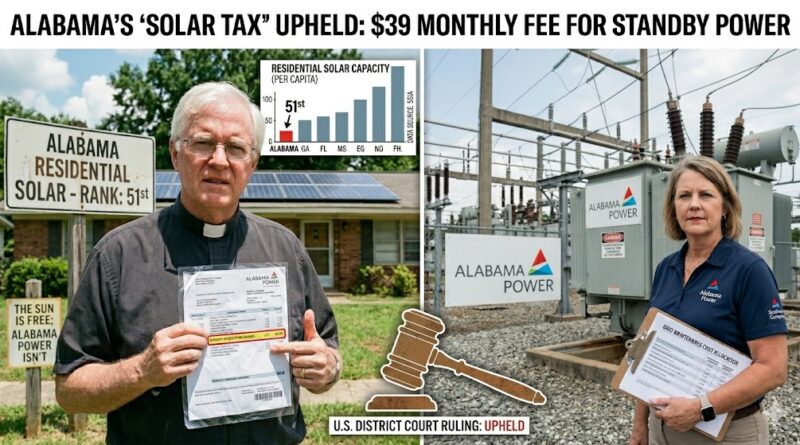
At the center of the controversy is Alabama Power’s “Capacity Reservation Charge.” For the average homeowner who installs a standard 7.2-kilowatt (kW) solar array, the utility adds a monthly fee of approximately $38.95 to their bill—regardless of whether the sun is shining or how much power the household actually pulls from the grid.
Over a year, this “solar tax” adds nearly $470 to a customer’s expenses, a cost that advocates say nearly doubles the time it takes for a solar investment to pay for itself.
“I am frustrated that Alabama Power solar customers like me have to pay an extra monthly fee just to reduce our power bills,” said plaintiff Mark Johnston, a retired Episcopal priest who pays roughly $32 a month for his 6kW system. “This charge discourages residential solar in a state that desperately needs clean, renewable power.”
A State Left in the Dark?
The impact of these fees is reflected in national rankings. According to data from the Solar Energy Industries Association (SEIA), Alabama currently ranks 51st in residential solar capacity (trailing all other states, Puerto Rico, and D.C., and ahead of only North Dakota). On a per capita basis, Alabama sits at the very bottom of the list.
While neighboring states have seen a boom in rooftop installations, Alabama’s market has remained stagnant. Critics argue this isn’t due to a lack of sunshine—Alabama is among the sunniest states in the Southeast—but rather a regulatory environment designed to protect the monopoly utility’s bottom line.
The Utility’s Defense: “Grid Fairness”
Alabama Power, which serves two-thirds of the state, maintains that the fee is a matter of equity, not an attack on renewables. The company argues that solar customers still rely on the massive infrastructure of the electrical grid at night, during cloudy weather, or when their systems fail.
“Customers who rely on the grid must help pay for the grid,” the company stated following the ruling. Alabama Power contends that without this fee, the cost of maintaining poles, wires, and backup power plants would be “unfairly burdened” onto non-solar customers, many of whom are low-income.
Judge Axon’s ruling echoed this sentiment, noting that the plaintiffs failed to provide sufficient evidence that the utility violated the Public Utility Regulatory Policies Act (PURPA), a 1978 federal law intended to promote energy conservation and domestic energy production.
“Apples and Oranges”: The FERC Controversy
The legal battle hasn’t just been confined to state courts. In 2021, the Federal Energy Regulatory Commission (FERC) took a look at Alabama’s fee. While FERC declined to take direct enforcement action at the time, two commissioners, Richard Glick and Allison Clements, issued a stinging concurrence.
They expressed “serious concern” that Alabama Power was “combining apples and oranges” in its math—using a mix of actual data and hypothetical projections to justify a fee that seemed disproportionately high compared to other states. They argued the utility had never proven that a solar customer’s impact on the grid was truly different enough from a standard customer to warrant such a steep surcharge.
Despite those warnings from federal regulators, the District Court found that the legal threshold for overturning the Alabama Public Service Commission’s (PSC) approval of the fee had not been met.
A Hostile Landscape for Clean Energy
Beyond the monthly fee, Alabama remains one of the few states without Net Metering. In states with net metering, solar owners are credited at the full retail rate for the excess electricity they send back to the grid.
In Alabama, the “buy-back” rate is significantly lower. Alabama Power credits customers only for the “avoided cost”—the raw price it would cost the utility to generate that same power at a coal or gas plant. When you combine the low credit rate with the high standby fee, the financial incentive for a homeowner to “go green” virtually evaporates.
“This is a disappointing day for customers who want relief from some of the highest electricity bills in the nation,” said Christina Tidwell, a senior attorney for the Southern Environmental Law Center (SELC).
An investigation by Inside Climate News recently found that Alabama Power customers paid the highest total residential power bills in the country in 2024, driven by high usage during hot summers and some of the highest rates in the Southeast.
Regional Comparisons
The “Alabama model” stands in stark contrast to its neighbors:
- Georgia: Georgia Power (also owned by Southern Company) attempted to implement a similar fee in 2013 but withdrew it following intense public and regulatory backlash.
- Virginia: Legislators recently moved to increase the threshold for standby charges to 20kW, meaning almost no residential systems pay the fee.
- Mississippi and Florida: Both states have significantly more robust solar incentives and higher residential adoption rates.
What’s Next?
The SELC and its partners, including the Greater-Birmingham Alliance to Stop Pollution (GASP), are currently evaluating whether to appeal the decision.
“Solar energy offers a unique opportunity for residents to take control of their energy costs,” said Jilisa Milton, executive director of GASP. “Meanwhile, Alabama Power and the PSC are chilling clean, bill-reducing power at a time when we should be sprinting toward a cleaner environment.”
For now, the ruling stands as a formidable barrier. For Alabamians looking to put panels on their roofs, the “price of the sun” just stayed a whole lot higher.
This report includes information originally appearing in Inside Climate News and local judicial filings.