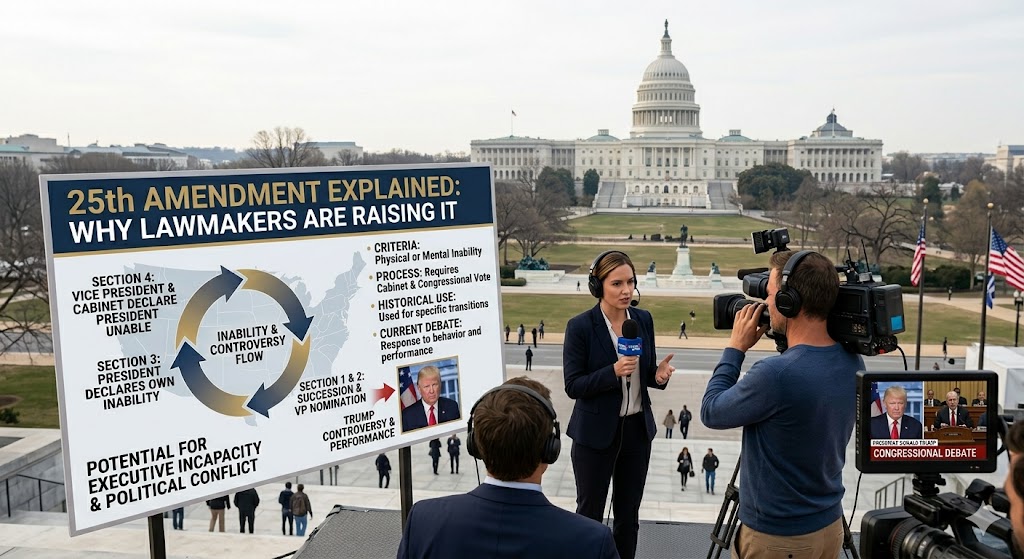


Rising Political Pressure and the 25th Amendment Debate
The 25th Amendment has suddenly returned to the center of American political debate as lawmakers question the leadership of President Donald Trump amid escalating tensions with Iran.
Recent decisions tied to military actions and strong rhetoric have triggered sharp reactions from political leaders, legal experts, and international observers. Some lawmakers have openly suggested that the 25th Amendment could be considered if concerns over presidential decision-making continue to grow.
The discussion around the 25th Amendment is not new, but it is rare. It represents one of the most serious constitutional mechanisms available in the United States—designed for moments when a president may be unable to perform their duties.
This situation has reignited public interest in what the 25th Amendment actually is, how it works, and whether it could realistically be used.
What Is the 25th Amendment?
The 25th Amendment to the U.S. Constitution was ratified in 1967. It was created to clarify presidential succession and establish procedures for dealing with situations in which a president is unable to fulfill their responsibilities.
Before the 25th Amendment, there was confusion about what should happen if a president became incapacitated. Historical incidents, including the assassination of President John F. Kennedy, highlighted the urgent need for clear rules.
The 25th Amendment addresses these concerns by outlining four key sections:
- Transfer of power if the president dies or resigns
- Appointment of a new vice president
- Temporary transfer of power
- Permanent or contested removal due to incapacity
Among these, Section 4 of the 25th Amendment is the most controversial—and the most relevant in today’s debate.
Section 4: The Most Powerful Provision
Section 4 of the 25th Amendment allows the vice president and a majority of the Cabinet to declare that the president is unable to discharge the powers and duties of the office.
If invoked, power is immediately transferred to the vice president, who becomes acting president.
This part of the 25th Amendment was designed as a safeguard for extreme situations. It is not intended for political disagreements but for cases involving serious incapacity—whether physical or mental.
The process under the 25th Amendment is complex:
- The vice president and Cabinet submit a written declaration
- The president can contest the claim
- Congress may be required to vote
- A two-thirds majority in both chambers is needed to uphold removal
Because of these high thresholds, the 25th Amendment is difficult to use and has never been applied in this manner.
Why Lawmakers Are Mentioning the 25th Amendment Now
Calls to consider the 25th Amendment have emerged following controversial statements and military actions tied to the Iran conflict.
Some lawmakers argue that recent decisions raise serious concerns about judgment and stability. Critics have expressed fears about escalation, global consequences, and humanitarian risks.
One prominent voice, Chris Murphy, publicly questioned whether the 25th Amendment should be considered, emphasizing the potential dangers of continued escalation.
These statements reflect growing unease within certain political circles. However, it is important to note that raising the 25th Amendment does not mean it will be used.
The discussion itself signals the seriousness of the moment.
Historical Context of the 25th Amendment
The 25th Amendment has been used several times—but almost always voluntarily.
For example, presidents have temporarily transferred power during medical procedures requiring anesthesia. In these cases, the vice president briefly served as acting president before power was returned.
However, Section 4 of the 25th Amendment, which involves involuntary action, has never been used in U.S. history.
This underscores how extraordinary such a move would be.
The rarity of the 25th Amendment’s use highlights its role as a last-resort mechanism.
# Political and Legal Challenges
Invoking the 25th Amendment would face significant political and legal obstacles.
First, it requires cooperation from the vice president and Cabinet—individuals typically chosen by the president.
Second, even if initiated, the president can challenge the decision. This would trigger a constitutional process involving Congress.
Securing a two-thirds majority in both the House and Senate is extremely difficult, especially in a politically divided environment.
Because of these hurdles, the 25th Amendment is often discussed but rarely considered a realistic outcome.
Public Reaction and Global Implications
The renewed focus on the 25th Amendment has sparked widespread public debate.
Supporters argue that it provides an essential safeguard for democracy. Critics warn that using the 25th Amendment in a political context could set a dangerous precedent.
Internationally, the discussion has added another layer of uncertainty. Allies and adversaries alike are closely watching developments in Washington.
Political stability in the United States has global implications, particularly during times of conflict.
The 25th Amendment, therefore, is not just a domestic issue—it is part of a broader geopolitical narrative.
What Happens Next?
At this stage, the 25th Amendment remains a topic of discussion rather than action.
There has been no formal move to invoke it. However, continued developments in the Iran situation could influence political dynamics.
Lawmakers may continue to raise the 25th Amendment as a way to express concern or apply pressure.
Ultimately, whether the 25th Amendment becomes more than a talking point will depend on political will, legal interpretation, and unfolding events.
# Final Thoughts
The 25th Amendment stands as one of the most powerful yet least-used tools in the U.S. Constitution.
Its mention in current political discourse reflects the seriousness of the moment, but also the high bar required for its use.
While calls for invoking the 25th Amendment have gained attention, the path to actual implementation remains steep and uncertain.
For now, the 25th Amendment serves as a reminder of the constitutional safeguards designed to protect leadership continuity—and the stability of governance during times of crisis.