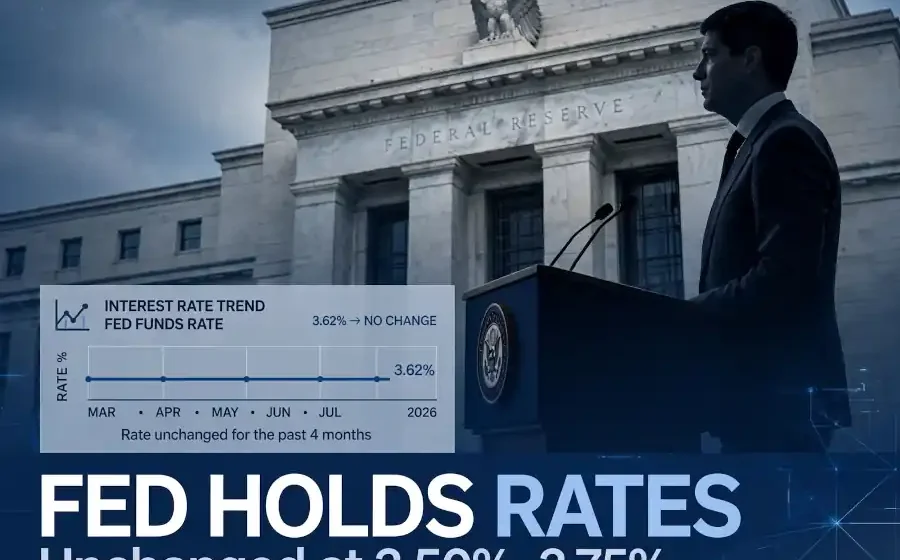
Fed Meeting Today: Rates Remain Unchanged Under Chairman Kevin Warsh Amid Persistent Inflation

Federal Reserve Holds Interest Rates Steady as Dissenting Votes Highlight Internal Inflation Debate
WASHINGTON: In a closely watched policy decision that capped off intense Wall Street debate, the Federal Reserve announced Wednesday that it will maintain its key benchmark interest rate at 3.50% to 3.75%. The decision keeps short-term borrowing costs at their current levels for the fifth consecutive meeting.
The meeting marked only the second Federal Open Market Committee (FOMC) gathering led by Federal Reserve Chairman Kevin M. Warsh since he assumed the role. The outcome put an end to speculative bets that the central bank might deliver an unexpected quarter-point rate hike to demonstrate its commitment to curbing inflation under new leadership.
Three Regional Fed Presidents Push for an Immediate Rate Increase
The central bank’s choice to remain on hold was not unanimous. Three regional Federal Reserve Bank presidents formally dissented, voting instead for a 25-basis-point interest rate hike:
-
Beth Hammack (Federal Reserve Bank of Cleveland)
-
Neel Kashkari (Federal Reserve Bank of Minneapolis)
-
Lorie Logan (Federal Reserve Bank of Dallas)
The three-way split highlights significant division within the committee on how to manage persistent inflation risks alongside an resilient U.S. employment market and shifting global commodity prices.
┌───────────────────────────────────────────────────────────────────────────┐
│                     FOMC JULY 2026 POLICY DECISION                        │
├──────────────────────────┬────────────────────────────────────────────────┤
│ Target Benchmark Rate    │ 3.50% – 3.75% (Unchanged)                      │
│ Committee Decision       │ Hold Rates Steady                              │
│ Dissenting Votes         │ 3 (Hammack, Kashkari, Logan favored +25 bps)   │
│ Chairman Presiding       │ Kevin M. Warsh (Second FOMC Meeting)           │
│ Next Scheduled Meeting   │ September 2026                                 │
└──────────────────────────┴────────────────────────────────────────────────┘
Chairman Warsh has actively encouraged vigorous debate inside the room, urging officials to engage in open dialogue before finalising policy positions. That approach, combined with Warsh’s firm refusal to provide traditional forward guidance on future rate paths, created significant uncertainty in financial markets leading up to Wednesday’s decision.
Since taking office as central bank chief, Warsh has emphasised an unyielding commitment to returning inflation to the Fed’s 2% target.
However, Warsh’s deliberate policy shift away from signalling explicit future rate trajectories means investors must rely entirely on incoming economic data rather than central bank hints.
                Fed Policy Balancing Act
                           │
      ┌────────────────────┴────────────────────┐
      ▼                                         ▼
Inflation Pressures                      Economic Factors
• Elevated Core Services Inflation       • Resilient Domestic Employment
• Fluctuating Oil & Commodity Costs      • Broader Technology Investments (AI)
• Target Rate Above 2% Benchmark         • Financial Market Volatility
While recent consumer price index (CPI) reports showed signs of moderation, volatile energy markets continue to complicate the Fed’s outlook. Resurgences in crude oil prices driven by renewed Middle East hostilities threaten to pass through into broader consumer costs. While the Fed typically looks past temporary energy spikes, prolonged geopolitical tensions increase the risk that supply-side price pressures linger.
Financial Market Reaction and Investor Focus
Financial markets experienced heightened activity following the 2:00 p.m. ET announcement.
-
Equity Markets: Major stock indices trended lower as traders digested the three hawkish dissents against the decision to stand pat.
-
Bond Yields: U.S. Treasury yields rose slightly, reflecting investor expectations that a rate hike remains possible later this year.
-
Energy Commodities: Oil prices traded higher amid broader supply chain concerns.
“The decision to hold rates steady gives the committee time to gather more data before their September meeting,” market strategists noted following the release. “The key signal for investors now lies in Chairman Warsh’s press conference comments and whether he keeps a rate hike on the table for autumn.”
What Comes Next: The September Meeting
By holding the benchmark interest rate in the 3.50% to 3.75% range, the Federal Reserve gains additional time to evaluate key economic data releases over the late summer.
| Key Upcoming Milestones | Expected Economic Inputs |
| August Economic Data | Non-Farm Payrolls, Core CPI, and PCE Price Deflator readings |
| Jackson Hole Symposium | Annual gathering of global central bankers |
| September FOMC Meeting | Policy decision accompanied by updated economic projections |
With three voting members already calling for tighter monetary policy, all eyes now focus on the upcoming September FOMC meeting. Unless upcoming inflation and employment data show sustained, broad-based cooling, a potential rate increase remains a distinct possibility before the end of the year.