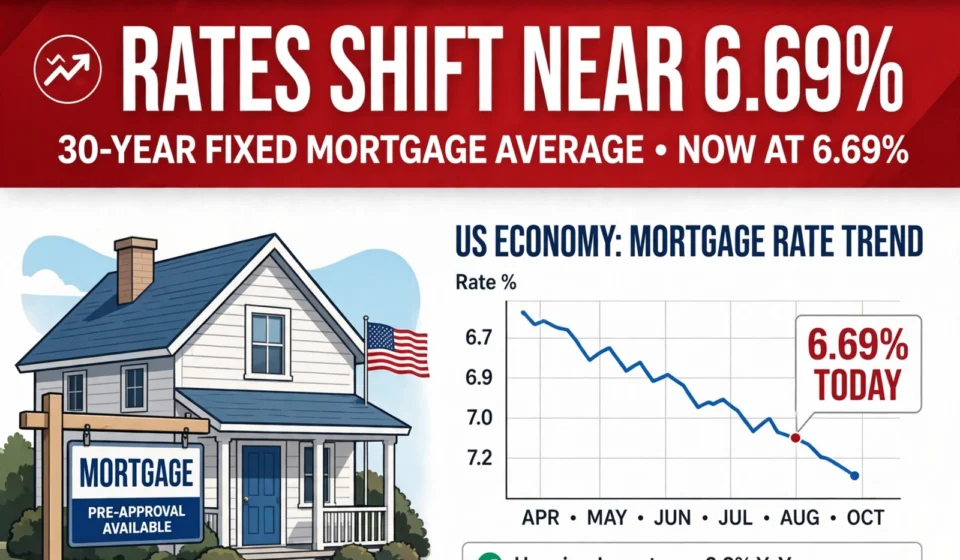

America Business News : The broader USA economy is navigating a critical transition as shifting interest rate forecasts reshape borrowing costs, home buying trends, and real estate market dynamics. Housing affordability remains a dominant topic across financial markets, with prospective homebuyers and existing homeowners watching daily rate adjustments closely. According to tracking from Mortgage News Daily and Freddie Mac data, the benchmark 30-year fixed mortgage rate recently hovered near 6.69%, influencing monthly payment calculations nationwide.
Federal Reserve Policy Shifts and Housing Market Dynamics
Subdued consumer and wholesale inflation readings have fueled active speculation regarding upcoming Federal Reserve monetary policy decisions. Money markets have adjusted interest rate projections, weighing whether central bank officials will pause or adjust borrowing benchmarks in late 2026. Because mortgage rates track ten-year Treasury yields closely, shifts in macroeconomic sentiment spill over immediately into domestic real estate markets.
Home purchase applications showed a modest 3% weekly uptick despite elevated borrowing costs, reflecting persistent underlying buyer demand. However, total existing home sales fell 1.7% month-over-month as record median home prices of $434,100 create affordability barriers for first-time buyers. High interest rates have also created a pronounced lock-in effect, keeping low-rate mortgage holders from listing their properties.
Benchmark 30-Year Fixed Rate:    6.69% (Up from 6.66% prior week)
Benchmark 15-Year Fixed Rate:    6.01% (Down from 6.04% prior week)
U.S. Median Existing Home Price: $434,100 (Up 2.0% Year-over-Year)
Typical Monthly Mortgage Payment: $2,626 (Median estimate)
As broader economic indicators stabilize, institutional investors and mortgage lenders are re-evaluating risk exposure across conventional and government-backed loan products. Borrowers who locked in record-low borrowing rates during previous years remain reluctant to trade up, maintaining low housing inventory levels across major metropolitan areas.
-
Inventory Constraints: Active listings remain constrained as homeowners hold onto sub-5% legacy fixed mortgages.
-
Regional Price Variance: High-demand markets in Florida and the East Coast see steady price gains, while select West Coast metros experience slight price cooling.
-
Refinance Activity: Refinancing demand remains suppressed, with activity primarily driven by necessity or cash-out debt consolidation strategies.
Loan Types Comparison and Affordability Breakdown
Selecting the right loan structure plays a decisive role in long-term financial planning during periods of rate volatility. Buyers comparing conventional fixed loans, shorter-term products, and adjustable-rate mortgages must evaluate upfront costs alongside long-term interest rate risk.
| Loan Product Type | Current Average Rate | Target Borrower Profile | Strategic Advantage |
| 30-Year Fixed Mortgage | 6.69% | Long-term primary homebuyers | Predictable monthly housing payment |
| 15-Year Fixed Mortgage | 6.01% | Accelerated equity builders | Substantially lower lifetime interest expense |
| 5/1 Adjustable-Rate (ARM) | 5.85% (Est.) | Short-term owners / relocation buyers | Lower initial interest rate and initial monthly costs |
| Jumbo Fixed Mortgage | 6.80% (Est.) | High-value property purchasers | Higher borrowing limits for luxury real estate |
While 30-year fixed-rate products remain the dominant choice for U.S. households, adjustable-rate mortgage (ARM) share has edged upward among non-conforming, higher-value loans where initial payment savings are substantial.
Macroeconomic Drivers Shaping Future Borrowing Costs
Several core economic forces dictate daily mortgage rate fluctuations across primary and secondary lending channels. Understanding these underlying drivers helps consumers time mortgage applications and rate lock decisions effectively.
-
Treasury Yield Fluctuations: Benchmark 10-year Treasury bond yields serve as the foundational pricing mechanism for fixed-rate mortgages.
-
Inflation Trends: Declining wholesale (PPI) and consumer (CPI) inflation rates reduce bond market risk premiums, supporting lower borrowing costs.
-
Federal Reserve Balance Sheet Operations: Mortgage-backed securities (MBS) purchasing or runoff policy directly impacts liquidity in secondary loan markets.
When inflation cools consistently, long-term bond yields tend to moderate, offering eventual relief to consumer borrowing channels.
Frequently Asked Questions
How do daily mortgage rate shifts impact homebuyer purchasing power?
Every 0.5% shift in mortgage interest rates changes a buyer’s purchasing power by roughly 4% to 5%. For a median-priced home, even small percentage moves alter monthly principal and interest obligations by over a hundred dollars.
Is now a good time to buy a house, or should buyers wait for rates to fall?
Waiting for lower interest rates carries the risk that rising home prices could offset potential interest savings. Many financial advisors suggest buying when personal finances are ready and refinancing later if rates decline significantly.
What is the lock-in effect in the U.S. housing market?
The lock-in effect occurs when current homeowners with existing 3% to 4% mortgage rates choose not to sell their homes because moving would require taking on a significantly higher rate. This restricts available housing inventory across the market.
Financial Tools and Housing Market Discussion Links
Stay informed with live financial market tracking and housing data through these verified industry resources:
-
Monitor live economic trends and index updates on Google Search Financial Trends.
-
Join active housing market discussions on the NT Live News Community Forums.
-
Review mortgage concepts and lending terminology on the Wikipedia Mortgage Loan Reference.
Navigating the U.S. economy and housing market requires a clear understanding of borrowing costs, property valuations, and macroeconomic trends. By tracking daily rate movements, assessing loan options carefully, and maintaining sound personal financial metrics, prospective buyers and homeowners can make confident real estate decisions in any interest rate environment.