Medicare Part D Shifts in 2027 | Trump Administration Ends Subsidy Program, Paving Way for Premium Adjustments

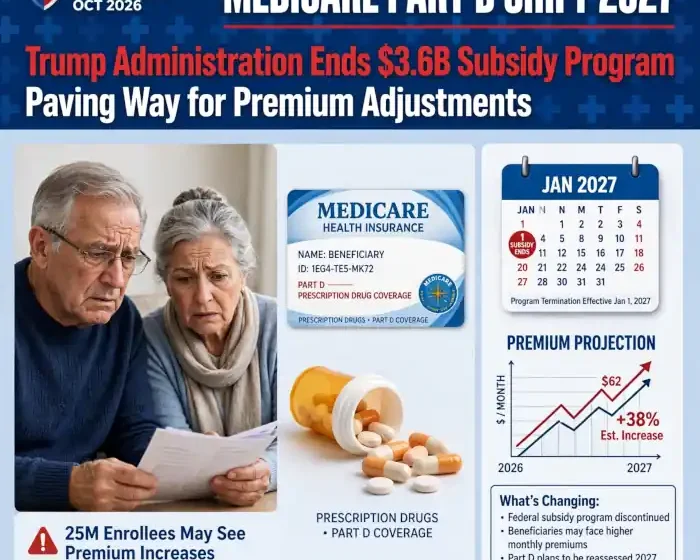
WASHINGTON: Millions of older and disabled Americans relying on Medicare Part D prescription drug plans could face changes to their monthly premiums in 2027. The Biden-era subsidy demonstration, designed to shield seniors from abrupt cost increases following major federal healthcare overhauls, will officially terminate at the end of 2026, the Centres for Medicare & Medicaid Services (CMS) announced.
The policy shift removes a multi-billion-dollar federal buffer that directly subsidised private insurance companies to keep standalone prescription drug plan (PDP) rates artificially low. While administrative officials argue that private insurers no longer require government support to price their plans accurately, health policy analysts and consumer advocacy groups warn that the change could lead to noticeable rate increases for millions of beneficiaries enrolled in standalone drug coverage.
The Policy Clash: “Bailout” vs. Market Stability
The decision marks a sharp pivot in federal healthcare management, pitting market-driven stabilisation efforts against fiscal conservative oversight.
The subsidy—formally known as the Part D Premium Stabilisation Demonstration—was launched in 2024 to counteract volatility caused by the 2022 Inflation Reduction Act (IRA). The IRA placed a historic $2,000 annual cap on out-of-pocket prescription drug costs for Medicare beneficiaries, shifting significant financial risk away from seniors and onto private insurance plans and pharmaceutical manufacturers.
Fearing that insurers would respond to this liability shift by spiking monthly premiums, federal regulators introduced direct taxpayer-funded subsidies to offset costs for insurers that agreed to cap annual premium increases.
┌───────────────────────────────────────────────────────────────────────────┐
│              PART D PREMIUM STABILIZATION DEMONSTRATION                   │
├────────────────────────────┬──────────────────────────────────────────────┤
│ Program Inception          │ Launched in 2024 (First active year: 2025)   │
│ Federal Cost               │ $9.8 Billion total across 2025 and 2026      │
│ Direct Insurer Subsidy     │ Reduced base premiums ($15 in 2025; $10 in '26) │
│ Premium Increase Cap       │ Capped monthly jumps ($35 in 2025; $50 in '26) │
│ Termination Date           │ Dec. 31, 2026 (No federal subsidy for 2027)  │
└────────────────────────────┴──────────────────────────────────────────────┘
The Trump administration firmly rejected the premise of the program, framing it as an unwarranted taxpayer-funded windfall for private managed care corporations.
“The Biden admin gave billions of taxpayer money directly to big insurance companies. This is unacceptable,” said CMS Administrator Dr. Mehmet Oz in a public statement. “We are stabilizing the market so this bailout is no longer needed.”
Oz added that CMS’s review of preliminary 2027 insurance bids revealed that private health plans have gained sufficient operational experience under the new IRA framework to price their drug coverage independently without federal backstops.
Consumer Reviews
The termination of the subsidy leaves roughly 25 million Americans enrolled in standalone Medicare Part D plans navigating a new cost landscape.
Federal health officials contend that market competition will prevent severe price shocks. According to administrative projections, approximately half of all Medicare Part D recipients will see monthly premium adjustments of less than $10, with some beneficiaries even seeing rate reductions. Furthermore, officials emphasise that low-cost plans priced at or below $10 per month will remain accessible across most geographic regions.
                Medicare Part D Cost Drivers for 2027
                                   │
      ┌────────────────────────────┴────────────────────────────┐
      ▼                                                         ▼
Cost Containment Factors                               Upward Rate Pressures
• Insurers adapt to $2,000 spending caps               • Removal of $16/mo average federal subsidy
• Broader access to low-cost generics                  • Rising utilization of expensive specialty drugs
• Targeted programs (e.g., $50/mo GLP-1 access)        • Cost-shifting under IRA risk frameworks
However, independent health policy research paints a more complex picture. Analysts at KFF (formerly the Kaiser Family Foundation) note that the stabilisation program reduced average monthly standalone PDP premiums by an estimated $26 in 2025 and $16 in 2026. Without those government offsets built into the baseline math, insurers may pass those underlying costs back to enrollees.
Potential Premium Divergence
While actual 2027 plan prices will not be finalised until autumn, healthcare economists anticipate a widening gap between different Medicare coverage choices:
-
Standalone Part D Plans (PDPs): Seniors who maintain Traditional Medicare alongside a separate prescription plan face the highest exposure to premium hikes. Some enrollees in higher-tier plans could see monthly rate increases ranging between $10 and $20.
-
Medicare Advantage with Prescription Drug Coverage (MA-PD): Beneficiaries enrolled in bundled Medicare Advantage plans are likely to experience far less volatility. Medicare Advantage sponsors can utilise extra federal rebate dollars from medical coverage to subsidise their drug plans, keeping average drug premiums near historical lows.
Focus Drug Coverage
The removal of the stabilisation subsidy occurs alongside broader structural shifts in drug pricing and utilisation. While the $2,000 annual out-of-pocket cap provides significant financial relief to seniors with complex chronic conditions or high-cost cancer medications, overall drug plan costs continue to face pressure from:
-
Surging Speciality Drug Demand: High-cost biologic therapies and speciality treatments represent a growing share of total Part D expenditures.
-
GLP-1 Expansion: The expanding use of weight-loss and diabetes treatments—such as GLP-1 receptor agonists—has increased spending across public and private health plans.
-
Reinsurance Shift: Under the restructured benefit design, Medicare plans bear a much higher share of costs in the catastrophic coverage phase, forcing insurers to adjust their underlying risk models.
| Coverage Type | Estimated Average Monthly Drug Premium (2026) | Projected 2027 Trend Line |
| Standalone Part D (PDP) | ~$36 / month | Upward pressure due to subsidy removal |
| Medicare Advantage (MA-PD) | ~$8 / month | Stable; buffered by Medicare Advantage rebates |
What Beneficiaries Should Do Next
The announcement serves as an early signal for Medicare beneficiaries to prepare for the upcoming Fall Open Enrollment season. CMS will publish official 2027 plan options, specific premium amounts, and formulary changes in late September.
Healthcare navigators recommend that seniors take three proactive steps:
-
Audit Current Prescription Lists: Document all active medications, dosages, and preferred pharmacies.
-
Compare Standalone vs. Bundled Options: Evaluate whether switching between Traditional Medicare with a PDP and Medicare Advantage offers better overall financial protection.
-
Review Annual Notices of Change (ANOC): Review the formal plan notices mailed every September to check for premium increases, changes to copay tiers, or alterations to covered drug lists.