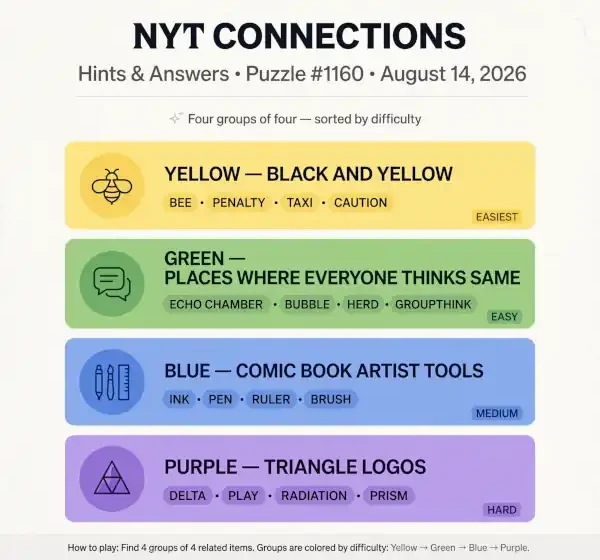

Mastering the daily word grid requires sharp pattern recognition, vocabulary depth, and an eye for clever red herrings. If today’s puzzle for Friday, August 14, 2026 (#1160) has you stumped, you are not alone. Today’s NYT Connections puzzle presents an intriguing mix of pop culture references, drawing supplies, visual logo motifs, and sociological terminology. Whether you need subtle directional nudges or the full category solutions, this expert guide breaks down every grouping so you can preserve your winning streak.
Deciphering the August 14 Connections Clues and Categories
The New York Times Connections puzzle challenges players to organise 16 random words into four distinct groups of four based on hidden association rules. The difficulty ranges from Yellow (easiest) to Purple (most obscure or tricky).
-
Yellow Group Hint: Think about distinct objects, iconic cartoon characters, comic superheroes, or warning signs defined by a striking two-tone colour scheme.
-
Green Group Hint: These terms represent insulated spaces, social bubbles, or ideological environments where dissenting opinions are filtered out and conformity reigns.
-
Blue Group Hint: Specialised physical art supplies, paper types, and drafting instruments traditionally used by illustrators and graphic artists to create comic books.
-
Purple Group Hint: Iconic corporate brand marks, digital app icons, or commercial emblems that prominently feature a three-sided geometric shape.
Full Solution Grid and Category Breakdown for Game #1160
For players ready to verify their answers or unlock a stuck board, here is the complete solution list for NYT Connections puzzle #1160:
| Category Level | Category Name | Included Words & Terms |
| Yellow (Easiest) | Black-and-Yellow | BUMBLEBEE, CAUTION TAPE, CHARLIE BROWN, WOLVERINE |
| Green (Medium) | Places Where Everyone Thinks the Same Ways | BUBBLE, ECHO CHAMBER, HIVEMIND, SILO |
| Blue (Hard) | Comic Book Artist’s Tools | BRISTOL BOARD, DIP PEN, INDIA INK, STRAIGHTEDGE |
| Purple (Tricky) | Triangle Logos | BASS ALE, CITGO, DELTA AIRLINES, GOOGLE DRIVE |
Tricky Red Herrings and Overlapping Themes in Today’s Puzzle
Word constructor Wyna Liu embedded several clever overlaps in today’s grid designed to lure players into false sub-groupings:
-
The NATO Phonetic Alphabet Trap: Words like CHARLIE BROWN, DELTA AIRLINES, ECHO CHAMBER, and INDIA INK all begin with terms from the official NATO phonetic alphabet (Charlie, Delta, Echo, India).
-
The Fictional Character Trap: BUMBLEBEE (from Transformers), CHARLIE BROWN, and WOLVERINE (from X-Men) form a strong initial cluster of pop culture figures. However, recognising that CAUTION TAPE shares their iconic black-and-yellow colour scheme resolves the true yellow group.
-
The Digital & Enterprise Trap: GOOGLE DRIVE might tempt players to look for cloud software or tech tools alongside SILO or ECHO CHAMBER, but its triangular logo places it firmly in the Purple category.
Frequently Asked Questions About NYT Connections #1160
What is the hardest group in NYT Connections?
The Purple category is traditionally considered the most obscure or abstract group. It frequently relies on wordplay, missing letters, shared visual features (like triangle brand logos), or second-half compound word connections.
How do I improve my score on daily word puzzles?
Start by scanning for candidate words that fit multiple interpretations before submitting your first guess. Group obvious four-word clusters mentally, check for false friends or partial associations, and leave tricky single-word overlap candidates for last.
Strategic Takeaways for Solving Word Grid Games
Consistently solving daily Connections puzzles comes down to patience and tactical deduction. When stuck on an ambiguous set of words, step back and look for visual patterns, shared brand characteristics, or specialised industry tools rather than literal dictionary definitions. Isolating straightforward categories like the colour association in today’s Yellow group clears space on the board, making hidden relationships in Blue and Purple much easier to spot. Explore strategies and share daily puzzle times with fellow word enthusiasts on the NTLiveNews Forums, read about the history of word games on the Wikipedia Connections Word Game Guide, or research historical puzzle archives using Google Search.