
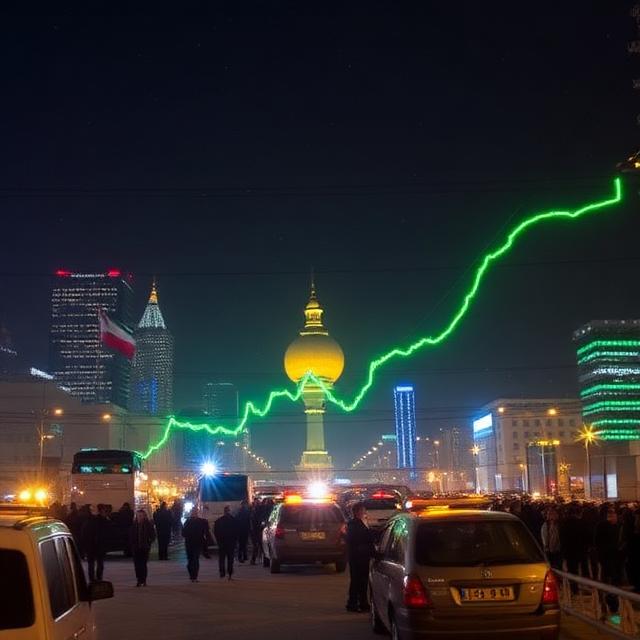
Unprecedented Surge: Iran’s Gold and Currency Markets Shatter Records on December 28, 2025
TEHRAN — The Iranian financial markets witnessed an extraordinary and historic “tsunami” on Sunday, December 28, 2025 (7 Dey 1404), as the prices of gold, benchmark coins, and major foreign currencies vaulted to new, staggering heights. In a single day of volatile trading, the Emami Gold Coin surged by over 6.7 million tomans, crossing the psychological threshold of 165 million tomans, a move that has left investors and the general public in a state of shock.
The domestic market’s rally comes amid a confluence of geopolitical anxieties, a tightening “maximum pressure” campaign from Washington, and a domestic economy struggling with a persistent budget deficit. As of this morning, 18-karat gold—the standard for the Iranian jewelry market—is trading at 15,748,000 tomans per gram, reflecting a massive daily increase of 402,000 tomans.
A Breakdown of Sunday’s Market Performance
The velocity of the price increases across all gold and currency categories has reached a pace rarely seen in the Tehran bazaar. Below is a detailed look at the closing rates for the day:
Gold and Coin Market
The coin market led the charge, with “bubbles”—the difference between the intrinsic value of the gold and the market trading price—expanding significantly as demand for safe-haven assets spiked.
| Asset Type | Current Price (Toman) | Daily Change |
| Gold 18-Karat (per gram) | 15,748,000 | +402,000 |
| Emami Gold Coin | 165,660,000 | +6,730,000 |
| Half-Coin (Nim) | 89,010,000 | +2,760,000 |
| Quarter-Coin (Rob) | 54,010,000 | +2,570,000 |
| Gram Coin | 15,230,000 | +500,000 |
Foreign Exchange (Secondary Market)
While the “free market” rates often fluctuate even higher, the official rates in the Secondary Market (Talar-e Dovom) also showed a sharp upward trend, signaling the Central Bank’s difficulty in anchoring the Rial.
- US Dollar: Offered at 119,052 tomans, an increase of 3,402 tomans from the previous session.
- Euro: Sold at 140,165 tomans, rising by 4,094 tomans in a single day.
The Economic Backdrop: Inflation and War Fears
Market analysts point to three primary drivers behind this week’s aggressive rally. First, the geopolitical climate has reached a boiling point. Recent reports regarding the restart of “maximum pressure” policies and uncertainty surrounding regional security have driven Iranians to convert their liquid Rial savings into gold and hard currency.
Second, the structural health of the economy remains a major concern. On the same day these records were shattered, President Masoud Pezeshkian addressed the parliament, acknowledging that the current government budget cannot keep pace with the nation’s soaring inflation. With the economy contracting by roughly 0.6% in the first half of the year, the “Rial’s slide” is increasingly seen as a reflection of dwindling foreign reserves and reduced oil revenues.
“I need to be able to carry my assets with me if I have to leave,” said one trader in Tehran’s Grand Bazaar, echoing a sentiment that has become common among the jittery public. For many, gold is no longer just a luxury; it is a portable survival kit.
The Social Impact
The ripple effects of this surge are being felt across all sectors of society. With 18-karat gold now costing over 15.7 million tomans per gram, labor representatives have noted that a single gram of gold now roughly equals the monthly minimum wage for many Iranian workers. This erosion of purchasing power has raised fears of a deeper cost-of-living crisis as the new year approaches.
As the market enters the final week of December, all eyes remain on the Central Bank of Iran. While officials often attempt to calm the market with promises of currency injections, the sheer scale of Sunday’s jump suggests that market forces—and the fear of further escalation—are currently in the driver’s seat.