
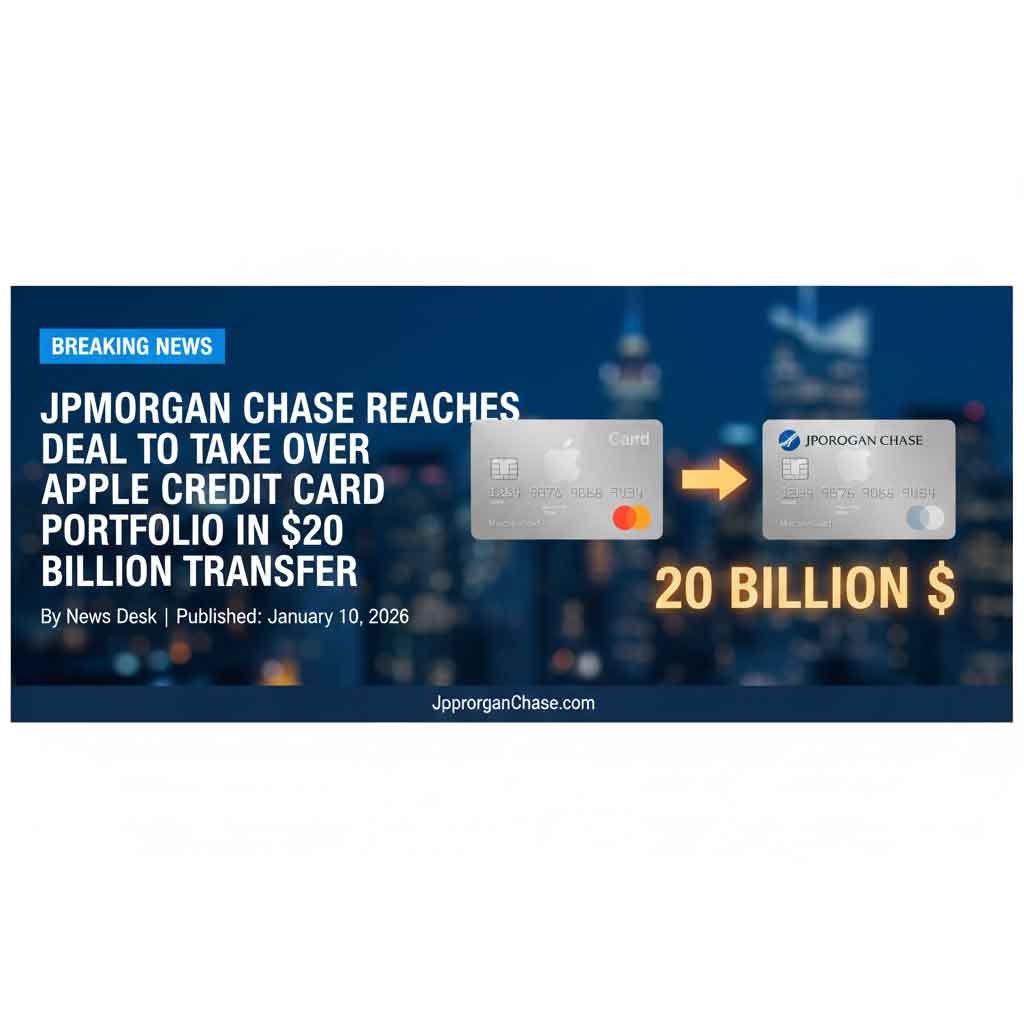
JPMorgan Chase Reaches Deal to Take Over Apple Credit Card Portfolio in $20 Billion Transfer
By News Desk Published: Saturday, January 10, 2026
In a landmark shift for the American financial sector, JPMorgan Chase (JPM) has finalized a deal to become the new issuer of the Apple Card, acquiring the massive credit card portfolio from Goldman Sachs (GS). Announced on January 7, 2026, the agreement effectively ends Goldman’s high-profile but financially turbulent foray into consumer lending while further solidifying JPMorgan’s status as the nation’s dominant credit card powerhouse.
The transition, which involves an estimated $20 billion in outstanding balances, is expected to take approximately 24 months to complete. During this period, Goldman Sachs will continue to manage the daily operations of the card until the full migration to Chase’s platform is finalized, likely by early 2028.
The Fine Print: A $1 Billion Discount and Steep Credit Provisions
While the acquisition brings millions of tech-savvy users into the Chase ecosystem, the financial terms highlight the risks involved. Sources familiar with the matter report that Goldman Sachs is offloading the credit card balances at a discount of more than $1 billion to their par value.
In the world of co-branded credit cards, portfolios typically trade at a premium (often up to 8%). A discount of this magnitude is rare and underscores the portfolio’s “challenging” nature, which includes:
- Higher Delinquency Rates: The Apple Card reportedly has a delinquency rate of roughly 4%, compared to the industry average of 3.05%.
- Subprime Exposure: Under Apple’s pressure to maximize the card’s reach during its 2019 launch, Goldman approved a wider range of lower-credit borrowers than most prime-focused banks typically target.
Reflecting these risks, JPMorgan Chase announced it expects to record a $2.2 billion provision for credit losses in its fourth-quarter 2025 earnings report to account for the forward purchase commitment of the loan book.
Continuity for Cardholders: What Changes?
For the millions of current Apple Card users, the message from both Apple and Chase is one of “business as usual.”
- Seamless Experience: Apple executives stated that users can continue to use their physical and digital cards exactly as they do today. The deep integration with the Apple Wallet app and the “no-fee” structure remain core to the product.
- Daily Cash Rewards: The industry-leading reward system—offering 3% Daily Cash at Apple and select merchants—will stay in place.
- Payment Network: The card will continue to operate on the Mastercard network, ensuring global acceptance is not disrupted.
- New Savings Solution: JPMorgan plans to launch its own Apple-branded savings account. Existing customers with savings accounts at Goldman Sachs will be given the choice to either stay with Goldman or migrate their funds to the new Chase-backed offering.
A Strategic Win for Jamie Dimon
The deal represents a significant strategic victory for JPMorgan CEO Jamie Dimon. Despite previously identifying Apple as a potential competitor in the digital banking space, the partnership allows Chase to embed itself deeper into the lives of Apple’s affluent, digitally engaged customer base.
“Chase shares our commitment to innovation and delivering products that enhance consumers’ lives,” said Jennifer Bailey, Apple’s Vice President of Apple Pay and Apple Wallet. For JPMorgan, the primary value lies in the data and cross-selling opportunities, allowing the bank to pitch mortgages, auto loans, and investment services to a new segment of loyal Apple fans.
The Final Retreat for Goldman Sachs
For Goldman Sachs, the exit marks the “final chapter” of its failed Marcus consumer banking experiment. While the deal is expected to provide a modest 46-cent boost to Goldman’s Q4 2025 EPS (due to the release of $2.48 billion in loan-loss reserves), it comes at the cost of $2.26 billion in lost revenue and contract termination fees.
Goldman CEO David Solomon noted that the move “substantially completes the narrowing of our focus,” as the firm returns to its historical strengths in investment banking and asset management.
Apple Card Issuer Transition: Frequently Asked Questions (FAQ)
The recent announcement that JPMorgan Chase will take over the Apple Card portfolio from Goldman Sachs has raised several questions for the 12 million current cardholders. Below are the most important details regarding the transition.
1. When will the change to Chase happen?
The transition is not immediate. Apple and JPMorgan Chase have announced a phased migration that is expected to take approximately 24 months (completing around early 2028). Until the official transfer date, Goldman Sachs remains the issuer and servicer of your account.
2. Do I need to reapply for my Apple Card?
No. Existing cardholders will not need to reapply. Your account, including your existing credit limit and payment history, will automatically transfer to JPMorgan Chase once the transition is finalized.
3. Will my Daily Cash rewards change?
Apple has confirmed that the core benefits of the Apple Card will remain the same. This includes:
- 3% Daily Cash back on Apple purchases and select merchants (Nike, Uber, etc.).
- 2% Daily Cash on all other Apple Pay purchases.
- 1% Daily Cash on physical card use.
4. What happens to my Apple Savings account?
This is one of the most significant changes. JPMorgan Chase plans to launch its own integrated savings product. When the transition occurs:
- You will likely be given the choice to move your balance to a new Chase-issued Apple Savings account.
- Alternatively, reports suggest you may be able to keep your existing account with Goldman Sachs, though it may no longer be integrated directly with the Apple Wallet “Daily Cash” features.
5. Will I get a new physical titanium card?
While your current card will continue to work, JPMorgan Chase will eventually issue new physical cards. The new cards will likely look identical on the front but will feature the Chase logo and updated legal information on the back, replacing the Goldman Sachs branding.
6. Will the “No Fees” policy remain?
Yes. A central part of the Apple Card’s identity is its lack of annual, late, foreign transaction, or over-limit fees. Both Apple and Chase have signaled their commitment to maintaining this fee structure to ensure a seamless “best-in-class” customer experience.
7. Does the payment network change?
No. Mastercard will remain the exclusive payment network for the Apple Card, ensuring your card continues to be accepted globally at all existing locations.