
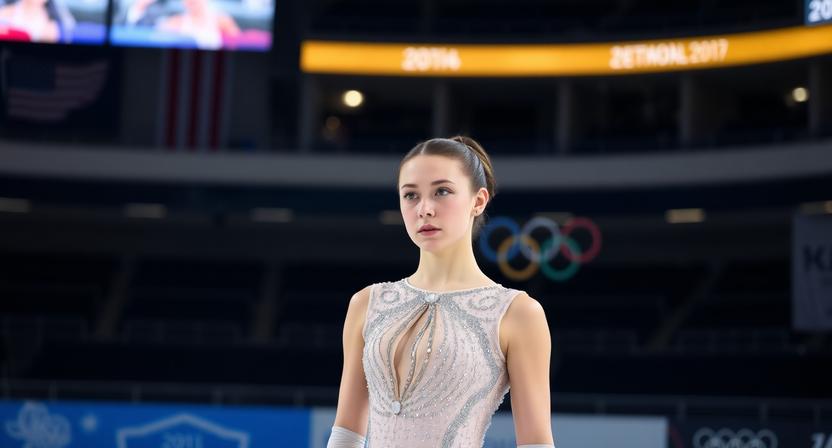
Amber Glenn Breaks Silence on “Scary” Threats Following Political Comments at Winter Games; Announces Social Media Blackout
MILAN — In a sobering development that has cast a shadow over the opening weekend of the 2026 Winter Olympics, U.S. figure skating star Amber Glenn revealed Saturday that she has received a barrage of “scary” threats and hate speech after speaking out about the political climate in the United States. The 26-year-old national champion, who is set to make her historic Olympic debut on Sunday, announced she is stepping back from social media to protect her mental health as she prepares to take the ice.
The controversy erupted following a press conference earlier this week in Milan, where Glenn—the first openly queer woman to represent the United States in Olympic singles skating—responded candidly to questions regarding the Trump administration’s policies and their impact on the LGBTQ+ community. Her remarks, intended to offer hope and solidarity to marginalized groups back home, instead ignited a firestorm of vitriol that has followed her across the Atlantic.
“Politics Affects Us All”
The incident began on Wednesday, February 4, when Glenn sat alongside her teammates at the Main Press Center in Milan. While most questions focused on triple axels and program components, a reporter asked Glenn how she felt representing the U.S. given the current administration’s stance on LGBTQ+ rights.
Glenn, known for her authenticity both on and off the ice, did not shy away from the question.
“I know that a lot of people will say, ‘You’re just an athlete, stick to your job and shut up about politics,’ but politics affects us all,” Glenn told the assembled media. “It’s something that I will not just be quiet about, because it is something that affects us in our everyday lives. It’s been a hard time for this community overall, and under this administration, it is the first time that we’ve had to come together as a community and fight for our human rights in this way.”
She continued, “I hope I can use my platform and my voice throughout these games to try and encourage people to stay strong in these hard times. So of course there are things that I disagree with, but as a community, we are strong and we support each other, and brighter days are ahead of us.”
The comments were widely reported, resonating with many fans who view Glenn as a trailblazer. However, in the hyper-polarized political environment of 2026, they also made her a target.
A Wave of Hate
By Saturday, the backlash had escalated from criticism to genuine menace. In a statement posted to her Instagram Stories, Glenn addressed the situation directly, her tone a mix of defiance and vulnerability.
“When I chose to utilize one of the amazing things about the United States of America—freedom of speech—to convey how I feel as an athlete competing for Team USA in a troubling time for many Americans, I am now receiving a scary amount of hate and threats for simply using my voice WHEN ASKED about how I feel,” Glenn wrote.
She admitted that while she wasn’t entirely surprised by the negative reaction, the intensity and violent nature of the messages were jarring.
“I did anticipate this, but I’m disappointed by it,” she continued. “I will be limiting my time on social media for my own wellbeing for now, but I will never stop using my voice for what I believe in.” She signed the message with a white heart emoji and “Xoxo,” a signature touch of grace from an athlete under siege.
U.S. Figure Skating and the U.S. Olympic & Paralympic Committee (USOPC) have reportedly been made aware of the threats. A spokesperson for the USOPC stated, “The safety and well-being of our athletes is our top priority. We are monitoring the situation closely and providing Amber with all necessary support, including security and mental health resources.”
The Burden of Representation
Glenn’s experience highlights the unique and often heavy burden placed on athletes from marginalized communities. Unlike many of her peers who can focus solely on their sport, Glenn arrived in Italy carrying the weight of history.
When she steps onto the ice at the Mediolanum Forum on Sunday to compete in the women’s free skate for the team event—substituting for teammate Alysa Liu—she will become the oldest American woman to make her Olympic singles debut in nearly a century. More significantly, she will be the first openly queer woman to ever compete for Team USA in the discipline at the Games.
For years, figure skating has been a sport of rigid aesthetics and conservative traditions. Glenn has shattered those molds, not just with her powerful jumps—she is one of the few women to land a triple axel in competition—but with her unapologetic identity. She came out publicly as bisexual and pansexual in 2019, a decision she has described as liberating.
“For a long time, I felt like I had to fit into this box of what a ‘ice princess’ should be,” Glenn said in a 2025 interview. “Breaking out of that, being my authentic self, actually made me a better skater. I wasn’t hiding anymore.”
In Milan, she has embraced her role as an ambassador. She has been seen in the Olympic Village handing out pins adorned with the Progress Pride flag and her personal slogan, “Believe + Breathe.”
“It’s to show representation for my community,” Glenn told a local news outlet in St. Louis before departing for Italy. “I want to continue to normalize having queer people in these spaces, that we can be some of the top athletes in the world and be ourselves while doing so.”
A Tense Atmosphere in Milan
The hostility directed at Glenn is not happening in a vacuum. The 2026 Winter Games have opened against a backdrop of geopolitical tension and domestic American strife that has spilled over into the sporting arena.
On Friday night, during the Opening Ceremony at San Siro stadium, U.S. Vice President JD Vance was met with a chorus of boos from the international crowd when shown on the stadium’s giant screens. The negative reception was linked to the administration’s controversial foreign policies and trade disputes with European allies.
Furthermore, the presence of U.S. Immigration and Customs Enforcement (ICE) agents as part of the American security detail in Italy has sparked protests in Milan and Rome. Demonstrators have waved placards reading “ICE Not Welcome” and “No Militias in Milan,” creating an uneasy environment for the American delegation.
Glenn is not the only Team USA athlete grappling with these complexities. Freestyle skiers Hunter Hess and Chris Lillis also made headlines this week for expressing “mixed emotions” about wearing the flag.
“It brings up mixed emotions to represent the U.S. right now I think,” Hess said in a candid moment with reporters. “There’s obviously a lot going on that I’m not the biggest fan of… I think for me, it’s more I’m representing my friends and family back home, the people that represented it before me, all the things that I believe are good about the United States.”
Lillis echoed those sentiments, referencing the protests against ICE. “I feel heartbroken about what’s happened in the United States,” he said. “I think that as a country, we need to focus on respecting everybody’s rights… And I hope that when people look at athletes competing in the Olympics, they realize that that’s the America that we’re trying to represent.”
While Hess and Lillis received pushback from conservative pundits, the vitriol directed at Glenn appears to be more personal and identity-based, following a disturbing pattern of online harassment targeting LGBTQ+ public figures.
Mental Health First
Glenn’s decision to step away from social media is a strategic move to preserve her competitive focus, but it also underscores the growing conversation around athlete mental health.
Since Simone Biles withdrew from events at the Tokyo Olympics in 2021 to prioritize her mental well-being, American athletes have become increasingly vocal about the psychological toll of elite competition. Glenn has been a leader in this space as well. She has spoken openly about her past struggles with depression and eating disorders, detailing how neurotherapy and sports psychology helped her rebuild her career after she nearly walked away from the sport in 2022.
“I realized that even if I come out of here and never skate again, I know I have the opportunity to still make a good life for myself,” she told Time magazine regarding a stay at a mental health treatment facility. “It got me out of that spiral.”
Now, facing a different kind of pressure—digital abuse rather than internal doubt—Glenn is applying those same lessons. By setting a boundary with social media, she is reclaiming her agency.
“It’s a protective measure,” said Dr. Sarah Vinson, a sports psychologist not treating Glenn but familiar with the pressures of the Games. “When an athlete is in the Olympic village, the phone is their connection to the world. If that connection becomes a source of threat and trauma, cutting it off is the healthiest thing they can do to remain performance-ready.”
The Competition Ahead
Despite the turmoil, Glenn remains a critical piece of Team USA’s medal hopes. Her inclusion in the team event’s free skate is a testament to her consistency and explosive power. With the U.S. team currently sitting in medal contention, Glenn’s performance on Sunday will be pivotal.
She is known for her high-risk, high-reward style. Her free skate, set to a hauntingly beautiful contemporary piece, features the triple axel—a jump that, if landed cleanly, sets her apart from most of the field.
Her coach, Damon Allen, expressed confidence in her ability to compartmentalize. “Amber is a fighter,” Allen said on Saturday. “She has been through so much to get here. Injuries, doubts, pandemic disruptions. This is just another hurdle. Once the music starts, she knows what to do.”
Fellow skaters have also rallied around her. Alysa Liu, the 20-year-old former world medalist who is also on the team, posted a photo of the two of them with the caption, “We got your back.”
A “shut up and dribble” Moment?
The backlash against Glenn reignites the age-old debate about the role of politics in sports. The “shut up and dribble” narrative—famously leveled at NBA superstar LeBron James—suggests that athletes forfeit their right to political expression in exchange for their platform.
However, the International Olympic Committee (IOC) has slowly softened its stance on Rule 50, which previously banned all forms of protest. While protests are still prohibited on the podium, athletes are now generally permitted to express their views in press conferences and mixed zones—exactly what Glenn did.
Critics argue that by wearing the national uniform, athletes represent the entire country and should remain neutral. Supporters counter that athletes remain citizens with First Amendment rights, and that representing a country includes the right to critique it in hopes of making it better.
“Patriotism isn’t about blind allegiance,” said Hudson Taylor, founder of Athlete Ally, an organization advocating for LGBTQ+ inclusion in sports. “Amber Glenn is demonstrating the highest form of patriotism by calling for a country that respects and protects all its citizens. The fact that she is receiving threats for this is an indictment of the current climate, not of her.”
What’s Next?
As the sun rises over Milan on Sunday, Amber Glenn will lace up her skates. She will step onto the Olympic ice not just as a skater, but as a symbol. For some, she is a divisive figure; for others, a hero.
The threats may have forced her off Instagram, but they have not forced her off the team. Her statement was clear: she will “limit” her time online, but she will “never stop using my voice.”
In a sport where victory is determined by balance, precision, and the ability to land on a thin steel blade after flying through the air, Amber Glenn is attempting her most difficult maneuver yet: staying true to herself while the world tries to knock her off balance.
The outcome of her Olympic journey will be written on the scorecards, but her impact on the conversation surrounding athletes, advocacy, and identity is already indelible. Whether she leaves Italy with a medal or not, Amber Glenn has ensured that her first Olympics will be remembered not for her silence, but for her refusal to be silenced.
Timeline of Events
- Wednesday, Feb 4: Amber Glenn speaks at a press conference in Milan, addressing LGBTQ+ rights and the political climate under the Trump administration.
- Thursday-Friday, Feb 5-6: Comments circulate online; backlash begins to mount on social media platforms X (formerly Twitter) and Instagram.
- Friday, Feb 6: Vice President JD Vance is booed at the Opening Ceremony; other U.S. athletes express “mixed emotions” about representing the country.
- Saturday, Feb 7: Glenn posts a statement to Instagram Stories revealing she has received “hate/threats” and announces she is stepping back from social media for her mental well-being.
- Sunday, Feb 8: Glenn is scheduled to compete in the Women’s Free Skate for the Team Event, marking her Olympic debut.
About Amber Glenn
- Age: 26
- Hometown: Plano, Texas
- Club: Dallas Figure Skating Club
- Achievements: 2024 U.S. National Champion, 2022 Skate America Bronze Medalist.
- Historic Significance: First openly queer woman to represent the U.S. in Olympic ladies’ singles figure skating; oldest U.S. women’s singles debutante since 1928.