
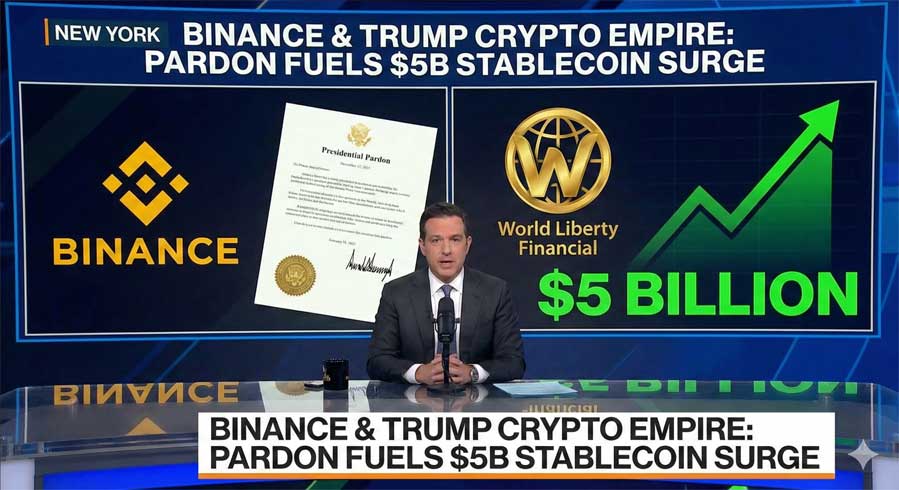
Binance and the Trump Crypto Empire: How a Pardon Fueled a $5 Billion Stablecoin Surge
In the rapidly evolving landscape of digital finance, few stories have captured the intersection of politics, business, and cryptocurrency quite like the meteoric rise of World Liberty Financial (WLF). As of February 2026, the Trump family’s crypto startup has shattered expectations, with its signature stablecoin, USD1, hitting a market capitalization of $5 billion.
While the Trump family celebrates this milestone with fire emojis on social media, industry analysts are pointing to a singular, powerful engine behind this growth: Binance. The world’s largest cryptocurrency exchange has become the de facto launchpad for the President’s family business, a partnership that has intensified following the controversial presidential pardon of Binance founder Changpeng Zhao (CZ) late last year.
This article dives deep into the mechanics of this alliance, the ethical questions it raises, and what the surge of USD1 means for the broader crypto market.
The Binance Effect: Fueling a $5 Billion Milestone
The headline number is staggering: $5 billion in total circulation for a stablecoin that didn’t exist two years ago. For context, this places USD1 firmly in the upper echelon of the global cryptocurrency market, challenging established giants like Tether (USDT) and Circle (USDC).
But a closer look at the on-chain data reveals a highly centralized growth engine. According to blockchain analytics firms Arkham Intelligence and Nansen, approximately 85% of all circulating USD1 tokens are held within Binance accounts. This is not organic, grassroots adoption; it is a coordinated, exchange-driven expansion.
Aggressive Marketing and “Airdrops”
Binance hasn’t just listed the token; it has aggressively marketed it. Over the last two months, the exchange has rolled out a series of lucrative promotions designed to incentivize its massive user base to acquire USD1.
- Yield Farming & Airdrops: Binance has reportedly offered “airdrop” campaigns where users are rewarded with World Liberty Financial’s governance token (WLFI) simply for holding USD1 in their accounts.
- Zero-Fee Trading: Pairs involving USD1 have been given preferential treatment, often with zero trading fees, making it the cheapest route for traders to move in and out of positions.
- VIP Incentives: High-volume traders on Binance have been nudged toward USD1 through tiered rewards programs.
These strategies have effectively funneled billions of dollars of liquidity into the Trump family’s project, bypassing the slow “cold start” problem that plagues most new stablecoins.
The Pardon Paradox: A Quid Pro Quo?
The timing of this business boom cannot be ignored. The symbiotic relationship between World Liberty Financial and Binance seemingly crystallized after a pivotal political event: the presidential pardon of Changpeng Zhao.
In 2025, President Trump exercised his executive clemency powers to pardon “CZ,” the billionaire founder of Binance who had previously faced legal challenges from the U.S. Justice Department. At the time, the pardon was framed as a move to “end the war on crypto” and support innovation.
However, the subsequent timeline paints a picture that critics call a conflict of interest:
- The Pardon (Late 2025): CZ is cleared of federal restrictions, allowing him to re-enter the global business stage with renewed vigor.
- The Partnership (Early 2026): Binance begins explicitly prioritizing World Liberty Financial’s products.
- The Boom (Feb 2026): USD1 hits $5 billion, directly enriching the Trump family’s equity in the project.
“It’s a masterclass in leverage,” says one D.C.-based ethics watchdog. “The President grants freedom to a crypto mogul, and months later, that mogul’s company becomes the primary distribution channel for the President’s family business. In any other era, this would be the scandal of the decade. In 2026, it’s just business.”
What Is USD1? The “Digital Dollar” of the MAGA Economy
Amidst the political noise, it is important to understand the product itself. USD1 is a stablecoin—a type of cryptocurrency pegged 1:1 to the U.S. dollar. Unlike volatile assets like Bitcoin or Ethereum, stablecoins are designed to maintain a steady value, making them ideal for payments, remittances, and as a “safe haven” for traders.
The Utility Pitch
World Liberty Financial pitches USD1 not just as a trading tool, but as a patriotic alternative to existing stablecoins. The marketing narrative leans heavily on “financial sovereignty” and protecting the dominance of the U.S. dollar in the digital age.
However, the token’s utility is currently limited mostly to the Binance ecosystem. While Eric Trump and the WLF team have promised integration with decentralized finance (DeFi) protocols and payment apps, the vast majority of USD1 volume is speculative or yield-seeking activity within Binance’s walled garden.
The Trump Family’s “Digital Real Estate”
For the Trump family, World Liberty Financial represents a pivot from physical real estate to digital real estate. Eric Trump, who has taken a leading public role in the project, celebrated the $5 billion news with characteristic enthusiasm on X (formerly Twitter).
“New milestones achieved,” he posted, accompanied by fire emojis.
The financial upside for the family is significant. In many crypto ventures, the founding team retains a portion of the “governance tokens” (in this case, WLFI) or earns fees on the “minting” and “burning” of stablecoins. With $5 billion in assets under management, even a small management fee or yield spread could generate tens of millions of dollars in annual revenue—revenue that is now intimately tied to the operational success of Binance.
The Risks: Centralization and Regulation
Despite the celebratory mood, the heavy reliance on Binance poses a structural risk to World Liberty Financial.
The “Single Point of Failure”
If 85% of your product sits on one exchange, your product is that exchange. If Binance were to face renewed technical issues, hacks, or regulatory crackdowns in other jurisdictions (since it is still largely barred from the U.S.), USD1 could face a liquidity crisis overnight.
Global Scrutiny
The fact that Binance is technically an offshore entity (unavailable to U.S. retail users directly) creates a strange dynamic. The President’s family is selling a “US Dollar” product that is primarily traded by non-Americans on a non-American platform. This has raised eyebrows among European and Asian regulators, who are increasingly wary of “politically exposed” financial products.
Conclusion: The New Normal in Crypto-Politics
The success of World Liberty Financial is a case study in the new power dynamics of 2026. It blurs the lines between statecraft, corporate strategy, and family enterprise.
For investors, the message is clear: USD1 is here to stay, backed by the most powerful political brand in the U.S. and the most powerful crypto infrastructure in the world. But for observers of democracy and markets, the “Binance Boost” is a stark reminder that in the world of high-stakes crypto, connections are the ultimate currency.
As earnings season approaches and World Liberty Financial prepares to release more data, the market will be watching one metric closely: Can USD1 survive outside the Binance incubator? Or is it destined to remain a golden bird in a gilded cage?
Disclaimer: This article is for informational purposes only and does not constitute financial advice. Cryptocurrency investments carry inherent risks.