










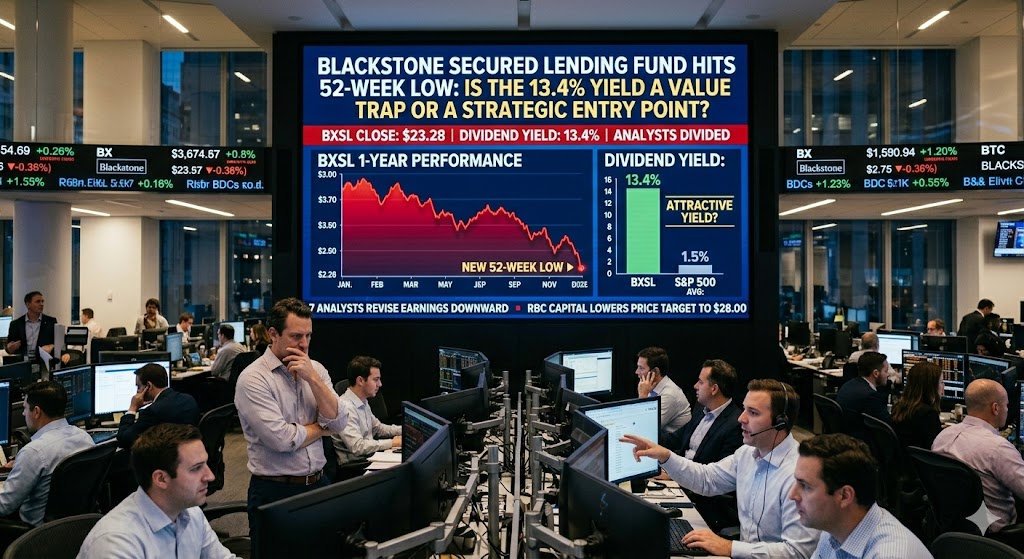
NEW YORK — Blackstone Secured Lending Fund (NYSE: BXSL), a heavyweight in the Business Development Company (BDC) sector with a $5.4 billion market capitalisation, reached a sombre milestone on Tuesday. The stock closed at a new 52-week low of $23.28, marking a definitive shift in investor sentiment as macroeconomic pressures and sector-specific headwinds converge on one of the industry’s most-watched credit vehicles.
The drop represents a 27.34% decline over the past twelve months, a stark contrast to the broader market’s performance. While the fund now sports a visually arresting 13.4% dividend yield and a modest P/E ratio of 9.66, the technical breakdown to a yearly low has sparked a heated debate among institutional analysts and income-focused retail investors alike: Is this a rare discount on a premium Blackstone-backed asset, or a warning sign of deteriorating credit quality in a high-interest-rate environment?
The Technical Breakdown: Anatomy of a 52-Week Low
The descent to $23.28 was not an overnight event but rather the culmination of a volatile fiscal year. Just months ago, BXSL was trading comfortably above its Net Asset Value (NAV), buoyed by a robust private credit market and the prestige of the Blackstone brand. However, as the Federal Reserve maintained a “higher for longer” stance on interest rates throughout late 2025 and into early 2026, the cost of capital for BXSL’s underlying portfolio companies began to strain balance sheets.
Market analysts note that breaking the $24.00 support level early in the trading session triggered a wave of automated sell orders. The stock’s 27.34% one-year decline significantly underperforms the S&P 500 and even lags behind many of its BDC peers, suggesting that idiosyncratic risks within the Blackstone portfolio are being priced in by sophisticated traders.
Fundamental Analysis: The Allure and Danger of a 13.4% Yield
For income seekers, BXSL’s current profile is a statistical anomaly. A 13.4% dividend yield is nearly ten times the average yield of the S&P 500. However, in the world of BDCs, a yield that climbs into the mid-teens often signals that the market is skeptical of the dividend’s sustainability or the health of the underlying assets.
Earnings Performance vs. Revenue Reality
Recent financial disclosures offer a mixed bag for the fund. In the fourth quarter of 2025, Blackstone Secured Lending reported earnings per share (EPS) of $0.80, narrowly beating the consensus estimate of $0.79. While this outperformance typically signals strength, the “top line” told a different story. Revenue came in at $358 million, missing the anticipated $359.59 million.
This revenue miss, though slight, indicates a slowing pace of new loan originations or a compression in the interest rate spreads that BXSL can command. As the private credit space becomes increasingly crowded with institutional capital, the “Golden Age of Private Credit” appears to be transitioning into a more competitive and margin-tightening era.
The Analyst Outlook: Downward Revisions
Perhaps most concerning for prospective buyers are the recent updates from the analyst community. InvestingPro data reveals that seven analysts have revised their earnings estimates downward for the upcoming period. Such a unified shift in sentiment usually precedes further fundamental softening.
Major firms have already begun trimming their expectations:
- RBC Capital: Lowered its price target from $29.00 to $28.00, while maintaining an “Outperform” rating.
- Keefe, Bruyette & Woods (KBW): Slashed its target from $29.00 to $27.00, citing a 1% decline in Net Asset Value (NAV) and a rise in non-accruals.
Credit Quality: A Rising Tide of Non-Accruals?
The lifeblood of a BDC is its credit performance. KBW’s report highlighted a rise in non-accruals to 0.6%. While 0.6% remains low relative to historical industry averages, the trend is what has investors on edge. In a zero-interest-rate world, portfolio companies could easily service debt; at current rates, the “interest coverage ratio” for mid-market companies—the primary borrowers from BXSL—is shrinking.
Non-accruals represent loans where the borrower has stopped making payments. If this figure continues to creep toward the 1.5% or 2% mark, the fund may be forced to write down the value of its investments, further eroding the NAV and potentially threatening the quarterly distribution.
The Macro Environment: Why Now?
The timing of this 52-week low coincides with broader concerns within the financial sector.
- M&A Slowdown: With high borrowing costs, the volume of mergers and acquisitions has cooled. This reduces the opportunities for BDCs like BXSL to deploy capital into high-yielding new deals.
- Refinancing Risk: Many of BXSL’s portfolio companies are approaching “maturity walls” where they must refinance debt taken out years ago at much higher current rates.
- The “Blackstone Effect”: As one of the largest players in the space, Blackstone often serves as a bellwether. When BXSL struggles, it is often viewed as a leading indicator for the entire $1.7 trillion private credit market.
Investor Sentiment: Fear vs. Opportunity
Despite the carnage, not all perspectives are bleak. Both RBC and KBW have maintained “Outperform” ratings, suggesting that at $23.28, the stock may be “oversold.” The bull case for BXSL rests on three pillars:
- Management Quality: Blackstone’s credit platform is among the most sophisticated in the world, with deep resources to workout troubled loans.
- Variable Rate Advantage: Most of BXSL’s loans are floating-rate. If rates stay high without causing a full-scale recession, the fund continues to collect high interest income.
- Valuation: Trading at a P/E of 9.66 and a significant discount to historical price-to-NAV multiples, value investors argue that the “bad news” is already fully priced in.
Conclusion: Watching the $23 Level
As Blackstone Secured Lending Fund enters the second quarter of 2026, the $23.28 level will be a critical line in the sand. Shareholders are looking for a stabilization in NAV and a clear signal from management that the 13.4% dividend is safe.
For now, BXSL stands as a microcosm of the current economy: high yields reflecting high risks, and a blue-chip name grappling with a changing financial landscape. Investors should remain cautious, keeping a close eye on non-accrual trends and the next round of earnings calls to see if this 52-week low is a floor—or just a landing on a longer staircase down.
Investment Disclosure: This article is for informational purposes only and does not constitute financial advice. Investors are encouraged to consult with a professional advisor and review comprehensive Pro Research Reports before making any investment decisions.