
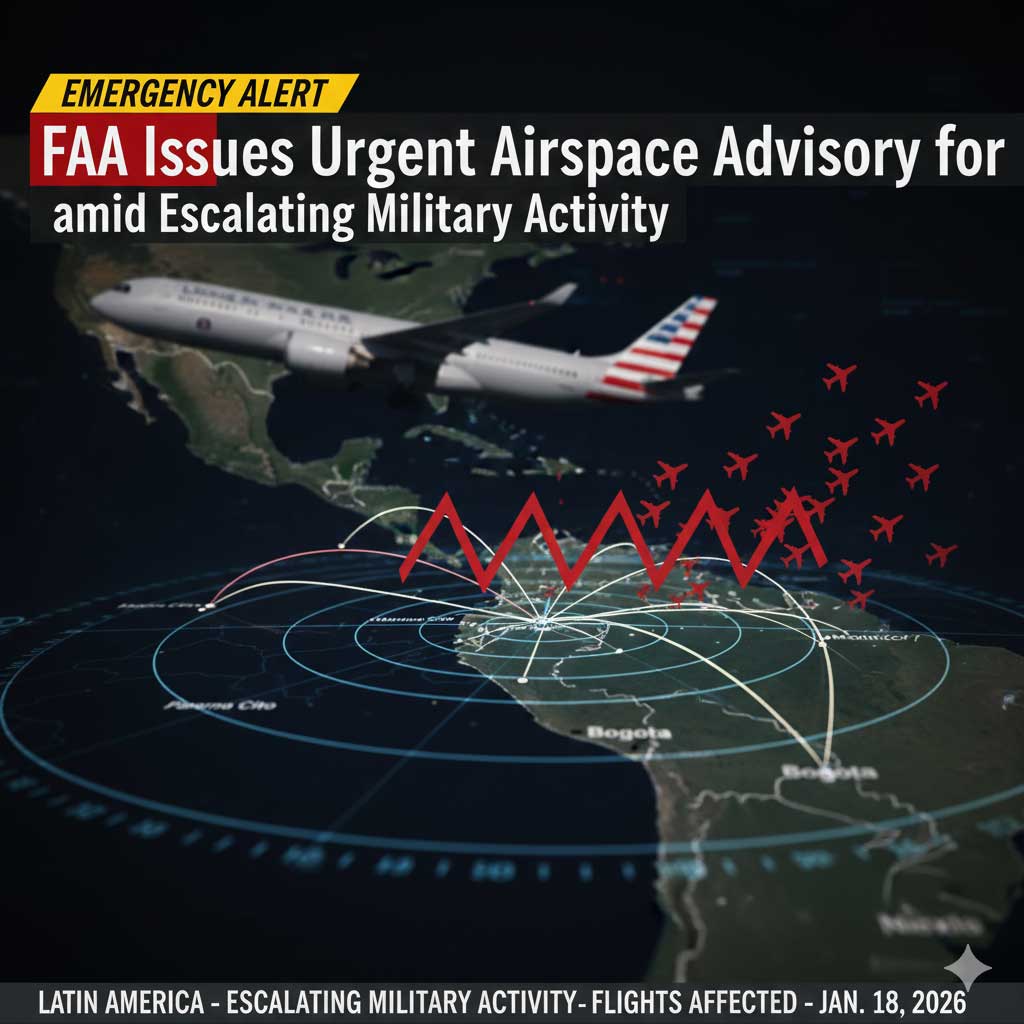
BREAKING NEWS: FAA Issues Urgent Airspace Advisory for Latin America Amid Escalating Military Activity
By Avery K. Bristow Aviation Safety Correspondent January 18, 2026
WASHINGTON D.C. — The Federal Aviation Administration (FAA) has issued a sweeping, high-priority cautionary advisory to all U.S. air carriers and commercial operators traversing Latin American airspace. The directive, which comes amid reports of heightened military maneuvers and geopolitical instability, warns of potential interference with civil aviation across a massive corridor spanning from the southern border of Mexico through Central America and deep into the South American continent.
The advisory, effective immediately and slated to remain in place for at least the next 60 days (through March 17, 2026), marks one of the most significant regional safety warnings issued by the U.S. government in recent years.
A Coordinated Warning: The Seven NOTAMs
On Friday, the FAA moved to publish seven distinct Notices to Airmen (NOTAMs), each targeting specific FIRs (Flight Information Regions) that are critical to international commerce and tourism. These notices are not merely administrative; they serve as a legal and safety framework for pilots and dispatchers to navigate “danger zones.”
The specific regions currently under heightened scrutiny include:
- Mexico: High-altitude transit corridors and coastal approach paths.
- Panama: The vital airspace surrounding the Panama Canal, a global transit bottleneck.
- Ecuador and Colombia: North-Andean routes frequently used for South American connection hubs.
- The Pacific Ocean: Specifically, the maritime air routes connecting North America to the southern cone.
Unlike previous advisories that focused on specific low-altitude threats, these new NOTAMs warn that risks to aircraft exist at all altitudes. This is particularly concerning for long-haul commercial jets that typically cruise at altitudes between 30,000 and 40,000 feet, suggesting that military activity—including potential missile drills, electronic jamming, or rapid-ascent interceptors—could reach the standard flight levels of civilian craft.
The Catalyst: Military Confrontations and Venezuela
The timing of the FAA’s move is no coincidence. It follows a series of harrowing “near-miss” encounters between U.S. military assets and commercial aviation. Sources indicate that within the last month, at least two U.S. military reconnaissance planes were forced to take evasive maneuvers to avoid commercial jets near the Venezuelan border.
The regional tension has been fueled by a massive U.S.-led counter-narcotics operation targeting vessels in the Caribbean and Eastern Pacific. This surge in presence has reportedly triggered defensive postures from regional militaries. Most notably, a recent “kinetic event” involving an attack on strategic locations in Venezuela has effectively turned the Caribbean into a restricted zone.
The fallout was immediate:
- Flight Cancellations: Major carriers were forced to scrub hundreds of flights last week as Venezuela closed portions of its airspace.
- Rerouting: Flights from Miami to Bogota or Lima are now being routed significantly further east or west to avoid the “hot zones,” adding hours to travel times and thousands of dollars in fuel costs.
Airline Industry on High Alert
As the FAA’s March 17 deadline looms, the “Big Four” U.S. airlines are playing their cards close to the chest. While no airline has yet canceled its entire Latin American schedule, the behind-the-scenes scramble to ensure passenger safety is immense.
| Airline | Official Stance | Operational Status |
| United Airlines | Monitoring developments closely. | Maintaining current schedules with “buffer” routing. |
| Southwest Airlines | In active contact with U.S. government. | Evaluating Caribbean corridor safety daily. |
| Delta Air Lines | Referring all inquiries to the FAA. | Tight-lipped on specific tactical changes. |
| American Airlines | No public comment. | Largest carrier to the region; currently reviewing NOTAMs. |
Industry analysts suggest that if the military activity persists, we may see a “mid-winter freeze” on travel to popular destinations like Quito, Panama City, and Mexico City.
The View from the Ground: Regional Pushback
The FAA’s advisory has not been received warmly by all neighbors. Mexico’s civil aviation authority was quick to issue a counter-statement, attempting to downplay the severity of the alert for non-U.S. carriers. According to Mexican officials, the FAA’s caution is a “unilateral preventive measure” that applies strictly to U.S.-registered aircraft and does not reflect the safety of the airspace for Mexican or European carriers.
However, aviation safety experts warn that “missiles and jamming do not check the tail number of a plane.” The concern remains that any kinetic military activity or electronic warfare (GPS spoofing) would affect all aircraft in the vicinity, regardless of their country of origin.
Traveler Impact: The Rise of “War Risk” Insurance
For the average traveler, the geopolitical friction is manifesting in the wallet. Travel insurance providers have reported a 40% spike in inquiries regarding “Cancel For Any Reason” (CFAR) policies and specific “war and terrorism” riders.
“People are seeing the headlines about Venezuela and the FAA alerts, and they are spooked,” says a travel consultant. “We are seeing people pivot their spring break plans away from Central and South America toward Hawaii or Europe, where the airspace is currently perceived as more stable.”
Conclusion: A 60-Day Window of Uncertainty
The FAA’s 60-day advisory acts as a ticking clock. Between now and March 17, the intersection of military operations and commercial necessity will be tested. For now, the message to pilots is clear: Maintain extreme vigilance, expect the unexpected, and be prepared to divert at a moment’s notice.
As this is a developing story, the FAA is expected to provide weekly briefings to airline safety boards. Travelers are advised to check their flight status frequently and remain updated on regional developments.