
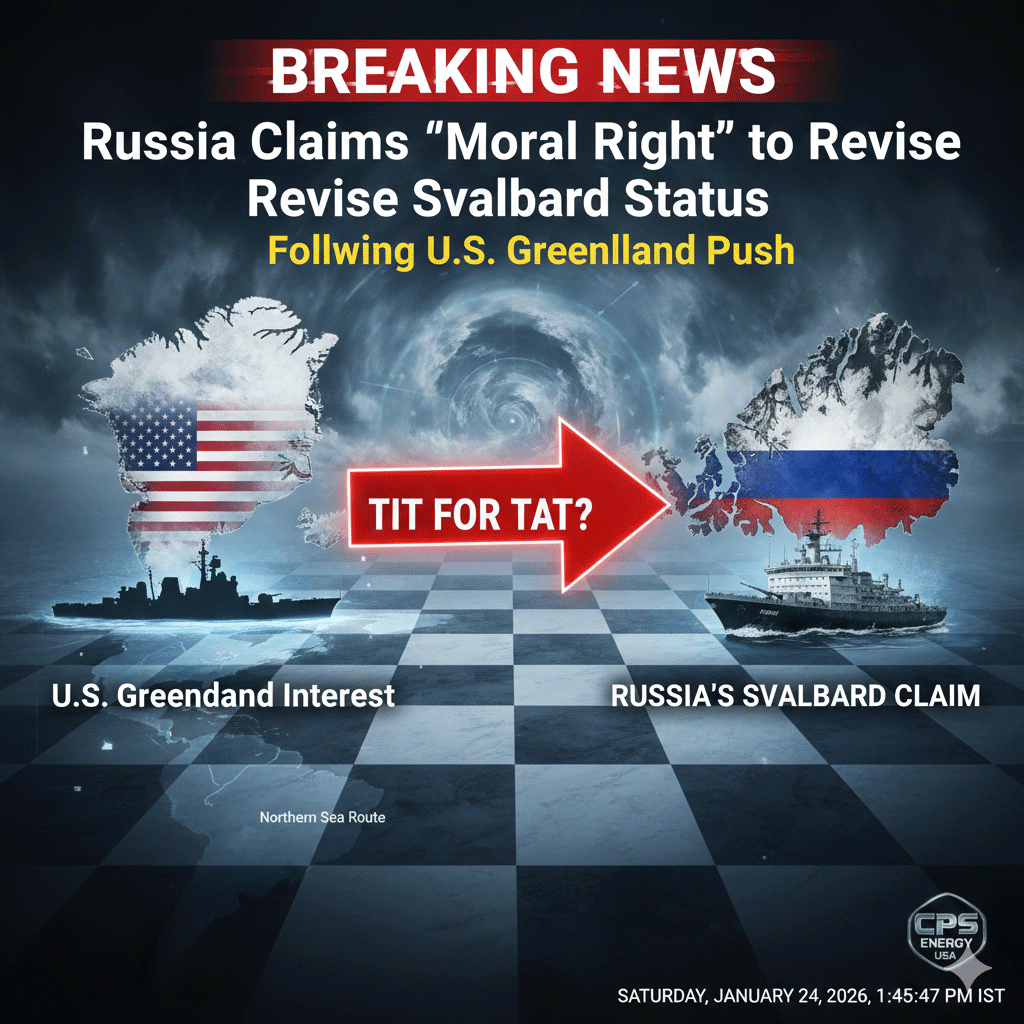
BREAKING NEWS: Russia Claims ‘Moral Right’ to Revise Svalbard Status Following U.S. Greenland Push
By Polini Antony USA — January 24, 2026
The geopolitical landscape of the Arctic has reached a fever pitch today as Moscow commentators suggest Russia has a “complete moral and historical right” to revise the status of Norway’s Svalbard archipelago. This provocative stance comes as a direct response to escalating discussions regarding a potential change in the status of Greenland under the U.S. administration of Donald Trump.
The Lavrov Doctrine: Crimea vs. Greenland
The current tension was ignited by Russian Foreign Minister Sergey Lavrov, who recently stated that Crimea is “no less important for the security of Russia than Greenland is for the U.S.” This comparison suggests that Moscow views U.S. interest in Greenland as a precedent for territorial and security-based claims elsewhere.
Restoring “Grumant”: The Historical Claim
Moscow commentator Nikolay Ilyasov argues that if the West allows the U.S. to alter Greenland’s status, Russia should move to restore its historical rights under the 1920 Svalbard Treaty.
- Ancient Presence: Ilyasov asserts that the archipelago, which Russians traditionally know as Grumant, saw a Russian “Pomor” presence long before Norway existed as a sovereign state.
- The “Anti-Russian Outpost”: Moscow claims that Norway is violating the demilitarized status of Svalbard by turning it into a forward NATO base, citing the installation of surveillance antennas and coast guard maneuvers.
Strategic Stakes
Svalbard is the strategic “key to the Arctic,” acting as a transit corridor for the Northern Sea Route. Currently, around 500 Russians live on the archipelago, primarily in the settlement of Barentsburg through the Arktikugol trust. Moscow accuses Oslo of using “environmental regulations” to slowly oust this Russian presence.
“If the world allows the US to revise the status of Greenland, then Russia has every moral and historical right to revise the status of Svalbard.” — Nikolay Ilyasov
International Reaction
While Norway maintains “full and absolute” sovereignty over the archipelago, the 1920 Treaty grants unique rights to signatory nations. Western analysts fear that Russia may use the narrative of “protecting Russian minorities” or “national identity”—the same rhetoric used in Ukraine—to justify a move against Svalbard.
Frequently Asked Questions (FAQs)
1. What is the Svalbard Treaty? Signed in 1920, it recognizes Norway’s sovereignty over the islands but mandates they remain demilitarized and gives all signatory nations (including Russia and the U.S.) equal rights to economic activity there.
2. Why is Russia bringing this up now? Moscow is using the U.S. interest in Greenland to argue that international rules are being rewritten by the powerful. They suggest that if the U.S. can ignore traditional status quos in Greenland, Russia can do the same in Svalbard.
3. What does “Grumant” mean? “Grumant” is the traditional Russian name for Svalbard, used by Pomor hunters who explored the area for centuries. Moscow uses this name to emphasize a “historical footprint” that predates Norwegian administration.
4. Is there a military threat? While Norway denies militarizing Svalbard, Russia claims NATO is using the island’s satellite infrastructure for reconnaissance. Analysts worry Svalbard could become a “test” for NATO resolve.