USA CPI Report Today: Inflation Steadies at 2.4% Before War with Iran Triggers Energy Shock
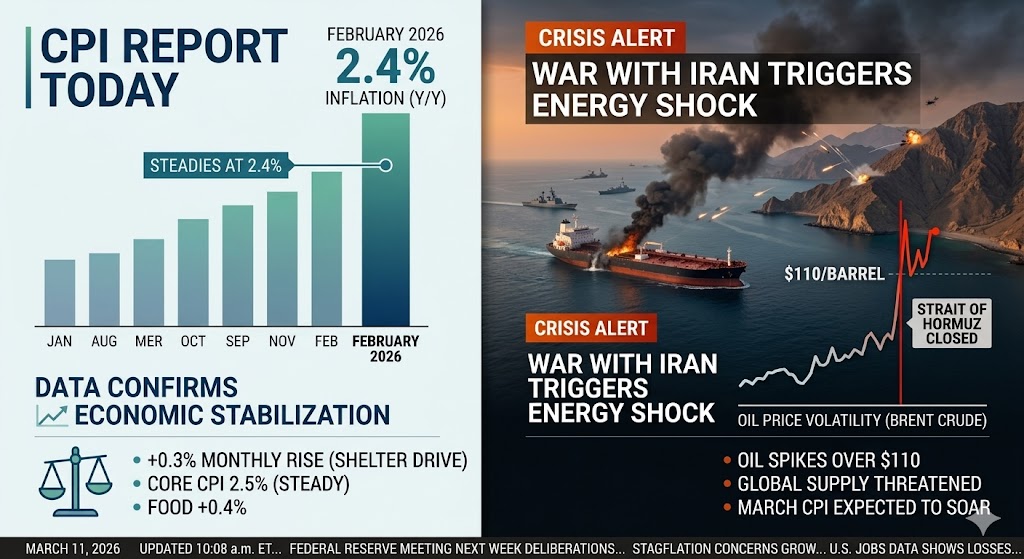
WASHINGTON, D.C. — The Bureau of Labor Statistics (BLS) released the highly anticipated CPI report today, revealing that annual inflation held steady at 2.4% in February. While the data met market expectations, economists warn that this snapshot represents the “calm before the storm,” as it was collected just before the military conflict with Iran sent global energy prices into a vertical climb.
The CPI report today serves as the final major data point for the Federal Reserve’s interest rate meeting next week. With core inflation also remaining firm at 2.5%, policymakers face a complex landscape where historical stability is being immediately challenged by a massive geopolitical energy shock.
February CPI: The Data at a Glance
The CPI report today shows that consumer prices rose 0.3% in February on a seasonally adjusted basis, a slight acceleration from the 0.2% increase seen in January.
Primary Drivers of Inflation in February:
- Shelter: Increasing by 0.2%, housing costs remained the single largest contributor to the monthly rise.
- Food: Grocery prices (Food at Home) jumped 0.4%, led by a 3.7% spike in candy and chewing gum and a 1.4% increase in fruits and vegetables.
- Energy: The energy index rose 0.6% during the month. Notably, fuel oil saw a significant 6.2% increase even before the war impacts were fully realized.
- Core CPI: Excluding food and energy, core prices rose 0.2% for the month and 2.5% over the last 12 months.
The “Iran Factor”: A Lagging Indicator
While the CPI report today reflects a stabilizing economy, it is essentially a “rear-view mirror” look. The data was gathered before the War with Iran and the subsequent blockage of the Strait of Hormuz, which handles 20% of the world’s oil supply.
Since the survey period ended, U.S. gas prices have skyrocketed from an average of $3.00 at the end of February to $3.57 per gallon as of March 11. This 19% jump in fuel costs is not captured in today’s release but is expected to dominate the March and April reports.
“The February data shows we had reached a point of stabilization,” noted one senior economist. “But with oil prices now hitting $110 a barrel due to the conflict, the 2.4% headline number is likely the lowest we will see for the remainder of 2026.”
Fed Outlook: The Stagflation Dilemma
The Federal Reserve now faces a “nightmare scenario.” The CPI report today confirms that inflation remains above their 2.0% target, but recent jobs data shows the U.S. economy lost 92,000 jobs in February, pushing the unemployment rate up to 4.4%.
The Fed must now decide whether to:
- Hold or Raise Rates: To combat the upcoming “war-driven” inflation spike.
- Cut Rates: To protect a labor market that is clearly beginning to fracture under the weight of high interest rates and global uncertainty.
Consumer Impact: The Cost of Living
Despite the “steady” headline from the CPI report today, American households are feeling the squeeze in specific sectors. Nonalcoholic beverages are up 5.6% year-over-year, and medical care services rose 4.1%. Conversely, used cars and trucks provided a rare reprieve, with prices falling 3.2% over the last year.
Summary Table: February 2026 CPI Changes
| Category | Monthly Change | Year-Over-Year |
|---|---|---|
| All Items | +0.3% | 2.4% |
| Core (Excl. Food/Energy) | +0.2% | 2.5% |
| Energy | +0.6% | +0.5% |
| Food at Home | +0.4% | +2.4% |
| Shelter | +0.2% | +3.0% |
Next Step: Would you like me to generate a 500-word analysis on how the “War with Iran” is specifically expected to impact the April CPI report?
WASHINGTON, D.C. — Federal Reserve officials received a final, critical piece of the economic puzzle on Wednesday as they prepare for next week’s high-stakes interest rate deliberations. The Labor Department reported that the Consumer Price Index (CPI) rose 2.4% in the 12 months through February—a figure that indicates inflation had effectively plateaued just before the outbreak of a major conflict with Iran sent global energy markets into a tailspin.
The report, released at 8:30 a.m., depicts a U.S. economy that was making slow but steady progress toward the Fed’s 2% target. However, with the “War with Iran” entering its second week and oil prices surging toward $110 a barrel, the “steady” data from February may already be a relic of a bygone economic landscape.
February Data: A Final Glimpse of Stability
The February CPI report showed a 0.3% increase on a monthly basis, largely driven by persistent costs in the housing sector. Core inflation—which strips out volatile food and energy costs to provide a clearer view of underlying trends—remained unchanged at 2.5% year-over-year.
Key Highlights from the February Report:
- Shelter: The cost of housing rose 0.2% in February, remaining the single largest contributor to monthly inflation.
- Food: Grocery prices increased 0.4%, with notable spikes in non-alcoholic beverages and fresh produce.
- Energy: Before the war’s full impact, the energy index had already begun to creep up, rising 0.6% in February after a sharp decline in January.
- Goods: Prices for used cars and trucks continued to decline, providing a rare deflationary bright spot for consumers.
The “Iran Factor”: Why February Doesn’t Tell the Full Story
While the February data suggests inflation was “behaving,” the timing of the conflict has rendered the report nearly obsolete for forward-looking policy. The U.S.-led military operations against Iran began on the final day of February, meaning the massive spikes in gasoline and shipping costs are not reflected in these numbers.
Since the war began, Brent crude oil has jumped from $70 to over $110 per barrel. The closure of the Strait of Hormuz—a chokepoint for 20% of the world’s oil and 33% of its fertilizer—is already being felt at American gas pumps, where prices have jumped as much as 15 cents a gallon in a single week.
“February was the calm before the storm,” said Mark Mathews, chief economist at the National Retail Federation. “The stability we see in this report is about to be wiped out by a massive energy shock. U.S. households are already seeing their weekly budgets squeezed by $10 to $20 just to fill their tanks.”
The Fed’s Impossible Choice
The Federal Open Market Committee (FOMC) meets on March 17-18 to decide the fate of interest rates. Before the war, markets had assigned a high probability to the Fed holding rates steady at 3.5% to 3.75%. Now, the central bank faces a “nightmare scenario” known as stagflation: rising inflation coupled with weakening economic growth.
The Debate Inside the Fed:
- The Hawks: Argue that the Fed must remain aggressive. If energy prices stay high, inflation could “unanchor,” leading to a 1970s-style spiral. They see the 2.4% plateau as proof that inflation was already “sticky” even before the oil shock.
- The Doves: Fear that the war will destroy consumer confidence and trigger a recession. They argue that high gas prices act as a “tax” on consumers, naturally cooling the economy, and that raising rates now would be “overkill.”
Market Reaction: Volatility is the New Normal
Wall Street reacted to the CPI data with muted anxiety. While the 2.4% figure was “as expected,” the Dow Jones and S&P 500 remain under pressure due to the geopolitical uncertainty. Gold, a traditional safe-haven asset, has seen its price surge as investors flee riskier stocks.
Current Economic Metrics (as of March 11, 2026):
- 30-Year Mortgage Rate: 5.99%
- Average Gas Price: Above $4.00/gallon (national average)
- Market Odds for March Rate Cut: Near 0%
Conclusion: A Fragile Recovery at Risk
The February CPI report proves that the U.S. was on the verge of declaring victory over the post-pandemic inflation surge. However, the “Iran War” has introduced a “black swan” event that complicates every metric the Fed uses.
As Washington braces for a potential government shutdown and a change in Fed leadership—with Kevin Warsh expected to take over from Jerome Powell in May—the next few weeks will determine whether the U.S. economy can absorb this latest shock or if it will slide back into a period of prolonged high costs.
Next Step: Would you like me to create a comparison table of how this inflation shock compares to the 2022 energy crisis following the invasion of Ukraine?