
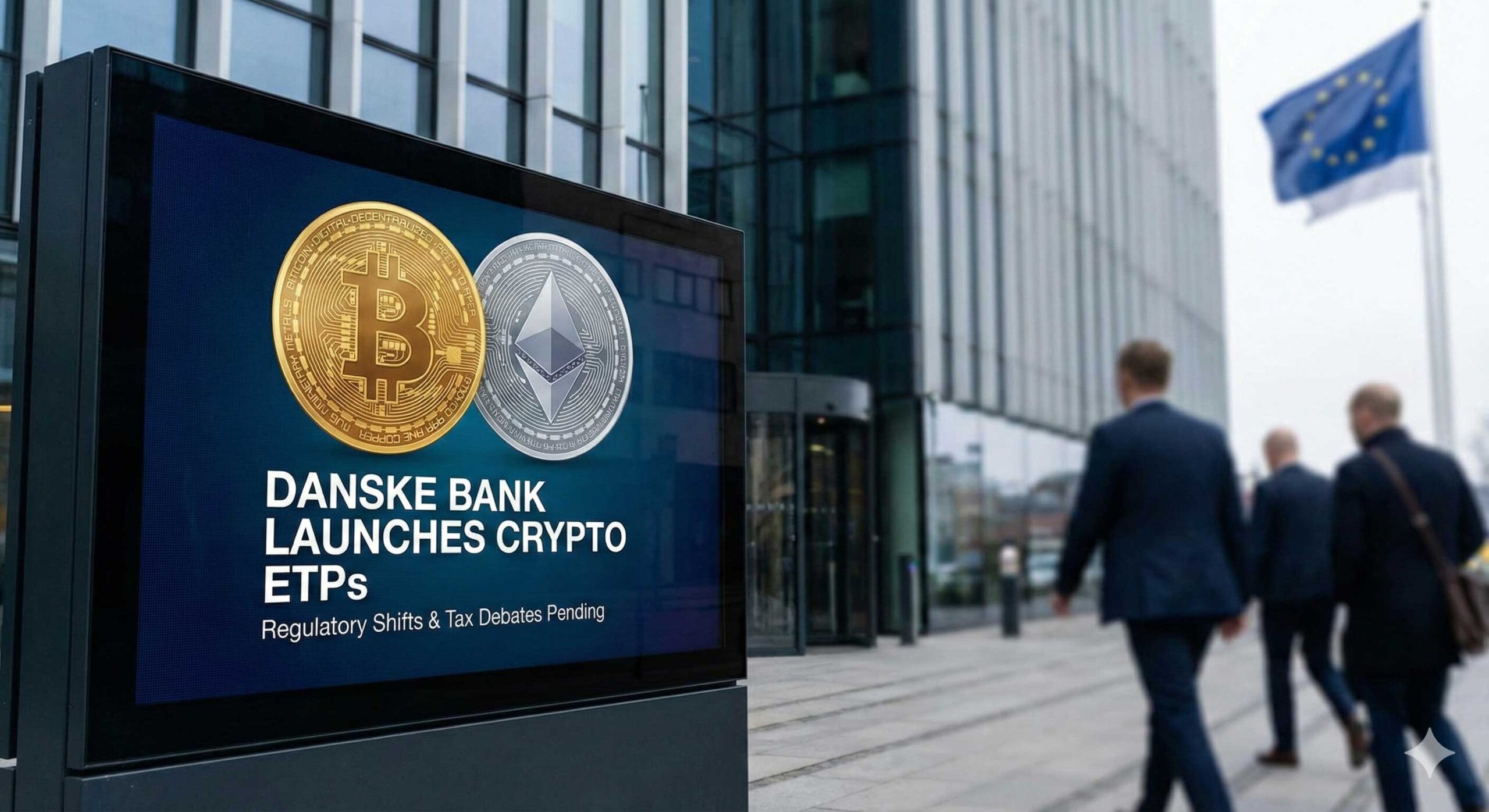
Danske Bank Ends 8-Year Ban, Launches Bitcoin and Ethereum ETPs Amid Regulatory Shifts and Tax Debates
In a landmark shift for the Nordic financial sector, Denmark’s largest financial institution, Danske Bank, has officially opened its doors to cryptocurrency trading. Ending an eight-year prohibition on digital assets, the bank has launched Bitcoin (BTC) and Ethereum (ETH) Exchange-Traded Products (ETPs) for its retail customers via mobile and online banking platforms.
This report analyzes the implications of Danske Bank’s pivot, the mechanics of the new investment vehicles, the influence of the European Union’s Markets in Crypto-Assets (MiCA) regulation, and the looming shadow of Denmark’s controversial proposal to tax unrealized crypto gains.
The Strategic Pivot: From “Avoid” to “Access”
For nearly a decade, Danske Bank stood as a fortress against the encroachment of digital assets into the traditional Danish banking system. In 2018, the bank issued a stark warning to its customers, labeling cryptocurrencies as opaque, volatile, and high-risk. This stance was solidified in 2021 when the bank renewed its internal ban, prohibiting the trading of crypto-related instruments on its platforms.
However, February 2026 marks a decisive 180-degree turn. The bank has acknowledged that the financial landscape has fundamentally altered, driven by two primary factors: undeniable customer demand and a maturing regulatory framework.
Kerstin Lysholm, Head of Investment Products and Services at Danske Bank, framed the decision as a pragmatic response to market reality rather than an ideological shift.
“As cryptocurrencies have become a more common asset class, we are receiving an increasing number of enquiries from customers wanting the option of investing in cryptocurrencies as part of their investment portfolio,” Lysholm stated.
The bank’s decision mirrors a broader trend among institutional wealth management firms and global banking giants, which are increasingly integrating digital asset management into their service suites to prevent capital flight to fintech competitors and dedicated cryptocurrency exchanges.
Understanding the Product: What are Crypto ETPs?
Danske Bank is not offering spot crypto trading—meaning customers are not buying actual Bitcoin or Ethereum tokens to hold in a private wallet. Instead, they are offering Exchange-Traded Products (ETPs).
- Ease of Access: ETPs track the underlying performance of Bitcoin and Ethereum. They trade on regulated stock exchanges during market hours, just like shares of Novo Nordisk or Maersk.
- Custody Solutions: This structure removes the technical barrier of entry. Investors do not need to manage private keys, set up cold storage, or worry about wallet security. The custody is handled by the issuer of the ETP, mitigating the risk of user-error hacking.
- Tax Reporting: In many jurisdictions, ETPs simplify the complex burden of crypto tax reporting, as they are treated similarly to traditional securities.
The “Non-Endorsement” Endorsement: A Cautious Rollout
Despite providing the infrastructure for trade, Danske Bank is treading a fine line regarding its fiduciary responsibility. The bank has made it explicitly clear that while it is facilitating access, it is not recommending crypto as a strategic asset class.
This distinction is crucial in the world of financial compliance and risk management.
Execution-Only Service
The bank has classified these assets as “speculative investments.” Consequently, Danske Bank will not offer investment advisory services regarding these ETPs. Relationships managers and financial advisors employed by the bank are instructed not to recommend Bitcoin or Ethereum to clients during portfolio reviews.
The Appropriateness Test
To gatekeep the volatility of the crypto market from inexperienced retail investors, Danske Bank has implemented a mandatory “appropriateness test.”
- Knowledge Assessment: Customers must demonstrate a fundamental understanding of how ETPs work and the specific volatility risks associated with digital assets.
- Risk Tolerance: The test ensures that the customer has the financial capacity to absorb potential losses, a standard practice in high-risk investment planning.
This mechanism is designed to shield the bank from future litigation should the crypto market suffer a catastrophic downturn, ensuring that all participants have informed consent.
The Regulatory Catalyst: The Impact of MiCA
Why now? The timing of Danske Bank’s entry is inextricably linked to the European Union’s implementation of the Markets in Crypto-Assets (MiCA) regulation.
For years, European banks hesitated to touch crypto due to regulatory uncertainty and fears of violating Anti-Money Laundering (AML) directives. MiCA has changed the calculus. It provides a comprehensive legal framework for crypto-assets, service providers, and issuers across the EU.
Kerstin Lysholm specifically cited this regulatory clarity as a driver for the bank’s decision:
“The crypto market has become better regulated in the past few years, especially with the implementation of the EU’s Markets in Crypto-Assets Regulation.”
By standardizing rules on transparency, disclosure, and supervision, MiCA has transformed crypto from a “wild west” asset into a regulated financial instrument that Tier-1 banks can touch without jeopardizing their banking licenses. This suggests that other Nordic giants, such as Nordea or SEB, may soon follow suit to remain competitive in the fintech and banking services sector.
Institutional Hypocrisy? The MicroStrategy Holdings
While Danske Bank publically labels crypto as “speculative” and advises caution, a look into the bank’s own institutional portfolio reveals a more nuanced reality.
The bank disclosed that it holds a significant position in MicroStrategy (MSTR), the American business intelligence firm that has effectively converted itself into a Bitcoin holding company.
- Current Holdings: 132,746 shares.
- Portfolio Value: Approximately $17.6 million.
- Recent Activity: An increase of 13,840 shares.
By holding MicroStrategy, Danske Bank has already been exposing its balance sheet to Bitcoin’s price volatility, albeit indirectly. This “proxy exposure” is a common strategy for institutional investors who want the upside of Bitcoin without the regulatory headache of holding the asset directly. The launch of consumer-facing ETPs simply aligns their retail offerings with their internal investment logic.
The Looming Threat: Denmark’s Unrealized Gains Tax
While the launch of ETPs is positive news for Danish crypto adoption, it arrives against a backdrop of potential fiscal upheaval. The Danish government is currently debating one of the most aggressive crypto taxation regimes in the world.
The “Inventory Taxation” Proposal
Current Danish tax law is complex and often punitive, taxing crypto gains as personal income (up to 52%) while often limiting deductions on losses. However, a proposal from the Danish Tax Law Council aims to shift this to “inventory taxation” or a mark-to-market model beginning potentially in 2026 or 2027.
Key components of the proposal:
- Unrealized Gains Tax: Investors would be taxed on the increase in value of their portfolio at the end of the year, even if they haven’t sold.
- The Rate: The proposed tax rate is approximately 42%.
- Retroactivity: There are fears the rules could apply to holdings dating back to the early days of Bitcoin.
The Impact on Investors
If passed, this law would force many investors to sell a portion of their assets annually just to pay the tax bill on paper profits.
- Liquidity Crisis: For illiquid assets or during bear markets following a bull run, this could be financially ruinous.
- Capital Flight: Critics warn that high-net-worth individuals and crypto entrepreneurs will simply relocate to tax-friendly jurisdictions like Switzerland, Dubai, or Portugal.
As of February 2026, the bill remains in legislative limbo. Sources from the Ministry of Taxation confirm the recommendations have not been fully debated. However, the mere existence of the proposal adds a layer of risk for Danske Bank customers entering the market now.
Market Analysis: Denmark’s Crypto Landscape
Despite high digital literacy, Denmark has lagged in crypto adoption compared to global peers.
- Adoption Rate: Only 1.2% of the population (approx. 70,605 people) own crypto.
- Global Ranking: 84th out of 151 countries according to Chainalysis.
Danske Bank’s entry is likely to act as a catalyst for normalization. When a trusted national institution offers a product, it de-stigmatizes the asset class for the “early majority”—older, wealthier investors who were previously deterred by the technical complexity of exchanges like Binance or Kraken.
Conclusion: A New Era for Nordic Finance
Danske Bank’s launch of Bitcoin and Ethereum ETPs is more than a product update; it is a signal that the integration of digital assets into the legacy financial system is inevitable. By leveraging the safety of MiCA regulations and the convenience of ETPs, the bank is bridging the gap between traditional finance (TradFi) and decentralized finance (DeFi).
However, the path forward is fraught with complexity. Investors must navigate the bank’s “non-recommendation,” pass appropriateness tests, and keep a wary eye on the Danish parliament’s taxation plans.
For the Danish investor, the doors to the crypto economy are finally open—but the toll booth may be expensive.
High-Value Keyword Analysis & Optimization
- Cryptocurrency Exchange Traded Products: The core subject of the article, essential for investors looking for regulated entry points.
- Bitcoin ETF vs ETP: Clarifying the product distinction for European investors.
- Financial Advisor for Crypto: Highlighted through Danske’s refusal to provide this specific service.
- Capital Gains Tax Denmark: The critical pain point for the target demographic.
- Institutional Bitcoin Adoption: Evidenced by the MicroStrategy holdings.
- Secure Crypto Storage: The value proposition of the ETP model (no wallet needed).
- Online Banking Investment Services: The platform of delivery.
FAQ: Danske Bank Crypto ETPs
Q: Can I buy actual Bitcoin through Danske Bank? A: No. You are buying an ETP (Exchange Traded Product) that tracks the price of Bitcoin. You do not hold the keys, and you cannot withdraw the coins to a private wallet.
Q: Does Danske Bank recommend buying these products? A: No. The bank explicitly labels them as “speculative” and does not offer advisory services for them. You must make your own investment decisions.
Q: What is the tax situation for these ETPs in Denmark? A: Currently, crypto gains are taxed as personal income. However, proposed legislation could introduce “inventory taxation” on unrealized gains in the near future. It is highly recommended to consult with a certified tax accountant.
Q: Do I need to be a Danske Bank customer? A: Yes, the services are available via Danske Bank’s mobile and online banking platforms for existing customers who pass the appropriateness test.