
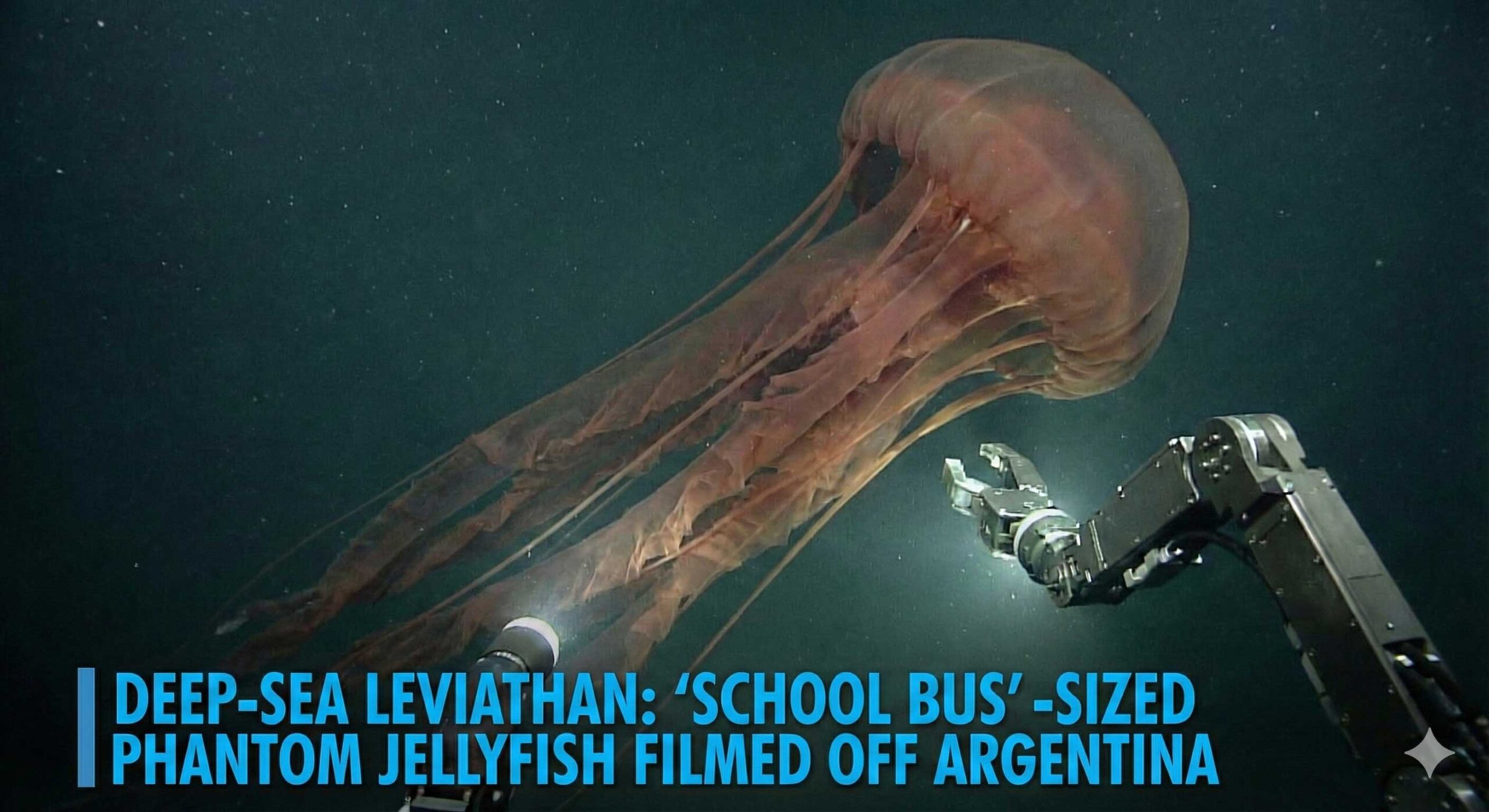
Deep-Sea Leviathan: ‘School Bus’-Sized Phantom Jellyfish Filmed off Coast of Argentina
By USA NEW BLOG 689— February 3, 2026
In the crushing darkness of the South Atlantic, nearly a thousand feet beneath the surface where the sun’s rays effectively vanish, a ghost has been found.
Researchers aboard the Schmidt Ocean Institute’s research vessel Falkor (too) have captured rare, high-definition footage of a Stygiomedusa gigantea—better known as the giant phantom jellyfish. With billowing oral arms that can extend more than 33 feet (10 meters), the creature rivals the length of a standard school bus, moving through the water with the slow, hypnotic rhythm of a living ribbon.
The sighting occurred during the final leg of an ambitious, months-long expedition to map and explore the deep-sea ecosystems of the Argentine Continental Shelf, a region that has long remained a biological black box to scientists. The discovery of the phantom jelly, drifting silently in the submarine canyons off the coast of Argentina, is being hailed not just as a viral moment, but as a crucial piece of evidence in understanding the hidden biodiversity of the “Midnight Zone.”
The Encounter
The discovery took place deep within the Colorado-Rawson submarine canyon, a massive underwater gorge that cuts through the continental shelf. Pilots operating the remotely operated vehicle (ROV) SuBastian were scanning the canyon walls for deep-sea coral when the massive shape drifted into the ROV’s floodlights.
“It was like seeing a ghost materialize out of the fog,” said one of the expedition’s lead researchers. “First you see the bell, which pulses slowly, and then you realize that the shadows behind it aren’t shadows at all—they are these endless, velvet-like arms trailing into the dark.”
The footage, which was streamed live to a global audience, shows the deep-red bell of the jellyfish—about three feet wide—pulsing rhythmically. Trailing behind it are four thick, strap-like oral arms that drape and fold over themselves, extending roughly 33 feet behind the main body. Unlike the stinging tentacles of more common jellyfish, these arms are fleshy and paddle-shaped, used to entrap prey rather than sting it.
Dr. María Emilia Bravo, the expedition’s chief scientist from the University of Buenos Aires and CONICET (National Scientific and Technical Research Council), described the find as a “once-in-a-lifetime” encounter.
“We were not expecting to see this level of biodiversity in the Argentine deep sea,” Bravo said in a statement released Tuesday. “Seeing the giant phantom jelly in its natural habitat, moving with such grace in the currents of the canyon, was incredible. It reminds us that we have opened a window into our country’s biodiversity only to find there are so many more windows left to be opened.”
The ‘Phantom’ of the Deep
The Stygiomedusa gigantea is one of the largest invertebrate predators on the planet, yet it is also one of the most elusive. Since it was first formally described in 1910 (and initially spotted in 1899), it has been encountered fewer than 130 times in more than a century of ocean exploration.
The “phantom” moniker is well-earned. The creature lives primarily in the mesopelagic and bathypelagic zones—the twilight and midnight zones of the ocean—at depths ranging from 3,000 to 21,000 feet. At these depths, the ocean is perpetually dark, cold, and under immense pressure.
The jelly’s coloration is a specific adaptation to this environment. Its deep reddish-brown or purple hue acts as a form of camouflage. In the deep ocean, red light is the first wavelength to be absorbed by water, meaning that red objects appear pitch black to predators and prey. To the inhabitants of the deep, the giant phantom jelly is effectively invisible until it is right on top of them.
Unlike surface-dwelling jellyfish that rely on venomous tentacles to paralyze fish, the phantom jelly uses its massive oral arms to physically trap plankton and small fish. These arms are lined with digestive enzymes, allowing the jelly to begin breaking down its meal the moment it is ensnared in the folds of its “ribbons.”
“The scale of this animal is hard to comprehend without a reference,” noted a marine biologist associated with the Schmidt Ocean Institute. “When we say ‘school bus,’ we aren’t exaggerating. If you laid this creature out on a street, its bell would be on the sidewalk and its arms would stretch across the entire intersection.”
A “Hidden” Ecosystem Revealed
The sighting of the phantom jelly was the crown jewel of an expedition that has fundamentally changed scientific understanding of the Argentine Sea. The mission, led by Argentine scientists, focused on the “Blue Hole,” a region where the warm, salty currents from Brazil collide with the cold, nutrient-rich currents from the Falkland (Malvinas) Islands. This collision creates a turbulent, nutrient-dense environment that fuels an explosion of life.
While the jellyfish grabbed the headlines, the team’s other findings were arguably more scientifically significant.
Over the course of the expedition, the team mapped thousands of square kilometers of the seafloor, discovering what is now confirmed to be the world’s largest known cold-water coral reef. The reef, built by the stony coral Bathelia candida, covers approximately 0.4 square kilometers—an area nearly the size of Vatican City.
“Finding a reef of this magnitude in these waters is revolutionary,” said Dr. Bravo. “It reshapes our understanding of where these ecosystems can thrive and highlights the urgent need to protect them.”
In addition to the reef, the team documented what they believe to be at least 28 new species, ranging from delicate sea anemones and echinoderms to unknown varieties of deep-sea worms. They also recorded the first-ever “whale fall” in the Argentine Sea—a decomposing whale carcass on the seafloor that supports a specialized ecosystem of scavengers, bone-eating worms (Osedax), and microbes that can feast on the remains for decades.
The Human Footprint
However, the expedition also uncovered a sobering reality: even the most remote corners of the ocean are not immune to human influence.
Alongside the ancient corals and the phantom jelly, the ROV cameras captured images of modern debris littering the canyon floor. In one jarring scene, the high-tech robot picked up a discarded Korean VHS tape, resting amidst the sediment thousands of feet down.
“It is a stark contrast,” said a member of the ROV team. “You are looking at a creature that has evolved over millions of years to be the perfect predator in this alien world, and right next to it is a piece of plastic trash from the 1990s. It shows that our footprint reaches everywhere.”
The Viral Deep
The Schmidt Ocean Institute has pioneered a model of “live exploration,” streaming their ROV dives in real-time to platforms like YouTube and Twitch. This transparency allowed the discovery of the phantom jelly to become an instant global event.
According to the Institute, the expedition shattered previous engagement records, drawing over 17.5 million views worldwide. The “phantom jelly” clip alone has been shared millions of times across social media platforms, introducing a new generation to the wonders of the deep ocean.
“The public reaction has been overwhelming,” said Jyotika Virmani, executive director of the Schmidt Ocean Institute. “People are hungry for discovery. They want to see these frontiers. And when they see a creature like the giant phantom jelly—something that looks like it belongs in a science fiction movie but actually shares our planet—it creates a connection that no textbook can match.”
What Comes Next?
As the R/V Falkor (too) returns to port, the real work begins. The terabytes of data, water samples, and high-resolution imagery collected during the dive will take years to analyze. The suspected new species must be taxonomically verified, and the maps of the coral reefs will be used to advocate for new Marine Protected Areas (MPAs) off the coast of Argentina.
For now, however, the image of the giant phantom jelly remains the enduring symbol of the mission: a silent, bus-sized sentinel drifting through the dark, reminding humanity that on our own planet, there are still monsters—and miracles—waiting to be found.
Video of the Event You can watch the rare footage of the sighting here: Rare Giant Phantom Jellyfish Spotted In Argentinian Deep Sea Canyon
The video shows the moment the ROV SuBastian illuminated the massive creature, highlighting its ribbon-like oral arms as it drifted through the submarine canyon.