
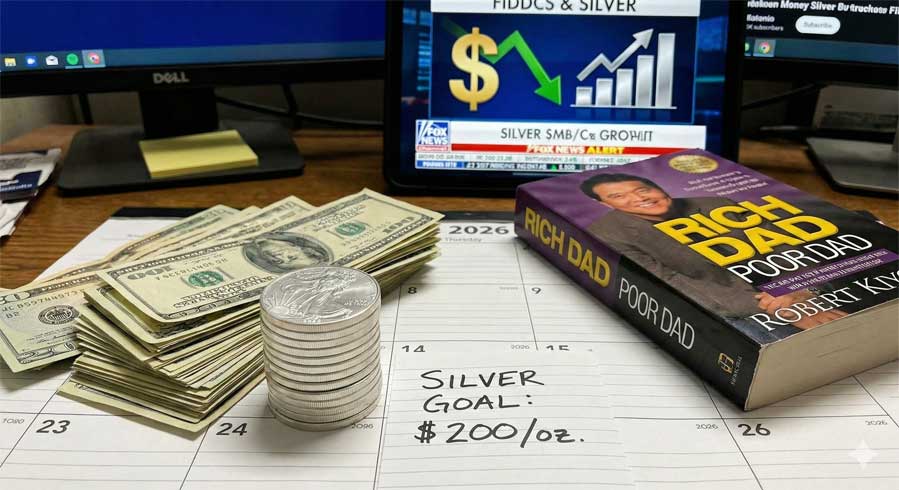
‘Fake Money’ Warning: Robert Kiyosaki Bets Big on Silver Hitting $200 in 2026
PHOENIX — In a financial landscape characterized by unprecedented volatility and shifting global economic alliances, best-selling author and investor Robert Kiyosaki has doubled down on one of his most aggressive market calls to date. The Rich Dad Poor Dad author forecasts that silver, the “poor man’s gold,” is poised to skyrocket to $200 an ounce or more within the year, driven by what he describes as the inevitable collapse of the US dollar.
Kiyosaki’s latest proclamation comes amidst a turbulent start to 2026 for precious metals, which have seen record highs followed by sharp corrections. Undeterred by the short-term noise, Kiyosaki announced this week that he has purchased an additional 600 US Silver Eagles, reinforcing his portfolio against what he terms the “fake money” system of central banks.
The $200 Prediction
Taking to the social media platform X (formerly Twitter), Kiyosaki revealed his latest acquisition while spot silver prices hovered around the $82 mark.
“Just purchased another 600 US Silver Eagles. Today’s spot is $82 an ounce. Still believe silver will reach $200 an ounce…or more…in 2026,” Kiyosaki wrote.
For silver to hit $200 from current levels, it would require a surge of approximately 144% in less than 12 months. While such a move would be historically anomalous for most asset classes, the silver market is notoriously explosive. The metal has already demonstrated its capacity for violent upside moves this year, briefly shattering the $100 ceiling in January before profit-taking forced a retreat.
Kiyosaki’s thesis is not merely technical but deeply ideological. He views the current price correction not as a warning sign, but as a final boarding call before a currency crisis devalues fiat savings globally.
“The US dollar is in trouble,” he warned in the same post. “Savers of fiat currency (fake $) biggest losers.”
The “Fake Money” Thesis
Central to Kiyosaki’s investment philosophy is the distinction between “real money” (gold and silver) and “fake money” (government-issued fiat currency). For years, he has argued that the decoupling of the US dollar from the gold standard in 1971 turned the global reserve currency into an instrument of debt rather than a store of value.
In 2026, this narrative has found renewed resonance. With US national debt continuing to spiral and geopolitical blocs like BRICS (Brazil, Russia, India, China, South Africa) actively trading in non-dollar currencies, the hegemony of the greenback is facing its stiffest test in decades.
Kiyosaki argues that as trust in sovereign debt erodes, capital will flee back to the safety of tangible assets. unlike fiat currency, which can be printed ad infinitum by the Federal Reserve, silver and gold have finite supplies and intrinsic value.
“History proves that when faith in paper money dies, the masses rush to silver,” Kiyosaki has stated in previous interviews. “It is the people’s money. It is affordable for the average person, unlike gold, which is now out of reach for many.”
Market Context: A Volatile 2026
Kiyosaki’s purchase comes during a period of extreme “whipsaw” price action. January 2026 saw silver prices spike to an all-time high of approximately $121 per ounce, driven by a perfect storm of industrial demand and speculative frenzy. However, the rally was cut short by a strengthening dollar and hawkish signals from the Federal Reserve regarding interest rates, dragging the metal back down to the low $80s.
For momentum traders, this 30% correction is a bear signal. For Kiyosaki, it is a discount.
Market analysts note that the “physical” price of silver—what you pay to buy a coin like a Silver Eagle—often diverges significantly from the “paper” spot price traded on exchanges like COMEX. Premiums on physical silver remain elevated, suggesting that while paper traders are selling, physical buyers are hoarding.
The “Structural Metal” Argument
Beyond the monetary debasement theory, Kiyosaki’s bullishness is supported by hard supply-and-demand fundamentals. He has increasingly referred to silver as a “structural metal,” essential to the modern economy in ways that gold is not.
While gold is hoarded in vaults, silver is consumed. It is the most electrically conductive metal on earth, making it indispensable for:
- Solar Panels: The global push for green energy has exponentially increased the demand for silver paste used in photovoltaic cells.
- Electric Vehicles (EVs): Modern EVs require significantly more silver than internal combustion engines for their electronic control units and battery management systems.
- AI and Electronics: As the artificial intelligence boom demands more powerful chips and servers, the industrial consumption of silver continues to rise.
Data from the Silver Institute projects a fourth consecutive year of structural deficits in 2026, where global demand outstrips mining supply. Above-ground stockpiles are dwindling, creating a powder keg for prices if investment demand spikes simultaneously.
Kiyosaki believes this “green” industrial demand provides a floor for the silver price, while the monetary demand provides the explosive ceiling.
The Risks of the “Rich Dad” Strategy
Despite Kiyosaki’s cult following, mainstream financial advisors often urge caution regarding his extreme predictions. A $200 price target implies a market capitalization for silver that would rival some of the world’s largest companies, a feat that would require a massive influx of capital from institutional investors who have historically shunned the volatile metal.
Critics point out that silver is uniquely vulnerable to economic downturns. Unlike gold, which is a pure safe haven, silver behaves like an industrial commodity. If the “dollar trouble” Kiyosaki predicts leads to a global recession, industrial demand for solar panels and electronics could collapse, dragging silver prices down regardless of its monetary status.
Furthermore, Kiyosaki has made similar doomsday predictions in the past that did not materialize on his timeline. In 2023 and 2024, he predicted massive crashes and swift rallies that took years longer to play out than anticipated.
Why Silver Over Gold or Bitcoin?
While Kiyosaki owns and advocates for Gold and Bitcoin, he frequently highlights silver as the asset with the highest asymmetric upside.
- Gold (trading near $5,000/oz) is seen as wealth preservation. It is steady but unlikely to do a 3x or 4x multiple in a short period.
- Bitcoin is viewed as “digital gold,” but its volatility and regulatory uncertainty make it a wilder ride.
- Silver, at $82, is accessible. A retail investor can buy a single ounce. If Kiyosaki is right and it hits $200, the percentage return dwarfs that of gold.
“Silver is the best bargain today,” Kiyosaki wrote earlier this year. “It is the only asset that is still 50% below its inflation-adjusted highs from 1980.”
Conclusion
Robert Kiyosaki’s $200 silver prediction is more than just a price target; it is a vote of no confidence in the modern financial system. By adding 600 more Silver Eagles to his vault, he is putting his money where his mouth is, betting that the “fake money” experiment is nearing its expiration date.
For the average investor, the takeaway is nuanced. While mortgaging the house to buy silver based on a single tweet is ill-advised, the underlying fundamentals of debt, currency debasement, and industrial scarcity suggest that having some exposure to the white metal may be a prudent hedge in 2026.
As the Federal Reserve navigates a soft landing and geopolitical tensions simmer, the world is watching to see if the “poor man’s gold” will finally have its day in the sun—and if Kiyosaki will once again say, “I told you so.”