
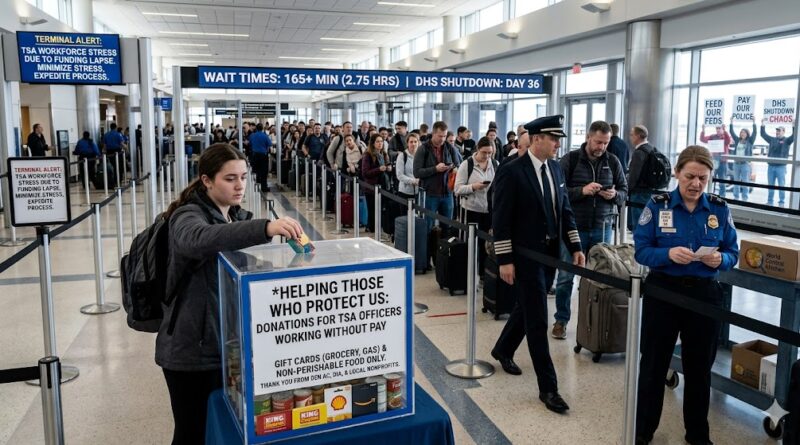
Feeding the Frontlines: Nonprofits and Unions Rally to Support TSA Officers as DHS Shutdown Enters Day 36
WASHINGTON, D.C. — In a scene more commonly associated with international war zones or the aftermath of a category-five hurricane, the charity World Central Kitchen has set up mobile kitchens at major U.S. aviation hubs. But the “disaster” they are responding to isn’t natural—it is political.
As of Sunday, March 22, 2026, the partial government shutdown affecting the Department of Homeland Security (DHS) has officially entered its 36th day. For the roughly 50,000 Transportation Security Administration (TSA) officers tasked with protecting the nation’s skies, the milestone is a grim one: it marks over a month without a full paycheck, sparking a nationwide humanitarian mobilization to keep federal officers from going hungry.
A Crisis of Conscience: Charities Step into the Breach
From Denver to San Diego, the infrastructure of American charity is pivotally shifting to support federal employees who, under normal circumstances, are the ones providing for their families and communities.
The San Diego Response
On Thursday, Feeding San Diego began an emergency distribution operation, delivering 400 specialized food boxes to agents near the airport. These boxes—filled with staples like pasta, beans, and peanut butter, alongside fresh strawberries and potatoes—were requested directly by the TSA and the San Diego County Regional Airport Authority.
“We need to work directly with the people who have direct access to these employees,” said Carissa Casares of Feeding San Diego. “Ethics rules around giving gifts to federal employees make it difficult for those affected to receive help directly, so we coordinate with the airports to get this food to them at a time and location that is most convenient.”
World Central Kitchen in D.C.
Chef José Andrés’ World Central Kitchen, known for its rapid response in places like Gaza or post-earthquake Haiti, has shifted its focus to the Washington, D.C. area. The organization is now providing daily meals to TSA officers at Dulles and Reagan National, ensuring that those responsible for national security don’t have to choose between a commute to work and a hot meal.
The Anatomy of the Shutdown: Why the Paychecks Stopped
The current funding lapse, which began on February 14, 2026, is rooted in a fierce legislative standoff over the future of American immigration enforcement.
The Catalyst for the Deadlock:
The shutdown was triggered when Congressional Democrats refused to fund Immigration and Customs Enforcement (ICE) and Customs and Border Protection (CBP). The refusal follows the controversial killings of two U.S. citizens, Alex Pretti and Renee Good, in Minneapolis during an ICE operation earlier this year.
The Demand:
Democratic leaders, led by House Minority Leader Hakeem Jeffries, have demanded “bold and dramatic” statutory changes to how ICE and CBP operate before they will release another dime of taxpayer funding. Conversely, the White House has remained steadfast, even threatening to deploy ICE agents to airports to help move lines (a move that has only deepened the political divide).
The Human Cost: 120,000 Working Without Pay
While the political debate rages in the halls of the Capitol, the “Human Cost” is visible in every airport terminal in the country.
- Total DHS Employees Affected: Over 120,000 workers are currently performing their duties without pay.
- TSA Workforce: Roughly 50,000 officers are on the front lines, many of whom live paycheck to paycheck.
- The “Sick-Out” Surge: As the shutdown drags on, an increasing number of TSA officers have been forced to call out—not in protest, but to find temporary side work to pay rent and buy groceries.
This crisis comes less than three years after the record-breaking 43-day shutdown of 2018-2019, which left scars on the federal workforce that many say have never truly healed.
Navigating the Ethics Minefield
One of the most complex aspects of this “charity for feds” movement is the strict federal ethics guidelines. Generally, federal employees are prohibited from accepting gifts from “prohibited sources” (like the public or contractors).
To bypass these hurdles:
- Airport Coordination: Nonprofits are working as “third-party providers” through airport authorities.
- “Pantry” Systems: Many airports have established “employee pantries” where officers can grab food items discreetly during their breaks.
- Gift Card Boxes: At Denver International Airport, donation boxes for gift cards have appeared, though they are managed by unions and nonprofit partners to ensure legal compliance.
Frequently Asked Questions (FAQs)
Why can’t TSA officers just quit and find other jobs?
Many have. Since the shutdown began, over 400 TSA officers have officially resigned. However, for those with years of service, leaving means forfeiting federal benefits and a career path they have spent a decade building.
Is air travel still safe during the shutdown?
Federal officials insist that security standards have not been lowered. However, with fewer agents and higher stress levels, wait times have increased significantly at major hubs like Atlanta (ATL) and New York (JFK).
How can I help TSA officers at my local airport?
The best way to help is through established nonprofits like Feeding America or World Central Kitchen, which have the legal framework to distribute aid without violating federal ethics laws.
When will the shutdown end?
Negotiations remain at a standstill. Democrats are holding firm on ICE reform, while the White House refuses to sign any bill that “handstrings” immigration enforcement.
The Bottom Line: A Thinning Line of Defense
As travelers walk past donation boxes and see world-renowned chefs serving soup to the men and women in blue uniforms, the irony is lost on no one. The very people tasked with defending the nation’s borders and skies are currently dependent on the charity of others to defend their own dinner tables.
Reference & Ways to Help: Support Federal Workers Impacted by the DHS Shutdown