
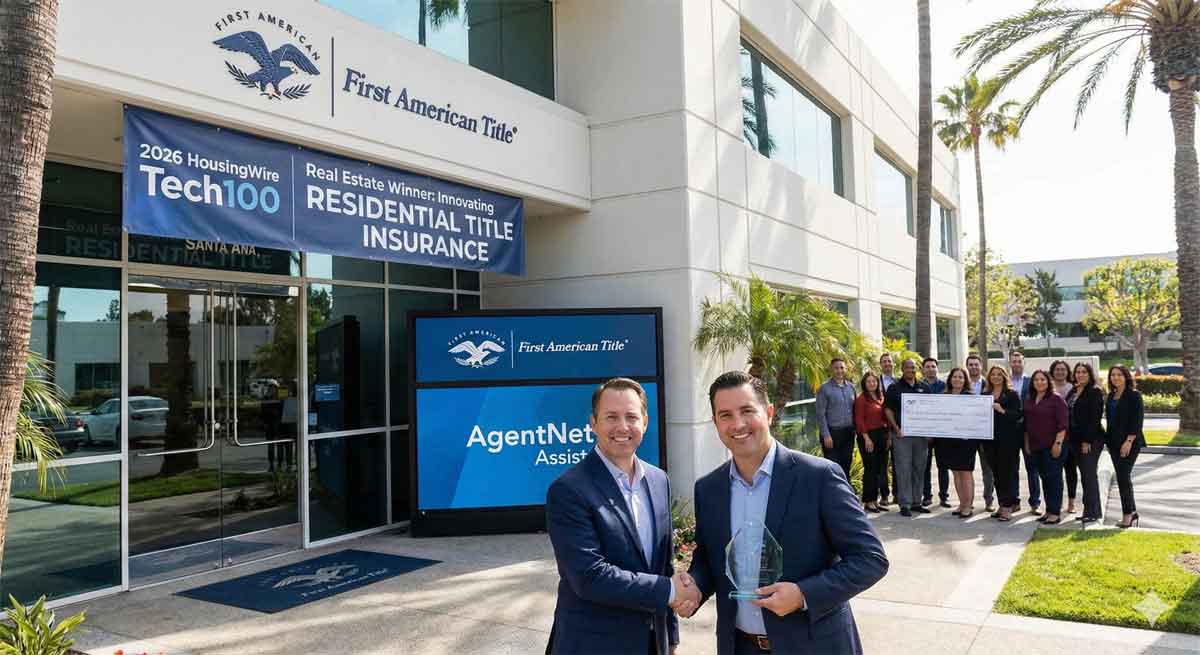
First American Title Named a 2026 HousingWire Tech100 Real Estate Winner: Innovating RESIDENTIAL TITLE INSURANCE
SANTA ANA, Calif. — First American Title Insurance Company, a leading provider of title insurance and settlement services, has been named a 2026 HousingWire Tech100 Real Estate winner. This prestigious recognition highlights the company’s pivotal role in transforming the residential title insurance landscape through its advanced digital platforms and fraud-prevention technologies.
The HousingWire Tech100 awards honor the most innovative and impactful technology companies in the housing economy. First American Title secured its spot on the list for the second consecutive year, driven largely by the evolution of its AgentNet® platform. This digital ecosystem has become a cornerstone for title agents, integrating cutting-edge tools that address the industry’s most critical challenges, including operational efficiency and the rising threat of real estate fraud.
“Earning this recognition for the second consecutive year represents a powerful affirmation of the innovative solutions we offer to support our title agents,” said Stephen Vincini, president of First American Title’s Agency Division. “We’re committed to constantly evolving to meet the needs of our title agents, so they can deliver the certainty and trust needed to power seamless real estate transactions for their customers and grow their businesses.”
A key factor in the company’s selection was the recent launch of AgentNet Assist, a generative AI-powered research assistant embedded directly into agent workflows. Unlike generic AI models, this tool is trained on over 130 years of First American’s proprietary underwriting data, providing agents with instant, reliable answers to complex title questions.
In addition to AI, the platform now features robust fraud-fighting capabilities. With real estate wire fraud and seller impersonation on the rise, First American Title has integrated real-time transaction alerts, identity verification, and contact validation into its systems. these tools are designed to detect anomalies early, protecting both agents and consumers from substantial financial loss.
“The 2026 Tech100 honorees represent the companies pushing housing forward in real, measurable ways,” said Sarah Wheeler, editor-in-chief at HousingWire. “They’re building technology that solves core industry challenges, from operational efficiency to better consumer experiences, and setting a higher standard for what innovation in housing truly looks like.”
As a subsidiary of First American Financial Corporation (NYSE: FAF), the company continues to leverage its financial strength and deep data assets to lead the digital transformation of the industry. By streamlining the complexities of residential title insurance, First American Title is setting a new benchmark for speed, security, and accuracy in real estate transactions.
This video provides an overview of the AgentNet platform, detailing the features and interface that contributed to First American Title’s recognition as a Tech100 winner. WASHINGTON (Feb. 7, 2026) — The U.S. residential title insurance industry faces a defining spring season, caught in a high-stakes pincer movement between federal regulators in Washington and sophisticated cyber-criminal syndicates operating in the digital shadows.
As the 2026 spring homebuying market kicks into gear, title insurers and settlement agents are grappling with three converging forces: the looming expiration of Fannie Mae’s controversial title waiver pilot, an aggressive crackdown on closing costs by the Consumer Financial Protection Bureau (CFPB), and an explosion of AI-driven fraud that has turned routine real estate transactions into cybersecurity battlegrounds.
The “Pilot” Cliff: May 2026 Looming
The immediate focal point for the industry is the approaching May 31, 2026 deadline for the Federal Housing Finance Agency’s (FHFA) “Title Acceptance Pilot.” Launched in 2024 and expanded in mid-2025 to include major players like Westcor Land Title Insurance Co., the program has allowed lenders to sell certain low-risk refinance loans to Fannie Mae without a traditional lender’s title insurance policy.
For nearly two years, the pilot has been a lightning rod. Proponents argue it saves homeowners hundreds of dollars in “unnecessary” fees on refinances where the title risk is statistically negligible. Opponents, led by the American Land Title Association (ALTA), describe it as a roll of the dice that shifts catastrophic risk onto taxpayers and exposes homeowners to long-tail title defects.
“We are approaching a critical decision point,” says Sarah Jenkins, a senior policy analyst at HousingWire. “If the FHFA decides to extend or—more controversially—expand this program to purchase transactions, it signals a fundamental shift in how American mortgages are underwritten. The industry is lobbying hard right now to ensure this pilot dies on the vine in May.”
ALTA has maintained a fierce offensive, arguing that the “savings” offered by the waivers are illusory when weighed against the risk of unrecorded liens or forgery—risks that traditional title insurance covers, but which alternative products like Attorney Opinion Letters (AOLs) often exclude.
The “Invisible” Thief: AI and Deepfake Fraud
While the regulatory battle plays out in boardrooms, title agents on the ground are facing a more visceral threat. The 2026 cybersecurity landscape has shifted dramatically, with “deepfake” technology moving from a theoretical risk to a daily operational hazard.
According to a 2026 fraud forecast by Experian, the real estate sector is a prime target for “agentic AI”—autonomous software bots capable of executing complex scams without human intervention. The most alarming trend is the rise of synthetic identity fraud and deepfake voice cloning.
“It used to be that you could spot a wire fraud attempt by checking the email address for a typo,” explains Marcus Thorne, Chief Information Security Officer for a mid-sized regional title agency. “Now, we are seeing bad actors use AI to clone the voice of a real estate agent or a buyer. They call the title officer, sound exactly like the client, and authorize a change in wire instructions. It’s terrifyingly effective.”
In one reported case in late 2025, a title agency nearly transferred $1.2 million in closing funds to a fraudulent account after receiving a video call from a “seller” who was actually a real-time deepfake avatar.
In response, the industry is rapidly pivoting from a paperwork business to a cyber-defense operation. Major underwriters are mandating multi-factor authentication (MFA) that goes beyond SMS texts, moving toward biometric verification and blockchain-based encrypted communication channels for wire instructions.
The “Junk Fee” War Continues
Compounding the pressure is the CFPB’s relentless campaign against “junk fees.” In its bid to lower housing costs for the average American, the Bureau has kept title insurance premiums in its crosshairs, categorizing them alongside surprise overdraft fees and concert ticket surcharges.
The industry argues this characterization is misleading. “Title insurance is not a ‘junk fee’—it is a one-time premium for a lifetime of protection,” ALTA CEO Chris Morton noted in a recent statement responding to CFPB inquiries. “Lumping a regulated insurance product in with ‘resort fees’ ignores the billions of dollars in claims we pay out to protect property rights.”
However, the regulatory pressure is having a market effect. To compete, more lenders are exploring Attorney Opinion Letters (AOLs) as a lower-cost alternative to title insurance. While AOLs have gained some traction in the refinance market, adoption in purchase transactions remains sluggish due to lender hesitation over coverage gaps. An AOL generally confirms that a title search was done correctly, but unlike insurance, it does not typically indemnify the owner against fraud, forgery, or errors that aren’t on the public record.
2026 Market Outlook: Stability Returns
Despite the headwinds, the economic picture for 2026 offers a glimmer of relief. After a volatile 2024 and 2025, the housing market is finding a new equilibrium. Interest rates have softened slightly, stabilizing near the 6% range, which has unlocked some pent-up inventory and spurred a modest recovery in transaction volume.
Fitch Ratings and other market analysts project a “stable” year for title insurers, with profitability supported by robust capitalization and a tech-driven reduction in operational costs. The “refinance boom” days of 2021 are not returning, but the “freeze” of 2023 appears to be thawing.
“The survivors of the last three years are leaner and more tech-savvy,” says Jenkins. “The companies that are thriving in 2026 are the ones that have successfully integrated AI to speed up title searches while simultaneously building a fortress around their wire transfer processes.”
The Bottom Line for Homebuyers
For the consumer closing on a home in February 2026, the landscape is complex. You might see lower closing costs if you qualify for a waiver program, but you will also face more rigorous identity checks than ever before.
“The closing ceremony is no longer just about signing papers,” Thorne warns. “It’s about proving you are who you say you are, to a person who might be skeptical that you are real. That is the new normal.”
As the clock ticks down to the May 31 pilot expiration, the entire housing finance ecosystem is watching. The outcome will decide whether the future of American homeownership is insured by private capital, or underwritten by government waivers.