
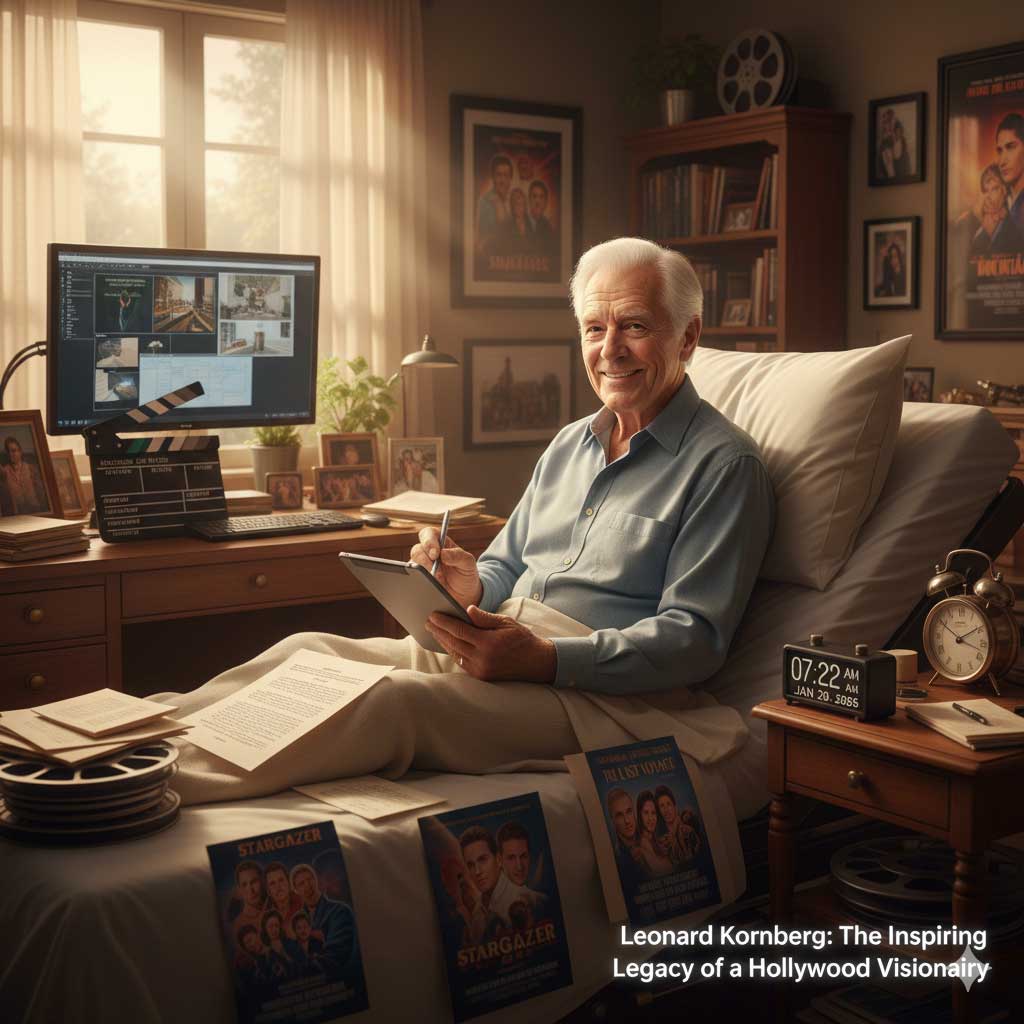
From King Kong to Paddington: Remembering Hollywood Legend Leonard Kornberg
The entertainment world is mourning the loss of Leonard Kornberg, a titan of studio production and story analysis, who passed away on January 3, 2026, at the age of 75. While the news of his passing has only recently been made public, tributes are already pouring in for a man whose influence on the modern blockbuster era was as profound as his personal courage.
Kornberg’s death comes after a remarkable 24-year battle with Adult Polyglucosan Body Disease (APBD), a rare and relentless neurodegenerative disorder. Despite the physical toll of the illness, Kornberg’s career remained a testament to the idea that creativity knows no physical bounds.
A Career Built on the Power of Story
Leonard Kornberg didn’t just work in Hollywood; he helped shape its narrative DNA. His career began in the high-stakes environment of the 1980s, where he served as a story analyst for Carson Productions, the company founded by late-night legend Johnny Carson.
His keen eye for structure and character quickly caught the attention of major studios, leading to pivotal roles at 20th Century Fox and Universal Pictures. At Universal, Kornberg rose through the ranks with a meteoric trajectory:
- Director of Development
- Vice President of Production
- Senior Vice President of Production
During his tenure, he was instrumental in greenlighting projects that balanced commercial appeal with narrative depth, earning him a reputation as a “writer’s executive.”
The Long Battle: Understanding APBD
In 2001, at the height of his professional powers, Kornberg was diagnosed with Adult Polyglucosan Body Disease.
What is APBD? It is an extremely rare genetic condition—with fewer than a few hundred confirmed cases globally—that affects the nervous system. It is caused by a deficiency in the glycogen branching enzyme, leading to the accumulation of “polyglucosan bodies” that damage nerve cells.
The disease is often misdiagnosed as Multiple Sclerosis (MS) or ALS because it gradually impairs movement, strength, and sensory function. For Kornberg, the diagnosis was a turning point, but not an end point.
Working Through the Unthinkable
As his mobility declined, Kornberg famously refused to retire. In an industry often criticized for being fast-paced and exclusionary, he adapted his environment to keep his mind in the game.
Even when the disease left him bed-bound in his final years, Kornberg remained a sought-after voice. He returned to his roots at Universal to conduct high-level story analysis and served as a consulting producer for Canal Plus. His colleagues frequently noted that while his body was failing, his “story sense” remained as sharp as it was in the 1980s.
The “Uncredited” Architect
Much of Kornberg’s work in the last decade was done behind the scenes. As an uncredited producer, he mentored a new generation of executives and writers, providing the “final polish” on scripts that would go on to become global hits. He proved that a great producer doesn’t need to be on a film set to build a world.
Tributes from the Industry
Following the announcement of his death, former colleagues have shared their memories of a man who was as kind as he was brilliant.
- “Leonard saw the heart of a movie before the first frame was even shot,” said one former Universal peer. “He fought his illness with a quiet dignity that left us all in awe.”
- Representatives for Canal Plus praised his “indomitable spirit,” noting that his contributions to their recent slate were invaluable.
Leonard Kornberg is survived by a legacy of cinematic excellence and a community of storytellers who owe their careers to his early mentorship. His life stands as a powerful reminder that while a body may be confined, a vision can remain limitless.