
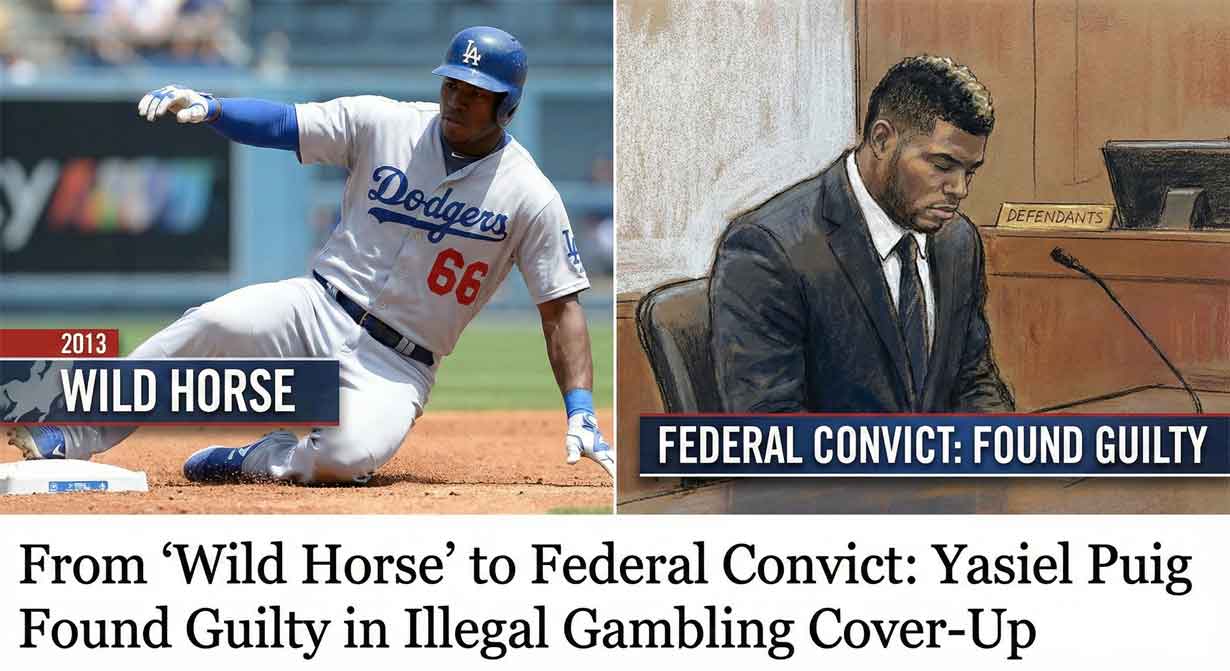
From ‘Wild Horse’ to Federal Convict: Yasiel Puig Found Guilty in Illegal Gambling Cover-Up
LOS ANGELES — The saga of Yasiel Puig, once the electrifying “Wild Horse” who captivated Los Angeles with his raw talent and unbridled energy, took a somber and definitive turn on Friday. A federal jury in downtown Los Angeles found the former Dodgers outfielder guilty of obstructing justice and lying to federal investigators, capping a years-long legal battle stemming from an illegal sports betting ring.
Puig, 35, stood silent as the verdict was read on the 13th day of the trial, a stark contrast to the boisterous persona that once made him a fan favorite at Dodger Stadium. The jury convicted him on one count of obstruction of justice and one count of making false statements to federal officials. The conviction brings a potential end to Puig’s hopes of an MLB comeback and carries significant prison time.
U.S. District Judge Dolly M. Gee scheduled sentencing for May 26, 2026. Puig faces a statutory maximum sentence of 10 years in federal prison for the obstruction of justice count and up to five years for making false statements. While federal sentencing guidelines typically recommend less than the maximum, the conviction marks a devastating nadir for a player whose arrival in 2013 sparked “PuigMania.”
The Wayne Nix Connection
The charges against Puig were not for gambling itself, but for his actions during the federal government’s investigation into an illegal gambling business run by Wayne Nix, a 49-year-old former minor league pitcher from Newport Coast.
Nix’s operation, which catered to professional athletes and wealthy individuals, had been under scrutiny since 2017. Prosecutors alleged that Nix ran a sprawling illicit bookmaking operation, laundering proceeds and hiding income from the Internal Revenue Service. Nix pleaded guilty to conspiracy to operate an illegal sports gambling business and filing a false tax return and is currently awaiting sentencing.
It was the investigation into Nix’s financial web that eventually ensnared Puig. According to the U.S. Attorney’s Office, the trail of money and digital footprints led directly to the Cuban outfielder.
Evidence presented during the trial painted a picture of a gambler deeply entrenched in the Nix operation. Prosecutors revealed that Puig began placing bets on sporting events in May 2019 through an intermediary connected to Nix. At the time, Puig was in the midst of his final Major League season, splitting time between the Cincinnati Reds and the Cleveland Indians (now Guardians) after being traded by the Dodgers the previous winter.
The betting activity was frantic and substantial. By June 2019, just a month after he began wagering with the ring, Puig owed Nix’s business $282,900 in gambling losses. Despite the mounting debt, the betting continued. Between July and September 2019, Puig placed 899 bets on tennis, football, and basketball games through a Costa Rica-based website known as “Sand Island Sports,” which was associated with Nix’s operation.
Crucially, prosecutors did not present evidence that Puig bet on baseball, a cardinal sin in the sport that led to the lifetime ban of Pete Rose. However, the sheer volume of bets—averaging nearly 10 a day over that three-month span—highlighted the intensity of his involvement.
The Cover-Up
The government’s case against Puig centered not on the bets, but on the lies. The crux of the prosecution’s argument was that when federal agents came knocking, Puig chose to deceive them rather than cooperate.
In January 2022, federal investigators interviewed Puig via video conference. He was accompanied by his then-lawyer. During the 90-minute interview, agents explicitly warned Puig that lying to federal investigators was a crime—a standard admonition in such proceedings. Despite these warnings, Puig vehemently denied knowing anything about the Nix gambling business or the individuals involved in it.
According to court papers, prosecutors presented a timeline of missed opportunities for Puig to come clean. During a break in that January interview, government lawyers privately flagged to Puig’s attorney that his client’s statements were directly contradicting evidence they already possessed—including text messages and wiretap info obtained during the Nix probe.
“Counsel conferred with his client outside the presence of the government, but defendant did not change his prior statements,” prosecutors wrote in their trial memorandum. Puig returned to the video conference and doubled down on his denials.
The “smoking gun” that likely swayed the jury was Puig’s own voice. In March 2022, two months after his interview with the feds, Puig sent a recorded voice message via WhatsApp to a friend. The message, played for the jury, seemed to confirm his intent to deceive.
“I no said nothing, I not talking,” Puig said in English in the recording, referring to his interview with federal prosecutors. “I said that I only know [Puig’s alleged bookie] from baseball.”
Prosecutors argued this message was a clear admission that he had stonewalled investigators to protect himself and his associates. Furthermore, the government alleged that Puig lied on immigration documents. As part of his naturalization process to become a U.S. citizen in 2019, Puig denied on an application that he had ever gambled illegally or received income from illegal gambling. He repeated this denial during an in-person interview with immigration officials.
The Failed Gamble on a Plea Deal
The road to Friday’s conviction was paved with legal reversals and high-stakes maneuvering. In August 2022, it appeared the case would be resolved quietly. Puig reached a plea agreement with the U.S. Attorney’s Office in Los Angeles. Under the terms of that deal, he agreed to plead guilty to a single count of lying to federal authorities. He would pay a fine of at least $55,000, and in exchange, he would likely receive probation and avoid prison time.
However, in a move that shocked legal observers, Puig reneged on the deal weeks later. Because he had not yet formally entered his guilty plea before a judge, the agreement was not binding. A Los Angeles federal judge ruled that Puig had the right to withdraw.
Puig, seemingly emboldened, released a statement at the time declaring his innocence. “I want to clear my name,” he said. “I never should have agreed to plead guilty to a crime I did not commit.”
That decision to fight the charges proved to be a catastrophic miscalculation. In response to the withdrawal, federal prosecutors significantly escalated the case. In January 2023, they returned with a new indictment, adding the more serious charge of obstruction of justice to the original false statement charge.
The case was subsequently delayed for over a year due to appeals regarding the admissibility of facts contained in the withdrawn plea agreement. When the trial finally commenced, the defense faced a mountain of evidence, including the betting records and Puig’s own recorded admissions.
Defense counsel argued throughout the trial that the government’s interpretation of Puig’s betting activity was flawed and that language barriers and confusion contributed to the alleged false statements. They disputed the characterization of their client, a Cuban refugee who navigated a harrowing journey to the U.S., as a criminal mastermind intent on obstructing justice.
However, the jury was unpersuaded, delivering a guilty verdict on all counts.
A Career in Twilight
The conviction casts a long shadow over the career of a player who once seemed destined for Cooperstown. Puig defected from Cuba in 2012 and signed a seven-year, $42 million contract with the Dodgers. He made his debut in June 2013, hitting four home runs in his first five games and showcasing a cannon arm in right field.
But his career was often as turbulent as it was brilliant. Clashes with managers, teammates, and the media became frequent. After six seasons in Los Angeles, he was traded to Cincinnati, then Cleveland. He last played in the MLB in 2019. Since then, he has played professionally in the Mexican League, the Dominican Winter League, and the KBO League in South Korea, always maintaining hope for an MLB return.
In August 2025, hinting at the legal battle to come, Puig posted a defiant message on X (formerly Twitter): “This story isn’t over yet, and you weren’t told the full story the first time.”
Now, the story has reached a legal conclusion, though perhaps not the one Puig envisioned.
The sentencing in May will determine the final cost of the scandal. While the statutory maximum is 15 years combined, legal experts suggest the actual sentence will likely be lower, though prison time is now a very real possibility given the obstruction charge and the rejection of the plea deal.
For the Dodgers faithful, the image of Puig circling the bases with his tongue out is now juxtaposed with the reality of a federal conviction. The illegal gambling ring that started with a minor league pitcher has ended with a major league tragedy.