
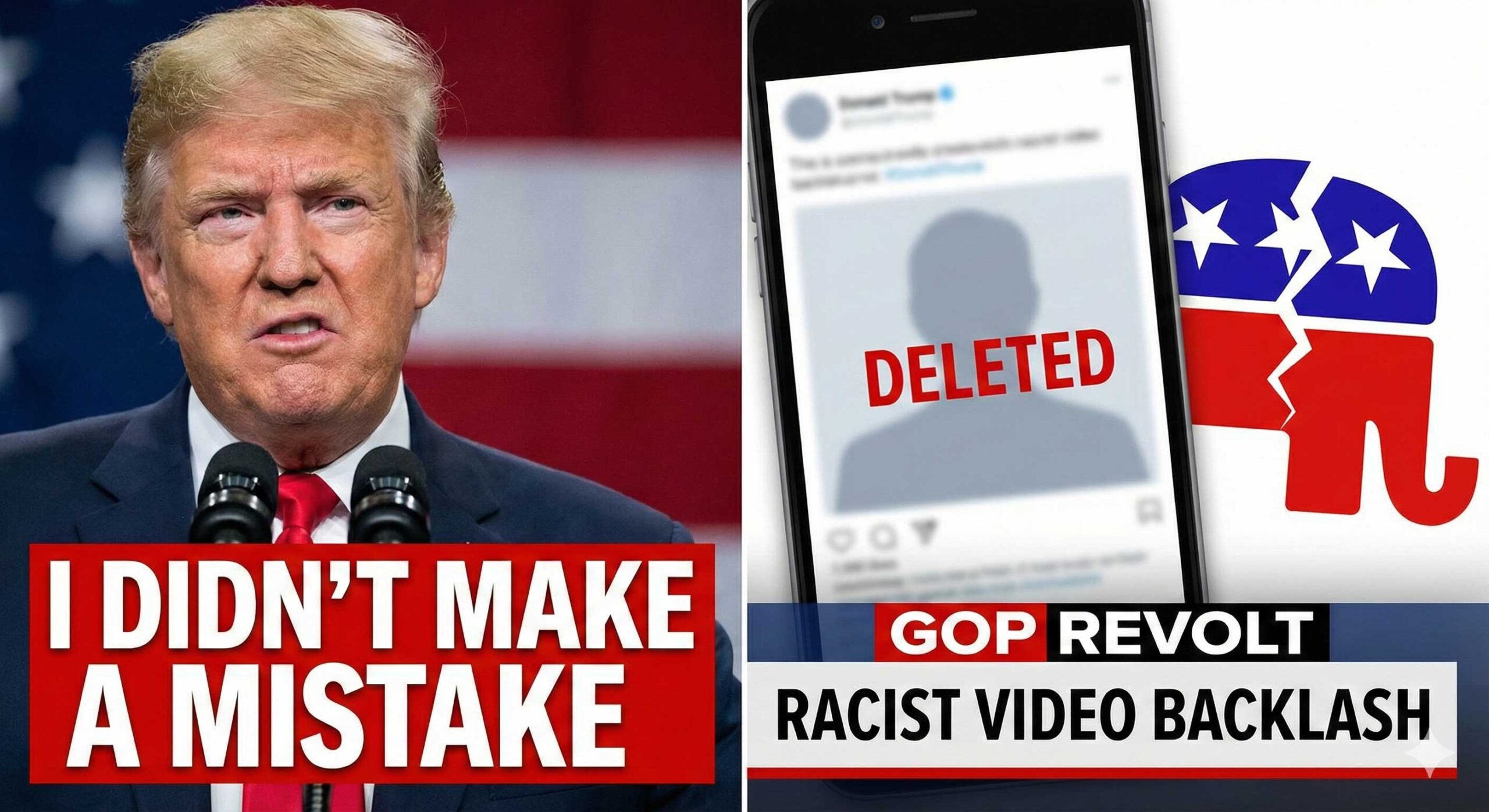
‘I Didn’t Make a Mistake’: Trump Defiant After Deleting Racist Video of Obamas Amidst GOP Revolt
WASHINGTON — In a late-night social media flurry that has reignited questions about racial rhetoric in the highest echelons of American politics, President Donald Trump has plunged the political landscape into chaos. Late Thursday, the President posted—and subsequently deleted—a blatantly racist video on Truth Social depicting former President Barack Obama and First Lady Michelle Obama as apes.
Despite the swift deletion of the post and an unusually strong public outcry from members of his own Republican Party, President Trump remained defiant on Friday. Speaking to reporters aboard Air Force One, he insisted, “I didn’t make a mistake,” claiming ignorance of the video’s offensive conclusion while attempting to shift the blame to his staff.
This incident, occurring just as the 2026 midterm election cycle begins to heat up, offers a stark glimpse into an administration struggling to contain self-inflicted damage while simultaneously doubling down on the very rhetoric that alienates moderate voters.
The Incident: A Late-Night Flurry on Truth Social
The controversy began late Thursday, February 5, 2026, during what has become a hallmark of the Trump presidency: a late-night stream of consciousness on Truth Social. Among a barrage of posts promoting conspiracy theories about the 2020 election and alleging voter fraud in Georgia, one video stood out.
The 62-second clip initially appeared to be a standard campaign-style video focusing on election integrity—a recurring theme for Mr. Trump. However, the video took a sharp and disturbing turn in its final moments. Spliced near the end, and set to the upbeat melody of “The Lion Sleeps Tonight,” were doctored images portraying the nation’s first Black president and first lady as apes.
The use of simian imagery to denigrate Black people is one of the oldest and most pernicious racist tropes in history. Its inclusion in a video shared by the President of the United States sent shockwaves through the political ecosystem.
The video remained on the President’s personal account for long enough to be downloaded, screen-recorded, and shared across X (formerly Twitter), TikTok, and Facebook, ensuring that the Truth Social deletion that followed came too late to stop the spread.
The Defense: “I Didn’t See the Whole Thing”
The following day, Friday, February 6, presented a chaotic scene as the White House scrambled to respond. The deletion of the link from Truth Social was widely interpreted as a rare admission of error—a “walk-back” from a President who famously never apologizes.
However, any hope for contrition was dashed when Mr. Trump emerged from the cabin of Air Force One to speak with the press.
When pressed on the video, Mr. Trump offered a defense based on ignorance rather than malice. “I just looked at the first part, it was about voter fraud in some place, Georgia,” Mr. Trump told reporters. “I didn’t see the whole thing.”
This explanation—that he shared a video without vetting it entirely—raises serious questions about the information pipeline reaching the President. However, Mr. Trump quickly pivoted to a familiar tactic: deflecting blame to his subordinates.
“I gave it to the people, generally they’d look at the whole thing but I guess somebody didn’t,” he said.
This statement attempts to absolve the President of direct responsibility, framing him as a passive participant in his own social media output. Yet, when asked directly if he regretted the action or if the post was an error, his defiance returned.
“No, I didn’t make a mistake,” he declared.
This refusal to apologize, even after deleting the content, highlights a central tenet of the Trump political brand: never show weakness, never admit fault, and always claim to be the victim of circumstance or incompetence by others.
The GOP Reaction: A Party Divided
Perhaps the most significant development in this saga is the reaction from the Republican Party. In the past, GOP lawmakers have often remained silent or offered tepid defenses of the President’s controversial statements. This time, the response was different.
The New York Times reported an “unusually strong and public outcry” from members of Trump’s own party. While specific names were not immediately released in the initial report, the characterization of the backlash suggests a shifting tide. With the 2026 midterms looming, vulnerable Republicans in swing districts may be calculating that the cost of defending such overt racism is finally too high.
This internal revolt poses a danger to the President. If the GOP coalition fractures over issues of basic decency and racial sensitivity, Mr. Trump’s ability to push his legislative agenda—and his narrative regarding the 2020 election—could be severely compromised.
Why This Backlash is Different
- Severity of Imagery: Unlike dog whistles or coded language, the imagery used in the video was explicit and undeniable in its racist intent.
- Targeting the Obamas: The Obamas remain highly popular figures nationally. Attacking them with racial slurs risks alienating independent voters who might otherwise be receptive to Republican economic messages.
- Fatigue: After years of defending the President’s social media habits, many lawmakers may simply be exhausted.
A Pattern of Behavior: The Trump-Obama Dynamic
This incident cannot be viewed in isolation. It is the latest chapter in a long history of Mr. Trump using degrading remarks and promoting offensive imagery regarding people of color, and specifically the Obamas.
- The Birther Movement: Mr. Trump’s political rise was fueled by the false conspiracy theory that Barack Obama was not born in the United States.
- Previous Slurs: Throughout his administration, critics have noted a pattern of singling out Black journalists, lawmakers, and athletes for questioning their intelligence or patriotism.
The splicing of this racist caricature into a video about voter fraud is also telling. It inextricably links the President’s false claims about a stolen election with racial animus, reinforcing the narrative that Black votes in cities like Atlanta (Georgia) are illegitimate.
Furthermore, reports indicate that this is not just a “Trump problem” but a systemic issue within his current administration. Racist images and slogans have reportedly become common on government websites and accounts, with the White House, Labor Department, and Homeland Security Department all having promoted posts that echo white supremacist messaging.
The Role of Truth Social and Tech Policy
The platform itself, Truth Social, plays a central role in this controversy. As an echo chamber for the President’s most ardent supporters, it often serves as a testing ground for content that would be immediately flagged or removed on other platforms.
The decision to delete the post is significant. It implies that even within the permissive environment of Truth Social, there are lines that—once crossed—trigger a damage control response. However, the “delete and deny” strategy is complicated by the internet’s permanence. The video has already been archived by watchdogs and journalists, ensuring it will remain a talking point throughout the election cycle.
This incident also reignites the debate over Section 230 and the responsibility of platforms to moderate content, even when that content comes from a world leader.
Analysis: The Strategy of Chaos
Why would the President’s team allow such a video to be posted? And why, after deleting it, would the President refuse to apologize?
Political strategists suggest several possibilities:
- Distraction: The controversy shifts the news cycle away from other damaging stories or policy failures.
- Base Mobilization: While the video offends the general public, it may quietly signal to the far-right elements of Mr. Trump’s base that he shares their cultural grievances.
- Incompetence: As Mr. Trump suggested, it may simply be a case of a hollowed-out staff failing to vet content in a chaotic West Wing environment.
However, the refusal to apologize (“I didn’t make a mistake”) suggests a strategic calculation: that apologizing is a sign of weakness that his base would punish more severely than the racism itself.
What This Means for 2026
As the calendar moves deeper into February 2026, the political ramifications of this event are just beginning to take shape.
- For Democrats: This provides fresh ammunition to paint the Republican Party as beholden to extremism and racism. Expect to see this video cited in fundraising emails and attack ads.
- For Republicans: It forces a “choose a side” moment. Do they condemn the President and risk his wrath, or stay silent and risk losing suburban voters?
- For the White House: The administration is now on defence. The narrative of a disciplined second term is crumbling under the weight of late-night posting sprees.
The White House response—described by the Times as moving from “defiance to retreat to doubling down”—indicates an administration without a clear crisis management strategy.
Conclusion: A Line Crossed?
President Trump’s assertion that he “didn’t make a mistake” will likely go down as one of the defining quotes of his presidency. In the face of clear evidence of racism, and despite the tactical retreat of deleting the post, the refusal to acknowledge the harm done speaks volumes about the current state of American political discourse.
As the Department of Homeland Security and other agencies struggle with their own internal messaging issues, the rot appears to be spreading. The question for voters in 2026 will be whether this is the leadership they wish to endorse, or if the “unusual outcry” from the GOP signals the beginning of the end for the Trump era’s unchecked rhetoric.
Key Facts at a Glance
- Date of Incident: Late Thursday, Feb 5, 2026.
- Platform: Truth Social.
- Content: A video about Georgia voter fraud ending with racist caricatures of the Obamas set to “The Lion Sleeps Tonight.”
- President’s Quote: “I didn’t make a mistake.”
- Location of Remarks: Air Force One.
- Current Status: Video deleted; backlash growing.