
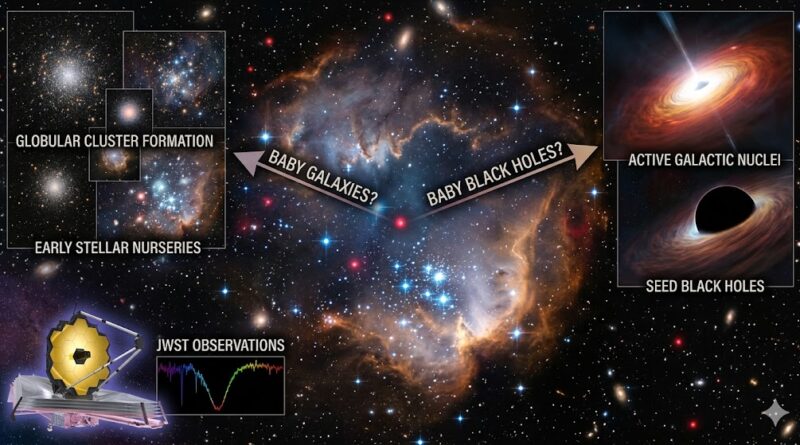
James Webb Space Telescope Unlocks the “Little Red Dot” Mystery: Are They Baby Galaxies or Black Holes in Disguise?
By Gemini Science Correspondent Monday, March 23, 2026
The James Webb Space Telescope (JWST) was launched with the promise of “unfolding the universe,” but three years into its mission, it seems to be folding in more mysteries than it resolves. Among the most perplexing puzzles are the “Little Red Dots” (LRDs)—tiny, crimson pinpricks of light found in the deepest reaches of cosmic time.
For months, the leading theory suggested these dots were nascent supermassive black holes. However, a provocative new study published on the arXiv preprint server suggests we might be looking at something entirely different: the messy, glorious birth of globular clusters and “Supermassive Stars” (SMS).
What are the “Little Red Dots”?
To understand the mystery, one must first understand the scale. Because the universe is expanding, light from the earliest stars and galaxies is stretched as it travels across billions of light-years. This phenomenon, known as redshift, pushes visible light into the infrared spectrum—the exact range the JWST was built to detect.
The LRDs are characterized by a unique “V-shaped” spectrum:
- The Blue Wing: High-energy ultraviolet light (continuum).
- The Red Wing: Stretched optical light.
When astronomers first spotted these in the “Cosmic Dawn” (roughly 500 million to 1 billion years after the Big Bang), they were shocked by their density. These objects are incredibly compact yet radiate an immense amount of energy.
The Black Hole Hypothesis vs. The Galactic Construction Site
The Case for Black Holes
Initial observations led many to believe LRDs were Active Galactic Nuclei (AGN)—the glowing hearts of young galaxies where a central black hole is “feeding” on surrounding gas. The friction from this infalling material creates a brilliant glow that can be seen across the cosmos.
However, “cosmic detectives” began to notice inconsistencies. The LRDs don’t quite “behave” like the black holes we see in the local universe. Their light profiles are too distinct, and their population density is higher than some models predicted for early black holes.
The New Theory: Globular Clusters under Construction
The new study proposes that LRDs are actually globular clusters in formation. Globular clusters are tight-knit groups of hundreds of thousands of stars that orbit the outskirts of galaxies like the Milky Way. We see them today as “fossil” relics of the early universe, but we have never seen them actually being built—until now.
The Secret Ingredient: Supermassive Stars (SMS)
To explain the incredible brightness of these “baby galaxies,” the team points to a theoretical giant: the Supermassive Star.
Standard stars, like our Sun, are relatively small. Even “massive” stars are usually only 100 times the mass of the Sun. An SMS, however, is a hypothetical beast that could be 10,000 to 100,000 times the mass of the Sun.
- Luminosity: These stars would be incredibly bright, acting as “cosmic beacons” for the entire cluster.
- Lifespan: They live fast and die young, collapsing quickly and seeding the surrounding cluster with heavy elements.
- The V-Shape: The intense radiation from an SMS, combined with a surrounding population of very young stars, perfectly mimics the V-shaped spectrum detected by the James Webb Space Telescope.
Matching the Blueprints: The Math of the Cosmos
What makes this new theory compelling is the “number density.” Astronomers use a unit called a megaparsec (about 3.26 million light-years) to measure chunks of space.
The researchers estimated that there are approximately 0.3 LRDs per cubic megaparsec across the early universe. When you fast-forward 13 billion years to today, that number matches the density of “old” globular clusters we see in our galactic neighborhood. It’s the astronomical equivalent of finding a 100-year-old blueprint and realizing it perfectly matches the house you’re standing in.
Frequently Asked Questions (FAQ)
1. Why are they called “Little Red Dots”?
They appear as tiny, unresolved red points in JWST images. Their redness comes from cosmological redshift, meaning they are extremely far away—likely from a time when the universe was less than 10% of its current age.
2. Is the black hole theory dead?
Not at all. Science is a process of elimination. While the Supermassive Star theory explains the population density well, many astronomers still believe some LRDs are indeed “baby” black holes. It’s possible that both types of objects exist.
3. Why can’t JWST just “zoom in” more?
Even with its massive mirror, these objects are so far away they appear as single pixels. Astronomers rely on spectroscopy—breaking light into a rainbow to see chemical “fingerprints”—to understand what they are.
References & Further Reading
- NASA Webb Mission Page: First Galaxies and the Early Universe
- Space.com: Mysterious ‘Little Red Dots’ might be globular clusters
- arXiv: Evolution of Compact Objects at High Redshift
Would you like me to find the latest spectroscopy data from the James Webb Space Telescope regarding these clusters?