
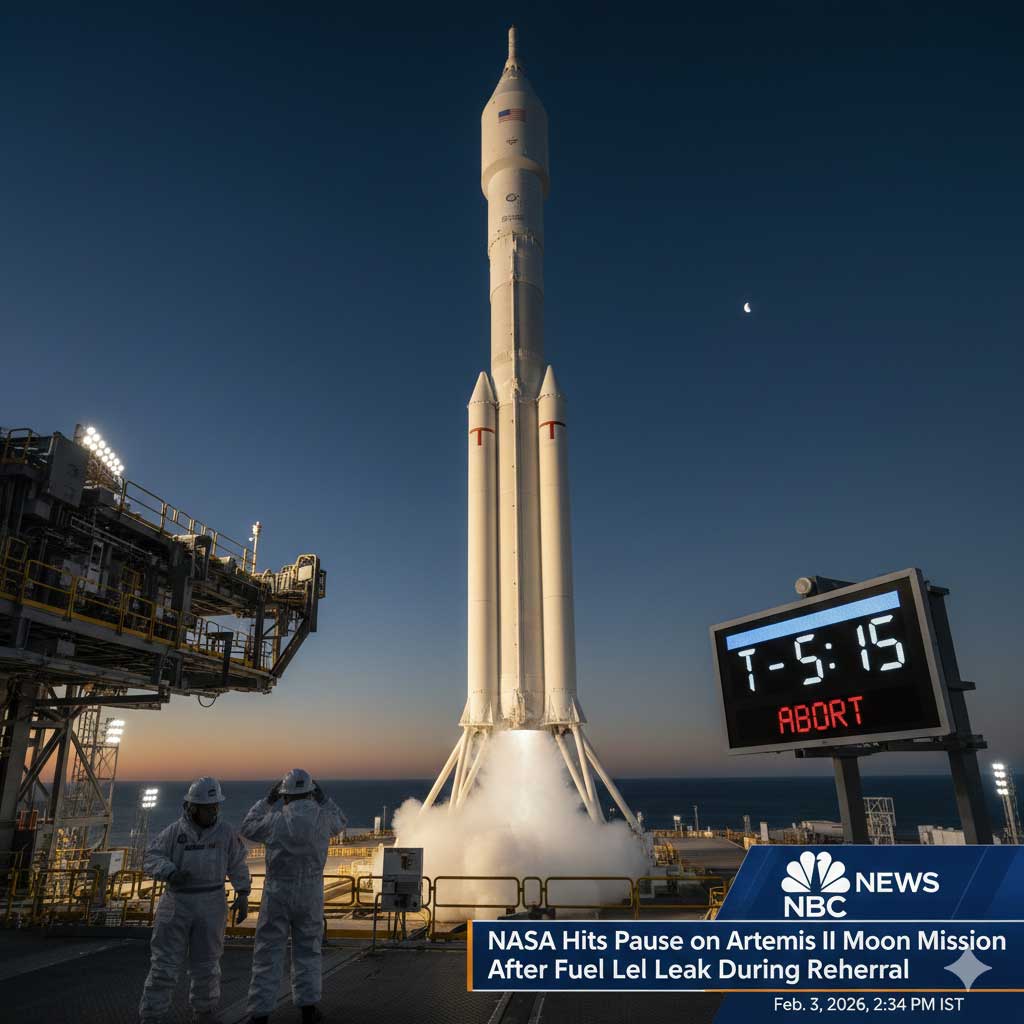
NASA Hits Pause on Artemis II Moon Mission After Fuel Leak During Rehearsal
KENNEDY SPACE CENTER, FL — NASA has officially scrubbed its plans for a February launch of the Artemis II mission, pushing the historic crewed lunar flyby to March 2026. The delay comes after a “wet dress rehearsal” on Tuesday was plagued by a hazardous hydrogen leak, forcing mission managers to halt the countdown just five minutes before the simulated liftoff.
The mission, which will carry four astronauts around the Moon, is a pivotal moment for NASA. However, the agency’s massive Space Launch System (SLS) rocket proved that it still has “new-vehicle jitters” after sitting on the pad for over three years since its last flight.
The Anatomy of the Delay: What Happened?
The mission-critical test was designed to mirror launch day exactly, including the loading of 700,000 gallons of cryogenic propellant. The countdown was progressing smoothly until engineers hit a wall at the T-minus 5 minutes and 15 seconds mark.
- The Hydrogen Leak: Sensors detected a dangerous leak at the “tail service mast umbilical”—the connection point at the base of the rocket where fuel flows from the ground into the SLS.
- Failed Workarounds: Despite attempts to fix the leak by cycling the temperature of the seals (a “warm and reseal” maneuver), the leakage persisted beyond safety limits.
- Environmental Strain: A recent cold snap in Florida further complicated matters, causing hardware glitches in ground communication systems and launchpad cameras.
“That is precisely why we conduct a wet dress rehearsal,” NASA Administrator Jared Isaacman posted on X. “These tests are designed to surface issues before flight and set up launch day with the highest probability of success.”
New Launch Windows for 2026
Because the flight path to the Moon depends on precise orbital mechanics, NASA cannot launch on just any day. With the February window now closed, the agency is pivoting to a series of opportunities in March:
| Potential Launch Date | Window Opens (ET) | Status |
| March 6 | 8:29 PM | Primary Target |
| March 7 – 9 | TBD | Primary Target |
| March 11 | 12:48 AM | Primary Target |
| April 2026 | TBD | Backup Window |
Looking Ahead to March
NASA officials are scheduled to hold a detailed briefing later today to discuss early data from the rehearsal. The plan involves draining the rocket, conducting a thorough inspection of the umbilical seals, and likely performing a second wet dress rehearsal to ensure the leak is fully resolved.
While the delay is a blow to the February schedule, the agency remains focused on safety. Artemis II serves as the essential precursor to Artemis III, which aims to land the first woman and first person of color on the lunar surface. For a program aiming to establish a permanent human presence on the Moon and eventually Mars, NASA maintains that a few weeks of caution on Earth is a small price to pay for success in the stars.
Artemis II Mission: Frequently Asked Questions
1. Why was the launch delayed?
The mission was postponed following a liquid hydrogen leak during the “wet dress rehearsal” (a full fueling and countdown test). Sensors detected high concentrations of the flammable gas at the tail service mast umbilical, the connection point at the base of the SLS rocket. An automatic abort was triggered at T-minus 5 minutes and 15 seconds.
2. When is the new launch date?
NASA is now targeting March 2026 as the earliest possible opportunity. The specific dates available for a lunar flyby are:
- Primary Windows: March 6, 7, 8, 9, and 11.
- Backup Windows: April 1, 3, 4, 5, 6, and 30.
3. Who are the astronauts on the mission?
The crew consists of four veterans who have been training since June 2023:
- Commander: Reid Wiseman (NASA)
- Pilot: Victor Glover (NASA)
- Mission Specialist: Christina Koch (NASA)
- Mission Specialist: Jeremy Hansen (CSA – Canadian Space Agency)
4. What happens to the crew during the delay?
The astronauts have been released from their pre-flight quarantine in Houston. They will re-enter isolation approximately 14 days before the new March launch window to ensure they remain healthy for the 10-day journey.
5. Did the Florida weather play a role?
Yes. A rare “Arctic blast” in Florida delayed the start of the rehearsal by several days. The sub-freezing temperatures also caused secondary issues during the test, including audio dropouts in ground communications and the failure of several launchpad cameras.
6. What is the next step for NASA?
Before a launch can occur, mission managers plan to:
- Drain the rocket and return it to a safe configuration.
- Inspect and replace the leaking seals at the umbilical interface.
- Conduct a second wet dress rehearsal to verify the fix before committing to a crewed liftoff.
7. Does this delay Artemis III (the Moon landing)?
While not officially delayed yet, Artemis III is currently slated for 2028. Because Artemis II is a vital test of the life-support systems needed for a landing, any significant slip in the Artemis II schedule typically puts pressure on the subsequent landing timeline.