
Nigeria Pushes West African Telecom Integration as Cross-Border Roaming Talks Intensify
By Royal Ibeh Abuja, Nigeria February 9, 2026
In a decisive move to reshape the digital landscape of the sub-region, Nigeria has intensified its diplomatic and regulatory efforts to create a unified West African telecommunications market. As the continent’s most populous nation and largest economy, Nigeria is stepping into a pivotal leadership role, rallying regulators across the Economic Community of West African States (ECOWAS) to dismantle the artificial borders that have long fragmented the region’s digital potential.
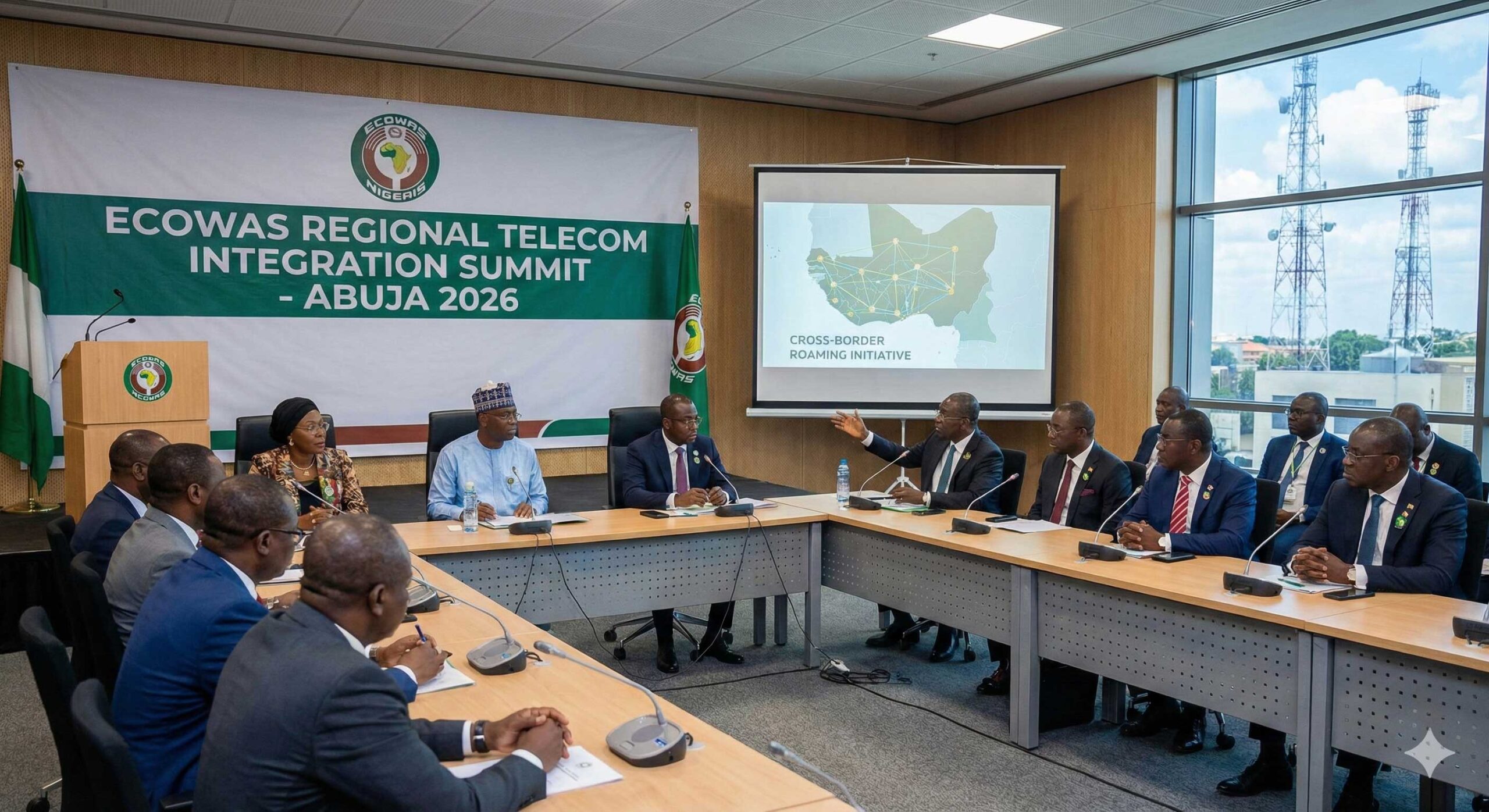
The renewed push comes as the Nigerian Communications Commission (NCC) deepens its collaboration with sister agencies, specifically targeting the dual challenges of exorbitant cross-border roaming costs and the vulnerability of critical digital infrastructure. The initiative was brought to the fore this week during a high-level bilateral meeting at the NCC headquarters in Abuja, where a delegation from the Liberia Telecommunications Authority (LTA) arrived to benchmark best practices and align regulatory frameworks.
This meeting is not merely a bureaucratic formality; it represents a significant gear shift in the slow-moving machinery of regional integration. For decades, the dream of a “borderless” West Africa has been hindered by uneven regulatory environments, linguistic divides, and protectionist telecom policies. However, with the digital economy now serving as the primary engine for post-pandemic growth, the cost of fragmentation has become too high to ignore.
The Imperative of Connectivity
Speaking at the strategic session in Abuja, Dr. Aminu Maida, the Executive Vice Chairman of the NCC, articulated a vision of a region where digital borders are as porous as physical ones are intended to be under the ECOWAS protocols. Represented by Kelechi Nwankwo, the Commission’s Director of Corporate Planning, Strategy, and Risk Management, Maida emphasized that the prosperity of individual nations is now inextricably linked to the connectivity of the collective.
“West Africa’s economic and social development is increasingly tied to seamless digital connectivity,” Maida stated. “The region becomes stronger and more prosperous when all countries are interconnected. We cannot operate in silos when data, capital, and talent are mobile.”
The timing of this push is critical. As of 2026, the digital economy contributes significantly to the GDP of West African nations, yet the friction involved in cross-border communication remains a massive tax on trade. A trader traveling from Lagos to Accra or Monrovia often resorts to swapping SIM cards at every border crossing to avoid roaming charges that can be hundreds of times higher than local rates. This “SIM-swapping” phenomenon is not just an inconvenience; it is a barrier to the smooth operation of the African Continental Free Trade Area (AfCFTA), which relies heavily on digital logistics and communication.
The “One Network” Dream: Tackling Roaming Charges
Central to the discussions between Nigeria and Liberia—and indeed, the broader West Africa Telecommunications Regulators Assembly (WATRA) agenda—is the implementation of the ECOWAS Roaming Regulation. Adopted in principle years ago, the regulation aims to treat voice, SMS, and data traffic originating from ECOWAS citizens as “local” traffic, regardless of which member state they are currently in.
While some bilateral successes have been recorded—notably between Ghana and Cote d’Ivoire, and Togo and Benin—a region-wide “One Network” has remained elusive. Nigeria’s re-entry into the fray as a primary agitator for implementation is expected to accelerate the process.
“The technical capacity is there,” noted an NCC insider familiar with the talks. “The challenge has always been commercial and regulatory. Operators fear the loss of roaming revenue, and regulators worry about tax implications. But what Nigeria is arguing is that the volume of traffic generated by a free-roaming regime will far outweigh the loss of high-margin, low-volume roaming fees. It’s a volume game.”
For the Liberian delegation, led by high-ranking commissioners from the LTA, Nigeria represents a template for scale. Liberia, with its smaller population but strategic coastal location, is looking to harmonize its gateway controls and consumer protection standards with Nigeria’s rigorous frameworks. By aligning technical standards, the two nations hope to create a corridor of connectivity that can serve as a pilot for the rest of the bloc.
ICT as Critical National Infrastructure: The Security Dimension
Beyond the consumer-facing issue of roaming, a more existential topic dominated the Abuja agenda: the security of telecommunications assets.
In recent years, the sabotage of fiber optic cables, the vandalism of base transceiver stations (BTS), and the theft of power generators have plagued telecom operators across West Africa. These incidents cause service outages that ripple through the economy, grounding banking transactions and halting logistics chains.
Nigeria has recently taken the bold step of formally designating Information and Communications Technology (ICT) assets as Critical National Information Infrastructure (CNII). This legal designation elevates telecom towers and fiber ducts to the same security status as oil pipelines or power grids, mandating stricter penalties for vandals and prioritizing their protection by security agencies.
Maida used the visit to advocate for this policy to be adopted ECOWAS-wide.
“We have formally designated ICT as part of our critical national information infrastructure,” Maida explained to the Liberian delegates. “This is a move aimed at strengthening resilience, security, and long-term investment in the sector. If we want investors to pour billions into 5G and fiber across West Africa, we must guarantee that those assets are protected by the full weight of the state.”
The proposal suggests a regional treaty where an attack on digital infrastructure in one country is viewed with a standardized level of severity across the bloc. This is particularly pertinent for landlocked countries like Burkina Faso, Niger, and Mali, which rely on terrestrial fiber cables running through coastal nations like Nigeria, Benin, and Ghana for their internet access. If a cable is cut in Nigeria, a business in Niamey goes offline. Thus, the security of Nigeria’s infrastructure is a matter of regional national security.
The Role of WATRA and Regulatory Diplomacy
Nigeria’s strategy relies heavily on the West Africa Telecommunications Regulators Assembly (WATRA), the regional body tasked with harmonizing regulations. Nigeria has long been a major financier and host to WATRA, but the 2026 strategy appears to be moving from passive support to active steerage.
The challenge WATRA faces is bridging the “Anglophone-Francophone” divide. The regulatory traditions in French-speaking West Africa, often modeled on French civil law, differ significantly from the common law systems of Nigeria, Ghana, and Liberia. Harmonizing licensing regimes, spectrum allocation, and quality of service (QoS) standards across these distinct legal frameworks is a Herculean task.
However, the meeting with the LTA suggests a “coalition of the willing” approach. Rather than waiting for a unanimous consensus among all 15 ECOWAS states, Nigeria seems prepared to forge strong bilateral and trilateral agreements that force the market to adapt.
“Nigeria has long championed regulatory alignment through platforms such as WATRA,” Maida reaffirmed. “Sustained engagement with regional partners is now even more critical as emerging technologies reshape the sector.”
The Economic Ripple Effect
The economic implications of this integration drive cannot be overstated. The World Bank estimates that a 10% increase in broadband penetration in developing markets correlates with a 1.3% to 2.5% increase in GDP. For West Africa, a market of over 400 million people with a median age under 19, the digital economy is the only sector growing fast enough to absorb the exploding workforce.
Integrated telecoms are the backbone of the region’s booming Fintech sector. Companies like Flutterwave, Paystack, and Interswitch have already effectively erased borders for payments. However, the underlying infrastructure—the pipes through which this money flows—remains fragmented.
If Nigeria succeeds in pushing a unified telecom market, it would drastically lower the cost of doing business for startups. A tech entrepreneur in Lagos could seamlessly deploy IoT (Internet of Things) solutions for agriculture in rural Liberia without negotiating entirely new carrier contracts. A remote worker in Accra could collaborate with a firm in Abuja without worrying about data throttling or latency caused by inefficient routing.
Furthermore, the rise of “sovereign AI” and data localization laws requires a regional approach. As nations begin to build data centers to host their own cloud infrastructure, they need robust, redundant fiber links to their neighbors. Nigeria’s push for integration includes discussions on “data diplomacy”—ensuring that data can flow freely across borders while respecting privacy laws and national sovereignty.
Challenges Ahead: The Road is Still Bumpy
Despite the optimism radiating from the NCC headquarters, the road to a fully integrated West African digital market is fraught with potholes.
1. Infrastructure Deficit: While Nigeria has extensive subsea cable landings (including 2Africa, Equiano, and Glo-1), the terrestrial backhaul network—the fiber that carries data from the coast to the hinterland—is still insufficient. Expanding this network requires massive capital expenditure (CapEx). Operators are hesitant to invest in cross-border links if the regulatory environment is unpredictable.
2. Political Instability: The Sahel region remains volatile. ensuring the physical safety of engineers and infrastructure in border regions is a major hurdle. A harmonized telecom policy means little if the physical territory is contested.
3. Quality of Service (QoS): Consumers in Nigeria and Liberia alike complain frequently about dropped calls and slow data speeds. Regulators are often caught in a bind: trying to force operators to improve quality while simultaneously asking them to lower prices and invest in rural telephony. Harmonizing QoS standards across the region will require a level of monitoring and enforcement that currently taxes even the most robust regulators.
4. The Revenue Question: Many West African governments view the telecom sector as a “cash cow,” levying heavy taxes on turnover, airtime, and data. Harmonization might require governments to harmonize these tax regimes to prevent arbitrage (where traffic is routed through the cheapest country). Convincing finance ministries to give up short-term tax revenue for long-term economic growth is a difficult political sell.
The Human Element: Bridging the Divide
Ultimately, the drive for integration is about the people of West Africa.
During the visit, the LTA delegation toured several of Nigeria’s digital installations, including the NCC’s Digital Bridge Institute. The exchange highlighted the need for human capital development. It is not enough to connect machines; the region must connect minds.
“We are looking at a future where a student in Monrovia can attend a virtual lecture in Lagos in real-time, without buffering, and at a cost that doesn’t eat their entire weekly food budget,” said a member of the Liberian delegation. “That is the metric of success. Not the technical specs, but the human impact.”
Conclusion: A New Era of Digital Diplomacy
The February 9th meeting between Nigeria and Liberia is a microcosm of a larger shift. Nigeria is waking up to the reality that its digital potential is capped by the limitations of its neighbors. To grow, it must lift the region.
By focusing on the twin pillars of affordable roaming and infrastructure security, the NCC is targeting the low-hanging fruit that can build momentum for deeper integration. The designation of ICT as Critical National Infrastructure is a game-changer, setting a precedent that, if followed by Ghana, Senegal, Cote d’Ivoire, and others, could turn West Africa into a fortress of digital stability in a turbulent world.
As the talks concluded in Abuja, the message was clear: The era of digital isolationism is over. The frequencies may be invisible, but the bridges they build are the most solid structures West Africa has for its future economic survival. The “One Network” is no longer just a slogan; it is an urgent economic necessity, and Nigeria is finally putting its weight behind the wheel.
This special report covers the deepening diplomatic and regulatory ties in the West African telecommunications sector, following the high-level meeting between the Nigerian Communications Commission (NCC) and the Liberia Telecommunications Authority (LTA) in Abuja.