
CHENNAI, INDIA — In what will be remembered as the defining underdog story of the 2026 T20 World Cup, Canada’s Yuvraj Samra etched his name into the history books on Tuesday morning, powering his side to a formidable 173/4 against a depleted New Zealand at the MA Chidambaram Stadium. Samra, just 19 years old, became the youngest player to score a century in T20 World Cup history, leaving the Black Caps with a daunting chase to secure their place in the Super Eight.
The morning began with a bizarre twist at the toss when New Zealand’s regular captain, Mitchell Santner, was a late withdrawal. Stand-in skipper Daryl Mitchell revealed that Santner was sidelined by an unlikely culprit: a “dodgy burger” consumed the previous evening.
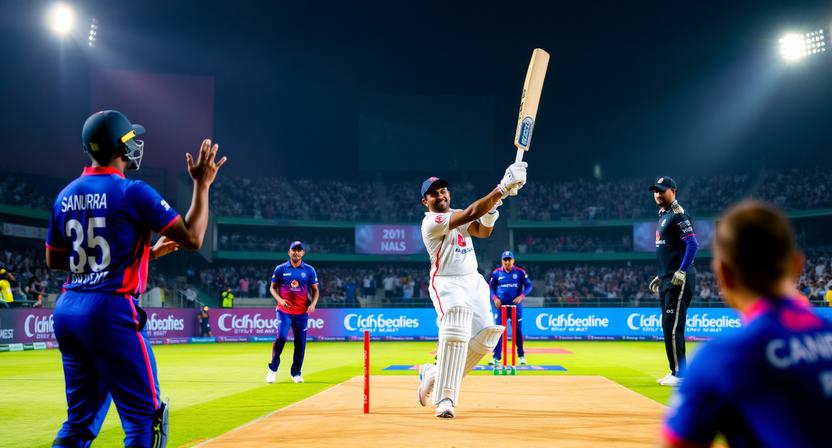
Samra’s Record-Breaking Masterclass
Opting to bat first on a dry, spin-friendly Chennai deck, Canada captain Dilpreet Bajwa (36 off 31) and Yuvraj Samra (110 off 65) unleashed a calculated assault on the Kiwi pace attack. While Bajwa played the anchor role, Samra was the aggressor, reaching his maiden T20I century off just 58 deliveries.
Samra’s innings was a blend of brutal power and technical elegance. He dismantled the likes of Matt Henry and the towering Kyle Jamieson, smashing 11 boundaries and six massive sixes. His 116-run opening stand with Bajwa set the foundation for Canada’s highest-ever total in a T20 World Cup fixture.
| Milestone | Player | Details |
|---|---|---|
| Highest Score | Yuvraj Samra | 110 (65 balls) |
| Record | Youngest Centurion | 19 years, 4 months |
| Partnership | Opening Stand | 116 runs (13.6 overs) |
The “Dodgy Burger” and Selection Shuffles
The New Zealand camp was rocked before a ball was bowled. In addition to Santner’s food poisoning, pace spearhead Lockie Ferguson had departed for New Zealand overnight to attend the birth of his first child.
Daryl Mitchell, stepping in as captain, was forced to make two changes:
- Cole McConchie (making his T20 World Cup debut) replaced Santner.
- Kyle Jamieson returned to the XI in place of Ferguson.
Despite the disruptions, Mitchell remained optimistic at the toss, noting that the team possessed the experience to adapt to the slow Chepauk surface. However, those words were put to the test as Canada’s batters capitalized on every loose delivery during the powerplay.
Canada’s Tactical Masterstroke
Skipper Dilpreet Bajwa’s decision to bat first was vindicated by the pitch’s behavior. The surface slowed significantly in the latter half of the first innings, and Canada made one crucial change to exploit this, bringing in off-spinner Shivam Sharma for seamer Kaleem Sana.
“The day game suits us,” Bajwa said during the break. “The spinners will have a lot more to work with as the ball begins to grip. We have the runs on the board; now we need the discipline.”
The Chase: New Zealand in Early Trouble
Chasing 174, New Zealand’s pursuit of a Super Eight berth got off to a disastrous start. Finn Allen (21 off 7) looked dangerous early, smashing three boundaries, but was brilliantly caught by Shivam Sharma off the bowling of Dilon Heyliger. Just four balls earlier, Tim Seifert was dismissed cheaply, leaving the Kiwis reeling at 35/2.
As the match reached the drinks break at the 10-over mark, New Zealand stood at 93/2, with Rachin Ravindra and Glenn Phillips fighting to rebuild. The required run rate currently hovers around 7.36, but with the pitch offering significant turn to Canada’s spin trio, the “upset of the century” is a distinct possibility.
Qualification Scenarios
- If New Zealand wins: They confirm their spot in the Super Eight alongside South Africa from Group D.
- If Canada wins: New Zealand must wait for the result of the upcoming South Africa vs UAE match to see if they progress on Net Run Rate, while Canada keeps a mathematical (though unlikely) hope alive.
Would you like me to provide the final match result and full scorecard once the New Zealand innings concludes?
For more on the history of international cricket at Chepauk, visit the [M. A. Chidambaram Stadium]() Wikipedia page.