
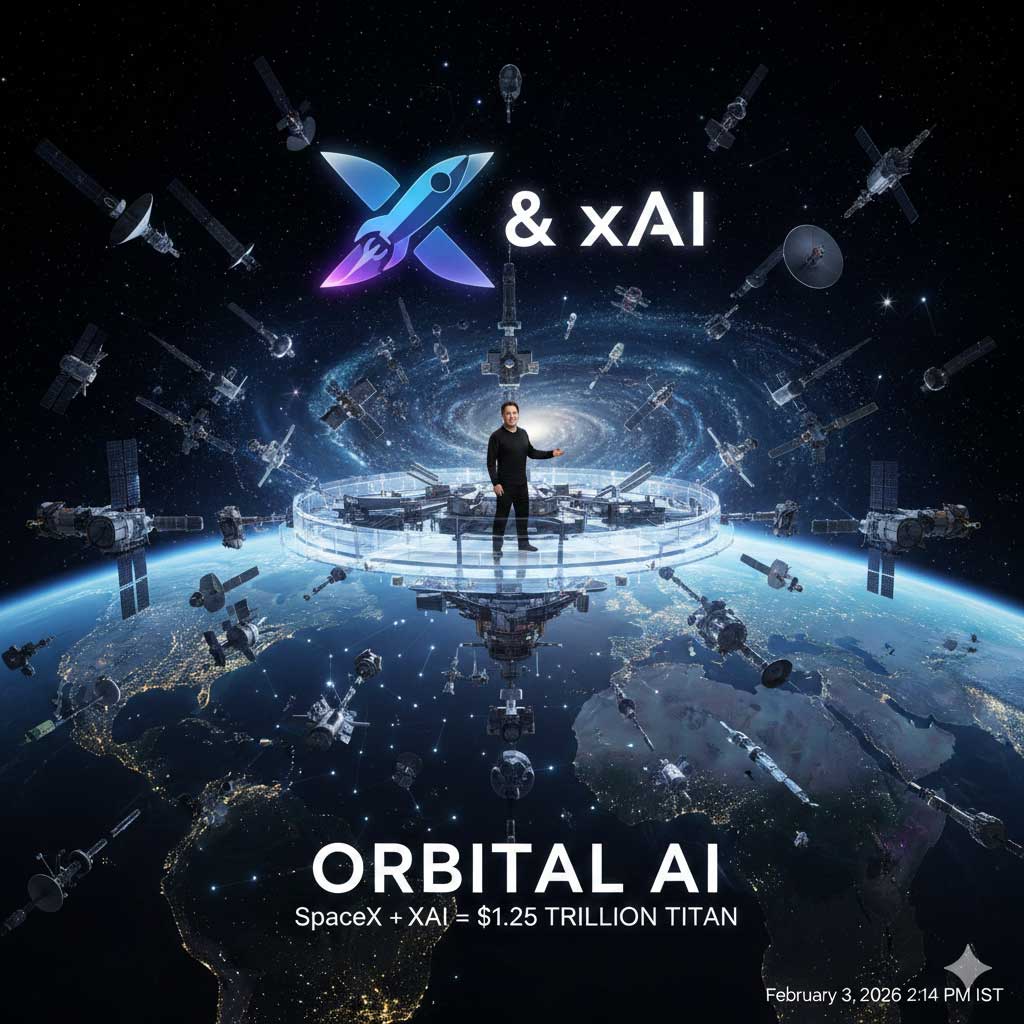
SpaceX and xAI Form $1.25 Trillion Titan: Musk Unifies Empire for ‘Orbital AI’ Era
HAWTHORNE, CA — In a move that redefines the boundaries of the modern industrial complex, Elon Musk has officially consolidated his aerospace powerhouse, SpaceX, with his rapidly ascending artificial intelligence venture, xAI. The merger, announced late Monday, creates a vertically integrated behemoth valued at an estimated $1.25 trillion, marking the largest M&A transaction in global corporate history.
The deal effectively folds the xAI startup—and by extension, the social media platform X (formerly Twitter)—under the SpaceX umbrella. This consolidation is seen by analysts as the ultimate “master plan” to fuel Musk’s most ambitious vision yet: moving the world’s massive AI computing needs from the power-constrained surface of the Earth into the vacuum of space.
The Terms: A Record-Breaking “Muskonomy” Consolidation
The transaction values SpaceX at approximately $1 trillion and xAI at $250 billion. For more than 25 years, the record for the largest M&A deal was held by Vodafone’s $203 billion acquisition of Mannesmann in 2000. Musk has now shattered that ceiling.
Key Financial Highlights:
- Share Swap: xAI investors will receive 0.1433 shares of SpaceX for every share of xAI held.
- Cash Option: Some xAI executives have the choice to receive cash at a rate of $75.46 per share.
- Implied Price: The combined entity is expected to price internal shares at roughly $527 each.
- IPO Pipeline: The merger serves as the final precursor to a blockbuster SpaceX Initial Public Offering (IPO) planned for June 2026, which analysts predict could push the company’s valuation past $1.5 trillion.
The Vision: Why Put AI in Space?
While the financial figures are staggering, the strategic rationale is even more disruptive. In a statement titled “xAI Joins SpaceX to Accelerate Humanity’s Future,” Musk argued that terrestrial data centers are hitting a wall due to extreme electricity demands and cooling costs.
“Scaling to make a sentient sun to understand the Universe and extend the light of consciousness to the stars!” Musk proclaimed.
By moving AI compute to orbit, the “Muskonomy” gains three distinct advantages:
- Unlimited Energy: Solar panels in space receive unfiltered solar irradiance, providing a constant power source without the “greenhouse” constraints of Earth.
- Natural Cooling: Using radiative cooling in the vacuum of space bypasses the multi-billion dollar liquid cooling systems required by terrestrial supercomputers like xAI’s “Colossus.”
- Low Latency Distribution: Integrated with the Starlink satellite network, the space-based AI could provide real-time reasoning and data processing directly to users anywhere on the globe.
Market Impact and Regulatory Scrutiny
The merger further blurs the lines between Musk’s private interests. By integrating X (the “global nervous system”) with SpaceX (the “sensory organs”) and xAI (the “reasoning layer”), Musk has created what some describe as a “reflexive” corporate species.
However, the “SpaceX-xAI Titan” will face intense scrutiny. SpaceX is a critical partner for the U.S. Department of Defense and NASA, holding billions in sensitive government contracts. Regulators are expected to closely examine the movement of proprietary tech and engineers between the commercially driven AI wing and the nationally vital launch wing.
Furthermore, the timing of the deal—ahead of a mid-June IPO that coincides with a rare planetary alignment of Jupiter and Venus—has led Wall Street to brace for what could be the most volatile and high-stakes public listing in history.
What’s Next for Investors?
The acquisition offers a clear “exit strategy” for xAI’s private investors while providing SpaceX with a high-growth software revenue stream to supplement its capital-intensive rocket business. For the broader market, the 2026 SpaceX IPO now becomes a play on the entire future of human infrastructure—both on and off the planet.
Would you like me to provide a breakdown of the projected share pricing for the June 2026 IPO based on these new merger valuations?
Elon Musk’s $1.25 Trillion SpaceX xAI Merger Explained
This video provides a deep dive into the financial strategy behind the $1.5 trillion IPO rumors and the shift toward space-based AI data centers.