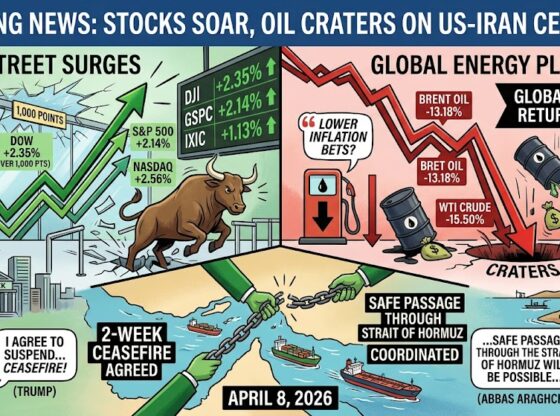

USA Breaking News: Wall Street experienced a massive resurgence on Wednesday, fueled by a sweeping relief rally following a major geopolitical breakthrough. U.S. stocks surged across the board, and global oil prices plummeted, after the United States and Iran officially agreed to a two-week suspension of hostilities. This sudden and highly anticipated ceasefire carries immediate global economic implications, most notably the temporary reopening of the Strait of Hormuz to international shipping—a crucial artery for global energy supplies that had been choked by the conflict.
The financial response was instantaneous and euphoric. The Dow Jones Industrial Average soared over 1,000 points, logging a 2.35% gain to break out of a recent slump driven by wartime uncertainty. The broader S&P 500 jumped 2.14%, trading at 6,757.29, while the technology-heavy Nasdaq Composite vaulted 2.56%, leading the major indices as investors rotated aggressively back into risk assets.
At the center of the market’s dramatic reversal is the energy sector. Oil prices, which had been trading at heavily elevated premiums due to the blockade, cratered on the news. Brent crude futures dove over 16%, settling just above $91 a barrel, while West Texas Intermediate crude plummeted nearly 18% to hover around $93. The sudden deflation of the oil shock has rapidly altered the macroeconomic landscape, breathing new life into equities and fueling bets that the Federal Reserve may have more maneuvering room regarding interest rates in the coming months.
The Breakthrough: A Two-Sided Pause in Hostilities
The catalyst for Wednesday’s market explosion originated from diplomatic backchannels that culminated in public declarations from both Washington and Tehran. The agreement provides a two-week window during which all direct military engagements will cease, allowing for the critical resumption of commercial transit through the Persian Gulf.
President Trump announced the suspension of U.S. military operations early Wednesday. In a statement published on Truth Social, he outlined the administration’s stance: “I agree to suspend the bombing and attack of Iran for a period of two weeks. This will be a double sided CEASEFIRE!”
The explicit condition of the U.S. halt was the immediate lifting of Tehran’s blockade on the Strait of Hormuz. Shortly after the American announcement, Iranian Minister of Foreign Affairs Abbas Araghchi released a statement confirming that Tehran had accepted the terms. Araghchi verified that Iranian armed forces would cease their operations against U.S. assets and allies, provided the halt in attacks on Iranian soil was honored. Crucially for the global economy, Araghchi stated that “for a period of two weeks, safe passage through the Strait of Hormuz will be possible via coordination with Iran’s Armed Forces.”
Within hours of the dual announcements, maritime tracking data showed commercial vessels cautiously beginning to navigate the 21-mile-wide waterway. The passage of these initial ships signaled to global markets that the blockade was, at least temporarily, lifted, immediately easing the severe supply chain anxieties that had gripped the globe.
Wall Street’s Massive Relief Rally
The psychological toll of the conflict on investors cannot be overstated. For weeks, markets had been heavily weighed down by the specter of a prolonged, escalating war in the Middle East, which threatened to permanently disrupt energy markets and send global inflation spiraling out of control. Wednesday’s news acted as a release valve for that immense pressure.
The Dow Jones Industrial Average
The blue-chip index was the most striking visual representation of the market’s relief, adding over 1,000 points in a single trading session. Industrial, consumer discretionary, and financial stocks, which are deeply sensitive to energy costs and inflation data, saw massive inflows of capital. Companies that rely heavily on global supply chains and stable fuel prices, such as major airlines, shipping logistics firms, and retail giants, led the charge.
The S&P 500
The S&P 500’s 2.14% surge pushed the index to 6,757.29. The breadth of the rally was remarkably wide, with the vast majority of the index’s sectors trading in the green. The only notable laggard was the energy sector itself, which dragged due to the collapse in crude prices. However, the heavy weighting of consumer and technology stocks in the S&P 500 easily overpowered the drag from energy equities.
The Nasdaq Composite
The tech-heavy Nasdaq was the day’s biggest winner, vaulting 2.56%. Technology stocks have been highly sensitive to the interest rate environment. The logic driving the Nasdaq higher is deeply tied to the oil markets: lower oil prices reduce headline inflation, which in turn reduces the pressure on the Federal Reserve to maintain punishingly high interest rates. With the threat of an oil-driven inflation spike momentarily tabled, investors rushed back into growth and tech stocks, anticipating a friendlier macroeconomic environment.
The Unblocking of the Strait of Hormuz
To understand the sheer magnitude of the oil market’s reaction, it is necessary to examine the geopolitical and economic importance of the Strait of Hormuz. Located between Oman and Iran, the strait connects the Persian Gulf with the Gulf of Oman and the Arabian Sea. It is arguably the world’s most important oil chokepoint.
Under normal circumstances, roughly 20% to 30% of the world’s total oil consumption passes through this narrow body of water every single day. Furthermore, a massive percentage of the world’s liquefied natural gas from Qatar also transits through the strait. When hostilities effectively closed the strait to commercial traffic, the global energy market was instantly deprived of a massive chunk of its daily supply, leading to the risk premiums that sent oil soaring well into the triple digits.
The confirmation from Araghchi that safe passage would resume—coordinated with Iranian forces—instantly removed that risk premium.
The Plunge in Crude
The resulting sell-off in energy markets was historic in its velocity. Brent crude futures, the international benchmark, saw a devastating drop of over 13%, settling near $91. West Texas Intermediate, the U.S. benchmark, suffered an even steeper decline, falling roughly 15.5% to the $93 range.
For weeks, energy traders had been pricing in the worst-case scenario: a months-long closure of the strait resulting in severe global shortages, rationing, and a massive hit to global GDP. The two-week ceasefire forces traders to immediately reprice contracts based on the sudden influx of millions of barrels of oil back into the global logistics network. Ships that had been idling outside the Gulf, waiting for a safe window, are now rushing to load and transport crude to refineries in Asia, Europe, and the Americas.
Inflation, The Federal Reserve, and Macroeconomic Shifts
The ripple effects of crashing oil prices extend far beyond the energy sector; they strike at the very heart of global monetary policy. Over the past year, central banks worldwide, led by the U.S. Federal Reserve, have been engaged in a high-stakes battle against inflation.
Just as the Fed appeared to be making headway, the outbreak of the U.S.-Iran conflict and the subsequent spike in energy prices threatened to undo months of progress. Energy costs are a primary driver of headline inflation; they dictate the cost of manufacturing, shipping, heating, and consumer travel. A sustained oil shock would have inevitably bled into core inflation, forcing companies to raise prices on everyday goods to offset their increased logistical costs.
Wednesday’s 16% to 18% drop in crude oil prices radically alters that trajectory. The plunge in fuel costs acts as an immediate, massive tax cut for both consumers and corporations.
Fueling Fed Bets
Wall Street analysts are already recalculating their inflation models based on the new crude prices. The market consensus is rapidly shifting toward a more dovish Federal Reserve. Prior to the ceasefire, futures markets were beginning to price in the possibility of emergency rate hikes or a prolonged period of restrictive monetary policy to combat war-driven inflation.
Following the ceasefire announcement, those bets evaporated. Instead, equity markets are surging on the renewed hope that the Fed will have the data necessary to either pause rate hikes or even consider rate cuts later in the year, provided the conflict does not resume with greater intensity after the two-week window closes.
The Impact on Consumer Confidence and Retail
The psychological relief of the ceasefire is expected to translate into an immediate bump in consumer confidence. The American consumer, whose spending drives roughly 70% of the U.S. economy, has been closely watching the numbers at the gas pump. Rising fuel prices act as a direct drain on discretionary income.
With wholesale gas prices expected to mirror the cratering of crude oil in the coming days, consumers will soon see significant relief at local gas stations. This expected drop in transportation costs frees up capital for retail spending, dining out, and travel. Consequently, retail and consumer discretionary stocks were among the strongest performers in Wednesday’s rally, as investors anticipated a stronger-than-expected spending season if the lower energy prices hold.
Furthermore, the airline industry, which is notoriously sensitive to jet fuel costs, saw broad, sector-wide gains. Airlines had been facing the prospect of severely reduced profit margins and the necessity of passing fuel surcharges onto passengers—a move that historically dampens travel demand. The reopening of the Strait of Hormuz provides a critical reprieve for the travel and hospitality sectors.
A Fragile Peace: The Two-Week Countdown
Despite the market’s euphoric reaction, geopolitical analysts and risk managers are urging caution. The agreement is explicitly temporary—a two-week suspension, not a permanent peace treaty.
The underlying issues that sparked the hostilities remain entirely unresolved. The next 14 days will feature intense, high-stakes diplomatic maneuvering. Global leaders, the United Nations, and regional powers in the Middle East will likely use this narrow window to attempt to broker a more lasting de-escalation.
However, the threat of a return to conflict looms large. If a broader diplomatic agreement is not reached by the end of the 14-day period, the blockade could be reinstated, and military operations could resume.
What Happens on Day 15?
Market volatility is expected to remain exceptionally high as the deadline approaches. While Wednesday was defined by a massive relief rally, the market’s tone will likely shift to one of deep anxiety if negotiations appear to be stalling by the second week of the ceasefire.
Energy traders, in particular, will be operating on a knife’s edge. The current sub-$100 oil prices are predicated on the assumption that the strait remains open. If rhetoric from either Washington or Tehran begins to sour, the risk premium will be rapidly priced back into crude futures, potentially leading to violent, sudden upward spikes in oil prices.
Corporations reliant on the strait are not taking any chances. Shipping companies are executing “sprint” logistics—moving as many vessels as physically possible through the corridor while the window remains open, stockpiling reserves in safe harbors globally in preparation for the possibility that the strait slams shut again in two weeks.
Looking Ahead
For now, Wall Street is choosing to celebrate the reprieve. The injection of over 1,000 points into the Dow Jones Industrial Average represents trillions of dollars in recovered market capitalization. The stock market is a forward-looking mechanism, and today, it looked exactly two weeks into the future and liked what it saw: lower inflation, a friendlier Federal Reserve, and the unobstructed flow of global commerce.
Investors will spend the coming days closely monitoring three key metrics:
- Vessel Tracking in the Gulf: The market will watch maritime data to ensure the safe passage of commercial ships continues unimpeded, verifying that the terms of the ceasefire are holding on the water.
- Diplomatic Rhetoric: Every statement from the White House, the Iranian Foreign Ministry, and allied nations will be parsed for clues regarding the likelihood of extending the ceasefire or reaching a broader accord.
- U.S. Economic Data: With the oil shock temporarily neutralised, the market will return its focus to domestic economic indicators, particularly upcoming consumer price index reports and labour market data, to gauge the fundamental health of the economy independent of the war.
Wednesday will be recorded as one of the most dramatic single-day reversals in recent financial history. The dual forces of a surging stock market and a crashing energy market have completely reset the economic narrative for the month of April. Whether this massive rally is the beginning of a sustained bull run or merely a temporary two-week illusion entirely depends on the diplomatic progress made before the ceasefire clock runs out.