
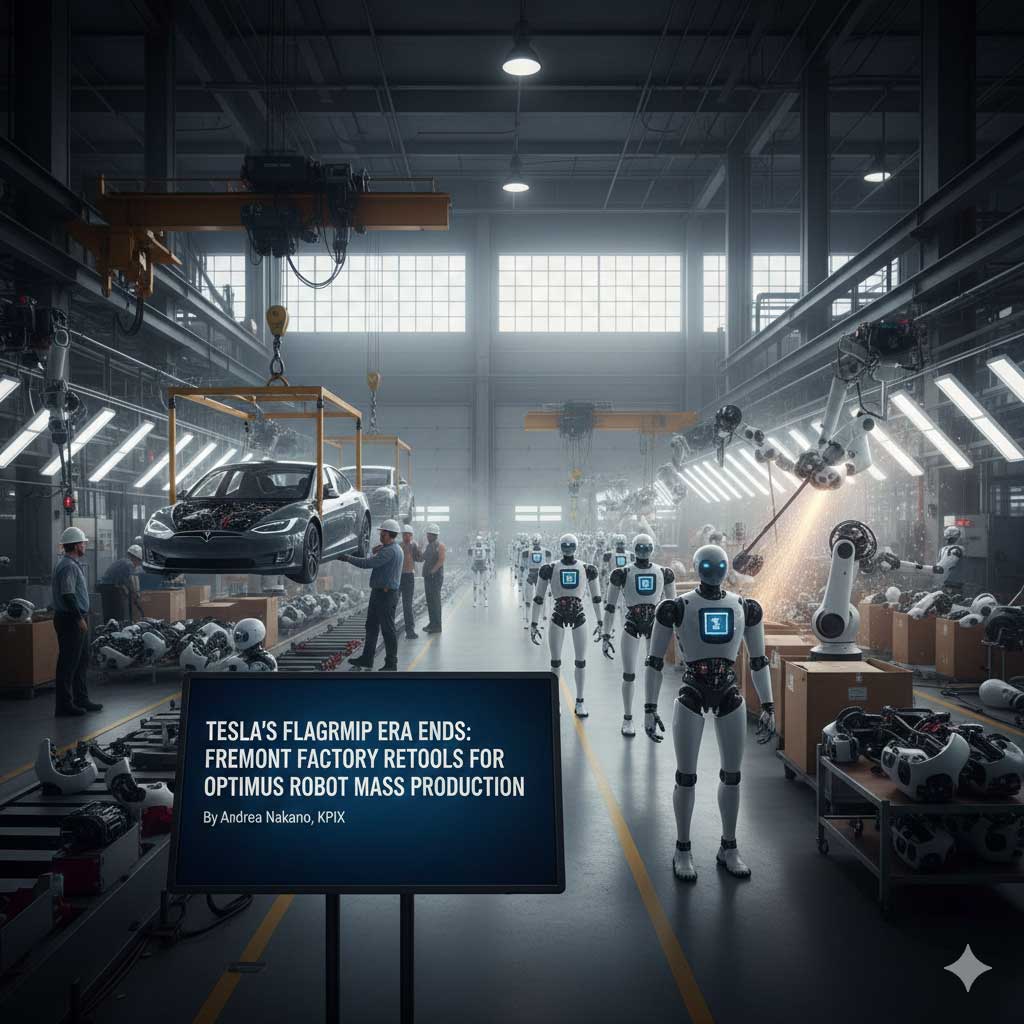
Tesla’s Flagship Era Ends: Fremont Factory Retools for Optimus Robot Mass Production
By TODAY HEALDINES USA January 29, 2026
FREMONT, CA — In a move that marks the definitive end of an era for the electric vehicle industry, Tesla has officially announced the discontinuation of its flagship Model S and Model X programs. The decision, revealed by CEO Elon Musk during the company’s Q4 2025 earnings call on Wednesday, will see the historic Fremont factory undergo a massive transformation. The assembly lines that once proved electric cars could be both luxury status symbols and performance monsters are being gutted to make room for what Musk calls the company’s “most important product ever”: the Optimus humanoid robot.
“It’s slightly sad, but it is time to bring the S and X program to an end with an honorable discharge,” Musk stated. “We are moving into a future that is based fundamentally on autonomy and robotics.”
The Sunset of the ‘S3XY’ Lineup
For over a decade, the Model S and Model X served as the pillars of Tesla’s brand identity. The Model S, launched in 2012, was the car that saved Tesla from obscurity, while the Model X followed in 2015 with its ambitious, albeit complex, Falcon Wing doors. However, by the end of 2025, the two models accounted for less than 3% of Tesla’s total sales, overshadowed by the more affordable Model 3 and Model Y.
According to sources at the Fremont facility, the space known internally as GA1 (General Assembly 1) is already being cleared. While production will officially wind down by the end of June 2026, Tesla has issued a “now or never” warning to prospective buyers, noting that custom orders will likely close within the next few weeks.
“If you want a new Model S or X, now is the time,” Musk noted. “Once the lines are converted, they are gone for good.”
Retooling Fremont: From Cars to Humanoids
The pivot to robotics is not just a change in product, but a complete overhaul of the Fremont campus. The city of Fremont confirmed today that while vehicle production for the Model 3 and Model Y will continue at record-breaking speeds, a significant portion of the factory will be dedicated to the Gen 3 Optimus robot.
Production Goals and Economic Impact
Tesla aims to reach a staggering annual production capacity of 1 million Optimus units at the Fremont site alone. To support this, the company is expected to invest upwards of $20 billion in 2026 toward AI infrastructure and robotic manufacturing.
| Category | Transition Details |
| Current Area | GA1 (Former Model S/X Lines) |
| New Focus | Optimus Gen 3 Mass Production |
| Target Output | 1 Million Units/Year (Fremont Hub) |
| Employment | Headcount expected to increase due to complex assembly |
| Timeline | Retrofitting begins Q3 2026; Mass output by late 2026 |
Fremont was selected as the global hub for Optimus production due to its highly skilled workforce and the city’s proven ability to manage complex manufacturing transitions. Local officials have expressed enthusiasm, noting that the move secures Fremont’s place as a leader in the “Physical AI” revolution.
What is Optimus Gen 3?
The third generation of the Optimus robot, scheduled for an official unveiling later this quarter, is described as the first version designed specifically for large-scale manufacturing. Unlike previous prototypes that struggled with basic balance and overheating, the Gen 3 features:
- Upgraded Dexterous Hands: Capable of handling delicate electronic components and heavy kitting tasks.
- Integrated FSD Neural Networks: The same “brain” that powers Tesla’s Full Self-Driving software, allowing the robot to navigate unscripted factory environments.
- Mass Production Design: Simplified actuators and sensors designed to be built by other robots.
The Stakeholder Perspective
While investors reacted positively to the news—Tesla’s stock rose nearly 4% in after-hours trading—the decision is not without risk. Tesla reported its first annual revenue decline in 2025, and Musk is essentially abandoning a proven (albeit niche) luxury car market for a product that has yet to generate a single dollar of commercial revenue.
Analysts like Alexander Potter of Piper Sandler suggest that “delivery volumes hardly matter anymore” for Tesla. The company’s valuation is now tied almost entirely to its progress in AI. For current owners of the Model S and X, Tesla has promised continued service and parts support “for as long as people have the vehicles,” but the era of the luxury electric sedan at Tesla is officially over.
As the Fremont factory prepares to swap steering wheels for robotic hands, the world watches to see if Musk’s “infinite money glitch” will truly usher in an age without poverty—or if the “slightly sad” end of the Model S/X is a gamble too far.