









Tech Finance blog Florida: Gasbuddy News
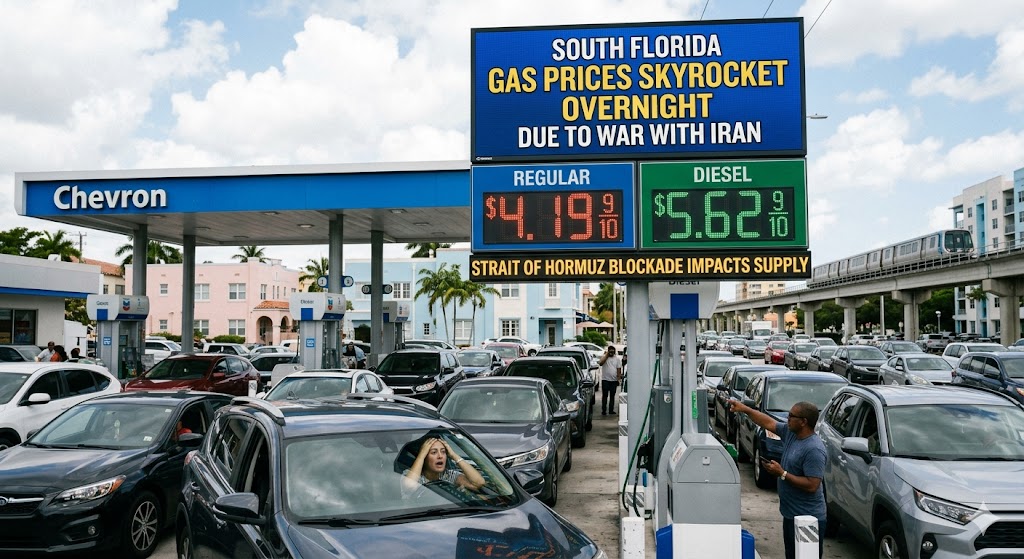
MIAMI, FL — South Florida drivers woke up to a harrowing new reality Tuesday morning as digital signs at gas stations from Jupiter to Key West flipped to prices not seen in nearly four years. In a dramatic overnight surge fueled by the escalating military conflict between the U.S.-Israeli coalition and Iran, the average price for a gallon of regular unleaded gasoline in the region officially eclipsed the $4.00 mark, with many high-traffic stations in Miami and Fort Lauderdale reporting prices as high as $4.25.
According to the latest daily tracking from AAA – The Auto Club Group, the Florida statewide average jumped to $3.95 per gallon today, but the South Florida metropolitan areas—heavily dependent on fuel barged in through Port Everglades—are feeling the sting more acutely. The overnight spike follows a month of relentless increases since the conflict began on February 28, representing a staggering $1.07 per gallon rise in just 31 days.
The “Strait” Jacket: Why Prices Jumped Overnight
The primary catalyst for the Tuesday morning “sticker shock” is the deteriorating situation in the Strait of Hormuz. On Monday evening, reports surfaced that the blockade of this vital waterway—which handles roughly 20% of the world’s petroleum liquids—had become absolute following a series of naval engagements.
With tankers from Saudi Arabia, Iraq, the UAE, and Kuwait effectively trapped, the global oil market reacted with “limit-up” volatility. Crude oil benchmarks, which were hovering around $70 per barrel before the war, have now stabilized above $115, with analysts at Goldman Sachs warning of a push toward $150 if energy infrastructure in the Persian Gulf sustains further damage.
“We are seeing a perfect storm,” said Mark Jenkins, spokesperson for AAA. “You have a massive geopolitical supply shock coinciding with the annual transition to more expensive ‘summer-blend’ gasoline and the beginning of the spring travel season. In South Florida, where every gallon of gas must be shipped in, the logistics costs are amplifying the global crude spike.”
The Local Impact: From Commuters to Commerce
For the millions of residents in Miami-Dade, Broward, and Palm Beach counties, the $4.00 threshold is more than just a number—it is a psychological and financial breaking point.
The Commuter Squeeze
In a region known for its lack of comprehensive mass transit and sprawling suburbs, the daily commute is unavoidable. For Brian Miller, a landscape contractor in Homestead, the math is becoming unsustainable.
“Yesterday I was filling my truck and equipment for about $2.90 a gallon. This morning, the station on my way to the first job was $4.15,” Miller said while fueling up at a Chevron in Kendall. “I’m spending an extra $25 to $30 every time I hit the pump. I can’t just raise my prices on my clients overnight, so that money is coming directly out of my rent and grocery budget.”
The Logistics Crisis: Diesel Hits $5.60
While passenger vehicles are hitting the $4.00 mark, the situation for the logistics and trucking industry is even more dire. Diesel prices in Florida have skyrocketed to an average of $5.62 per gallon, up nearly $2.00 since the start of the war.
Port Everglades, the fuel hub for nearly 12 counties in South Florida, is seeing a surge in surcharges from trucking fleets. Economists warn that these costs will inevitably trickle down to the grocery store shelf. “Everything you eat in Florida arrived on a truck,” says Dr. Elena Rodriguez, an economist at the University of Miami. “When diesel jumps $2 in a month, you can expect the price of milk, bread, and produce to follow suit within weeks.”
Regional Price Variations across South Florida
While the “official” average sits just under $4 statewide, the reality on the ground in South Florida varies by neighborhood:
| Location | Regular Unleaded (Avg) | Premium (Avg) | Diesel (Avg) |
|---|---|---|---|
| Miami (Brickell/Downtown) | $4.19 | $4.85 | $5.72 |
| Fort Lauderdale | $4.08 | $4.72 | $5.65 |
| West Palm Beach | $4.12 | $4.78 | $5.68 |
| Homestead | $3.98 | $4.60 | $5.55 |
The Political Fallout: Trump Vows Action
The rapidly rising prices have placed immense pressure on the White House. On Monday morning, President Donald Trump issued a stern warning via social media, stating that the U.S. is prepared to “completely obliterate” Iran’s oil infrastructure, including the critical Kharg Island terminal, if the Strait of Hormuz is not immediately reopened.
“The United States is in serious discussions with a new, and more reasonable, regime to end our military operations,” the President posted. “But if a deal is not reached shortly… we will conclude our ‘stay’ in Iran by blowing up all of their electric plants and oil wells.”
This rhetoric has kept the markets in a state of high anxiety. While the administration has authorized the release of 172 million barrels from the Strategic Petroleum Reserve, experts like Patrick De Haan of GasBuddy suggest these measures are “mere band-aids” for a global supply gap of this magnitude.
Consumer Confidence and the Road Ahead
Surprisingly, a report released Tuesday by the Conference Board showed that U.S. consumer confidence inched higher in March (91.8, up from 91.0), but the fine print suggests a growing sense of dread. The survey noted that “expectations of higher inflation” have surged to levels not seen since the tariff anxieties of 2025.
Is $5 Gas Next?
Analysts are no longer asking if gas will hit $5 in Florida, but when. “If the Strait of Hormuz remains closed through April, we are looking at a national average of $5.00 and a Florida average that could easily test $5.25,” said Rory Johnston, a veteran energy analyst.
For now, South Floridians are being advised to use fuel-tracking apps, maintain proper tire pressure to maximize MPG, and consolidate trips where possible. However, in a state built for the automobile, the “overnight skyrocket” is a stark reminder of how vulnerable the local economy remains to the volatility of global conflict.
Quick Tips for South Florida Drivers:
- GasBuddy/Waze: Check prices in real-time; stations just two blocks apart in Miami are currently showing price differences of up to 35 cents.
- Warehouse Clubs: Membership stores like Costco and BJ’s are currently trailing the “overnight” spikes by 12–24 hours, offering a temporary window of savings.
- Avoid Premium: Unless your vehicle specifically requires it, stick to regular. The spread between regular and premium has widened to nearly 70 cents in some Broward County locations.
Disclaimer: Gasoline prices are subject to extreme volatility due to ongoing military developments in the Middle East. Data provided by AAA and GasBuddy is updated daily.