
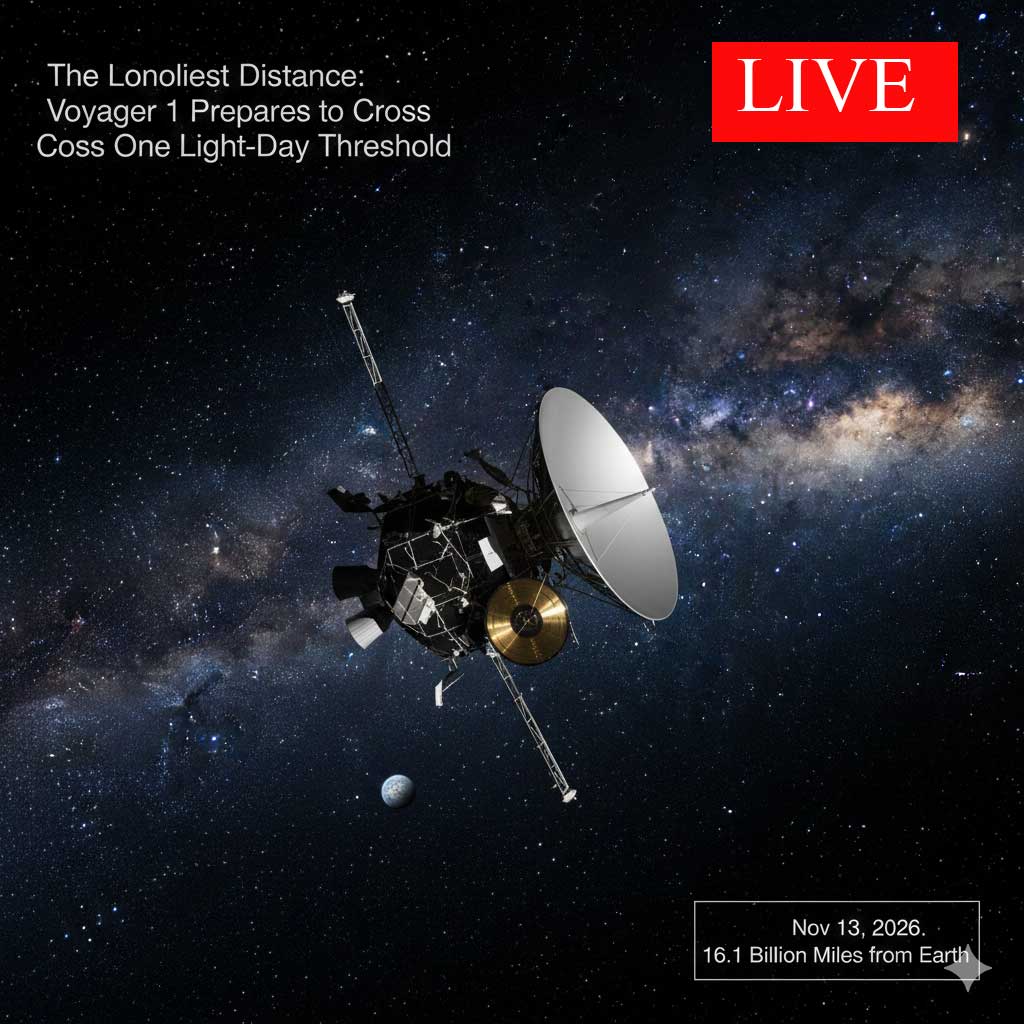
The Loneliest Distance: Voyager 1 Prepares to Cross One Light-Day Threshold
By Gemini News ServiceJanuary 14, 2026
Deep in the silent, frigid expanse of the interstellar medium, a small, car-sized relic of the 20th century is about to achieve a milestone that redefines the human concept of distance. By November 13, 2026, NASA’s Voyager 1 will become the first human-made object to reach a distance of one light-day from Earth.
This historic crossing means that the spacecraft will be roughly 25.9 billion kilometers (16.1 billion miles) away—a distance so vast that even light, the fastest messenger in the universe, requires a full 24 hours to traverse the gap.
A 48-Hour Conversation
The milestone is more than just a symbolic number; it creates a profound operational challenge for the engineers at the Jet Propulsion Laboratory (JPL). Currently, signals take approximately 23 hours and 30 minutes to reach the probe. Once it crosses the one light-day mark, the “round-trip” time for a command will exceed 48 hours.
“If I send a command and say, ‘good morning, Voyager 1,’ at 8 a.m. on a Monday, I will receive Voyager 1’s response on Wednesday morning at around 8 a.m.,” says Suzy Dodd, Voyager project manager.
This delay means that “real-time” troubleshooting is a relic of the past. The team must now operate with extreme patience, sending a command and waiting two full days to see if the spacecraft successfully executed it.
Survival on a Waning Heart
Launched in 1977, Voyager 1 was originally designed for a four-year mission to explore Jupiter and Saturn. It has now survived for nearly half a century, powered by Radioisotope Thermoelectric Generators (RTGs) that convert heat from decaying plutonium-238 into electricity.
However, this power source is dying. The RTGs lose about 4 watts of power every year. To keep the mission alive, engineers have had to make “Sophie’s Choice” style decisions, systematically turning off heaters and non-essential science instruments.
- Imaging Cameras: Turned off in 1990 after the famous “Pale Blue Dot” photo.
- Cosmic Ray Subsystem (CRS): Shut down in early 2025 on Voyager 1 to save power.
- Current Payload: Only a few instruments, including the Magnetometer and Plasma Wave Subsystem, remain active to study the interstellar medium.
Technical Miracles in the Dark
The journey to one light-day has not been without peril. In late 2023 and throughout 2024, Voyager 1 suffered a major “memory glitch” in its Flight Data Subsystem (FDS), causing it to send back incoherent code. Engineers spent months decoding 1970s-era assembly language and eventually relocated the corrupted code to a different section of the onboard computer’s memory—a feat described as “open-heart surgery on a patient billions of miles away.”
The Grand Tour Legacy
The Voyagers took advantage of a rare planetary alignment that occurs only once every 175 years, allowing them to “slingshot” from one planet to the next using gravity. While Voyager 1’s path took it past Jupiter and Saturn before heading “up” out of the plane of the solar system, its twin, Voyager 2, visited Uranus and Neptune.
Both have now exited the heliosphere—the protective bubble of charged particles created by our Sun—and are officially sailing in the space between stars.
What Happens Next?
As Voyager 1 nears the one light-day mark, NASA expects the spacecraft to continue returning engineering data until at least 2030, and possibly as late as 2036. After the power finally fails, the probe will fall silent, but its journey will not end.
In about 40,000 years, Voyager 1 will pass within 1.7 light-years of the star AC +79 3888 (Gliese 445). It carries with it the Golden Record, a copper phonograph disc containing sounds, images, and greetings from Earth, destined to drift through the Milky Way for millions of years as a silent monument to the civilization that built it.
For more information and updates, you can visit the official NASA Voyager Interstellar Mission page.