
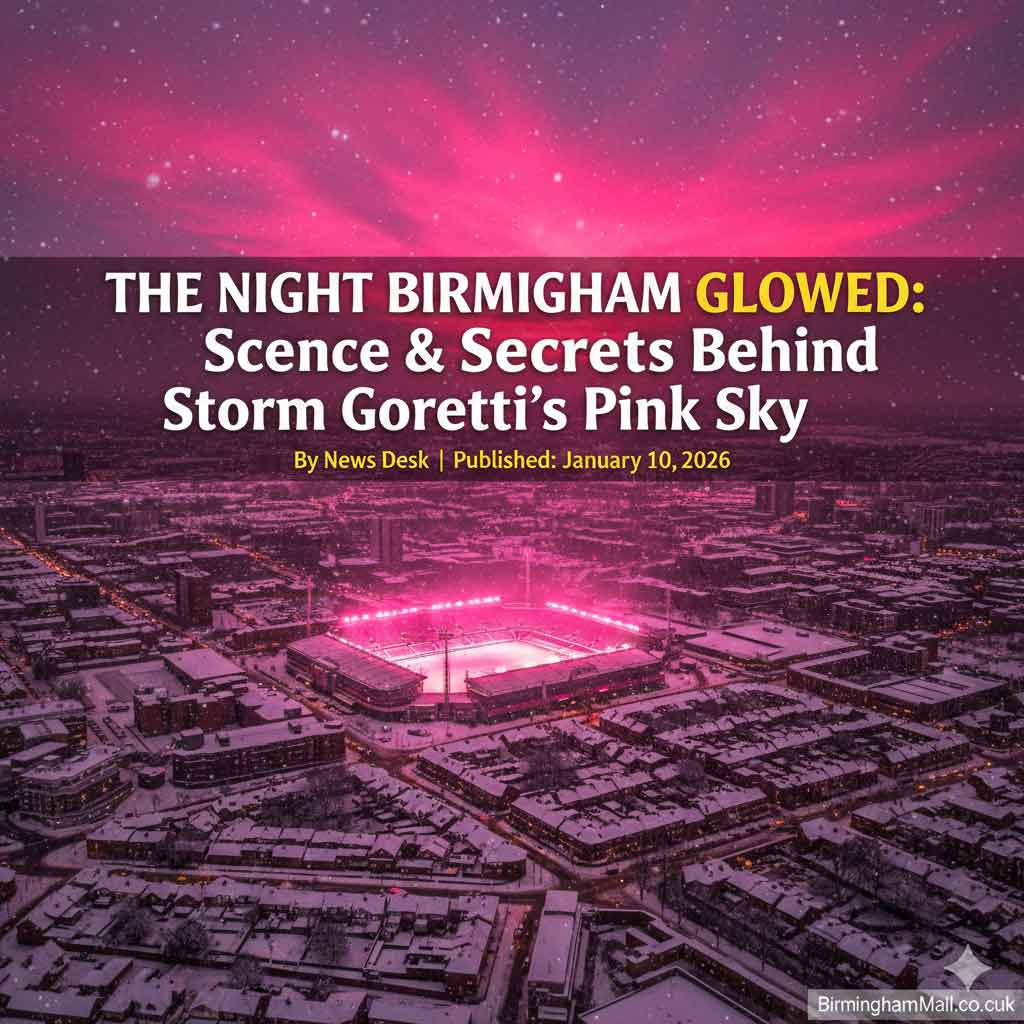
The Night Birmingham Glowed: The Science and Secrets Behind the Storm Goretti Pink Sky
By Gemini News Service Published: Saturday, January 10, 2026
For a few surreal hours on the evening of Thursday, January 8, 2026, the citizens of Birmingham didn’t just witness a storm—they stepped into a science fiction movie. As Storm Goretti hammered the West Midlands with the heaviest snowfall seen in a decade, the sky didn’t turn the typical bruised grey of a winter blizzard. Instead, it ignited into a vivid, “Stranger Things” shade of neon pink.
From the Bullring to the suburbs of Small Heath and Bordesley Green, and even as far north as Hednesford in Staffordshire, residents stopped in their tracks. Social media was instantly flooded with thousands of photos and videos. Was it a rare Arctic aurora? A chemical reaction in the atmosphere? Or, as some more imaginative TikTokers suggested, the arrival of something extraterrestrial?
The truth, while more “down-to-earth,” is a fascinating intersection of high-stakes sports technology and rare meteorological physics.
1. The Culprit: St Andrew’s Stadium and the “Blurple” Glow
The primary source of the neon light was traced back to Birmingham City Football Club’s St Andrew’s Stadium. Like many top-tier professional clubs, “The Blues” utilize sophisticated LED pitch-growth technology.
During the harsh British winter, natural sunlight is insufficient to keep professional-grade grass healthy, especially when it is being trampled by elite athletes every fortnight. To combat this, the club uses massive, wheeled lighting rigs that hover over the pitch. These aren’t your standard white floodlights; they are specialized SGL Systems LED units that emit a specific spectrum of light—largely red and blue—which appears as a bright, fuchsia-pink or “blurple” hue to the human eye.
These wavelengths are optimized for photosynthesis, helping the grass recover from the “wear and tear” of matches and the damp, freezing conditions of a West Midlands January. Ordinarily, this light is localized to the stadium. However, on Thursday night, Storm Goretti turned the stadium into a giant lantern.
2. The Physics of the “Pink Out”: Why Now?
If these lights are used throughout the winter, why did the sky only turn pink this Thursday? The answer lies in the specific “multi-hazard” conditions created by Storm Goretti.
A. The “Cloud Mirror” Effect
Meteorologists from the Met Office explained that Storm Goretti brought an exceptionally low and dense cloud deck over Birmingham. These clouds acted as a literal ceiling. Instead of the stadium’s pink light dissipating into the upper atmosphere, it was trapped. The low-hanging water droplets in the clouds acted as a reflective surface, bouncing the pink LED glow back down toward the city and spreading it horizontally for miles.
B. Snow as a Refractive Prism
The rare, heavy snowfall was the final ingredient. Unlike rain, which can absorb light, snowflakes are complex ice crystals. Each flake acting as a tiny prism, refracting and scattering the light in every direction. This created a “wash” of color rather than a single beam, making it appear as though the entire atmosphere had changed hue.
C. Rayleigh Scattering and Wavelengths
Met Office spokesman Grahame Madge noted that the atmosphere during a storm filters light differently. “The blue wavelengths of light are more easily scattered by snow or water droplets,” Madge explained. “This allows the longer wavelengths—such as red and orange—to get through.” When the stadium’s already red-heavy LED lights hit this “atmospheric filter,” the result was an intensified, saturated pink that looked almost artificial.
3. Not Just Birmingham: The Staffordshire Connection
Birmingham City wasn’t the only club “painting” the sky. Similar reports came in from Hednesford in Staffordshire. Local club Hednesford Town FC took to social media to clear up the confusion after their own neighbors reported a mysterious glow earlier in the week.
The club joked that their LED pitch lights were “helping the grass grow and recover, keeping us ready to chase three points, not the aurora.” This confirmed that the phenomenon is becoming a hallmark of modern “Smart Stadium” technology interacting with traditional British weather.
4. Storm Goretti: The Dark Side of the Glow
While the pink sky provided a moment of viral beauty, the storm itself was anything but beautiful for the region’s infrastructure. Storm Goretti, the first named storm of 2026, was described by forecasters as a “weather bomb.”
- Power Outages: National Grid reported that approximately 60,000 premises were left without power as high winds and heavy snow brought down lines across the Midlands and the South West.
- Travel Paralysis: Birmingham Airport was forced to suspend flights temporarily to clear the runways. On the ground, the “worst snowfall in a decade” (up to 10cm in some city areas) led to gridlock on the M6 and the cancellation of almost all West Midlands Railway services.
- Red Warnings: While the Midlands remained under an Amber warning for snow, the South West faced a rare Red “Danger to Life” warning for wind, with gusts exceeding 90mph.
5. Is This the Future of British Winters?
As football clubs move away from older, high-pressure sodium lamps (which emit an orange glow) toward energy-efficient, pink-spectrum LEDs, these “Pink Outs” may become a more common sight during foggy or snowy weather.
For the residents of Birmingham, the “Goretti Glow” will be remembered as a rare night where technology and nature collided to create something truly spectacular. It served as a reminder that even in the middle of a “weather bomb,” there is still room for a bit of (perfectly explainable) magic.