
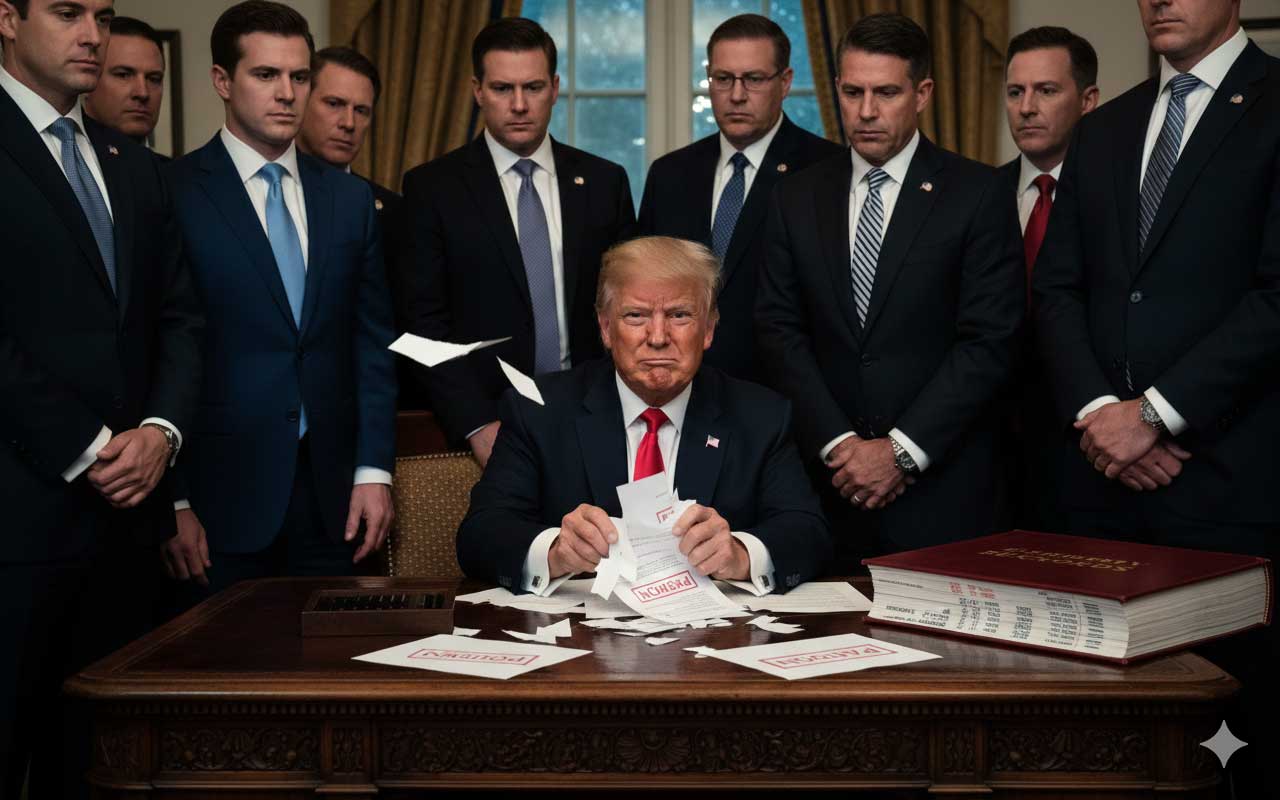
The Pardon Marketplace: How Trump’s Second Term Redefined Executive Clemency as a Transactional Asset
Washington, D.C. — January 20, 2026
The questions that have dogged the White House for the first year of Donald Trump’s second term are no longer being whispered in the corridors of the Justice Department; they are being shouted from the headlines of every major news outlet. The central inquiry—whether the presidential pardon power has been effectively transformed into a high-stakes commodity—reached a boiling point this week following a flurry of clemency grants that many critics describe as a blatant “pay-for-play” scheme.
The controversy was reignited on January 16, 2026, when President Trump issued a wave of pardons that seemingly rewarded loyalist donors and individuals represented by his own former legal defense team. While the White House maintains that these decisions are based on the “merits of justice” and the correction of “political prosecutions,” the timing and financial trails associated with the latest recipients tell a far more transactional story.
The Case of Julio Herrera Velutini: A Timeline of Influence
At the center of the current firestorm is Julio Herrera Velutini, a Venezuelan-Italian banker who was embroiled in a sprawling federal bribery case involving the former governor of Puerto Rico, Wanda Vázquez Garced. The details of Herrera Velutini’s path to a pardon have become the primary exhibit for those arguing that the pardon office has been bypassed in favor of the super PAC.
According to campaign finance records and investigative reports, the timeline of Herrera Velutini’s clemency is strikingly correlated with massive financial infusions into the pro-Trump super PAC, MAGA Inc.:
- Late 2024: While facing felony bribery charges, Herrera Velutini’s daughter, Isabela Herrera, donated $2.5 million to MAGA Inc.
- May 2025: Herrera Velutini’s lawyer, Christopher M. Kise—who previously served on Trump’s own criminal defense team—negotiated a remarkably lenient plea deal with the Justice Department. Authorized by a top Trump appointee, the deal allowed the banker to plead guilty to a mere misdemeanor, over the strenuous objections of career prosecutors.
- July 2025: Isabela Herrera donated another $1 million to the same super PAC.
- January 15, 2026: President Trump granted a full pardon to Julio Herrera Velutini, as well as his co-defendants, Wanda Vázquez and former FBI agent Mark Rossini.
The White House has dismissed the connection as coincidental, with Press Secretary Karoline Leavitt stating that the donations “had no bearing” on the President’s decision to correct what he viewed as a “weaponized DOJ” investigation.
A “Pardon-Shopping Industry”: The New Lobbying Frontier
The Herrera Velutini case is not an isolated incident. Reports from the Wall Street Journal published late last year described the emergence of a specialized “pardon-shopping industry.” Lobbyists with close ties to the administration have reportedly set their going rate at $1 million just to present a clemency application to the President, with “success fees” reaching as high as $6 million.
This dynamic has been facilitated by the systematic dismantling of traditional checks on executive clemency. In early 2025, President Trump fired the Justice Department’s career pardon attorney, Liz Oyer, and replaced her with political loyalist Ed Martin. Martin, who has famously adopted the slogan “No MAGA Left Behind,” has largely bypassed the standard review procedures that have governed the pardon process for over a century.
| Key Figure | Role in Pardon Controversy | Notable Action |
| Ed Martin | DOJ Pardon Attorney | Fired career staff; vowed to prioritize “MAGA” defendants. |
| Alice Marie Johnson | “Pardon Czar” | Named to a new advisory role to recommend clemency candidates. |
| Christopher Kise | Defense Attorney | Former Trump lawyer who secured lenient deals for donor-clients. |
| MAGA Inc. | Super PAC | Recipient of millions in donations from families of pardon seekers. |
As the controversy surrounding President Donald Trump’s second-term pardons continues to escalate, here are the answers to the most frequently asked questions regarding the current “pardon for sale” allegations and the administration’s new approach to executive clemency.
Pardon Controversy FAQs
What is the “Pardon Marketplace” controversy? The controversy involves allegations that presidential pardons are being traded for political donations or high-priced lobbying fees. Reports from the Wall Street Journal and New York Times suggest a “pardon-shopping industry” has emerged where lobbyists reportedly charge $1 million for access, with success fees for clemency reaching as high as $6 million.
Who is Julio Herrera Velutini and why is his pardon significant? Herrera Velutini is a Venezuelan-Italian banker recently pardoned by President Trump. The case is controversial because his daughter, Isabela Herrera, donated a total of $3.5 million to the pro-Trump super PAC MAGA Inc. ($2.5M in late 2024 and $1M in mid-2025) while her father faced bribery charges. The White House denies any connection between the donations and the pardon.
What is “No MAGA Left Behind”? This is the unofficial slogan used by the new DOJ Pardon Attorney, Ed Martin, to describe the administration’s priority of granting clemency to political allies and those involved in the January 6 Capitol protests. Martin replaced career attorney Liz Oyer, who was fired after accusing the administration of valuing political loyalty over justice.
Who is the “Pardon Czar”? President Trump appointed Alice Marie Johnson as the “Pardon Czar” in early 2025. Johnson, whose own sentence was commuted by Trump in his first term, now leads a new office that bypasses traditional Department of Justice review channels to recommend candidates directly to the President.
How does this compare to past presidencies? In his second term, Trump has granted over 1,600 acts of clemency in just one year—far exceeding his first-term total of 237. Critics point to George W. Bush’s 2008 decision to revoke a pardon over a $28,500 donation as a contrast to the current administration’s acceptance of multi-million dollar contributions from families of pardon seekers.
| Feature | Traditional Process | Trump Second-Term Model |
| Primary Reviewer | Career DOJ Pardon Attorney | “Pardon Czar” Alice Marie Johnson |
| Volume of Pardons | Varies (Conservative) | High (1,600+ in Year 1) |
| Lobbying Influence | Minimal/Regulated | High-Fee Success-Based Lobbying |
| Financial Links | High scrutiny/Appearance of impropriety | Direct super PAC donations from families |
As the controversy surrounding President Donald Trump’s second-term pardons continues to escalate, here are the answers to the most frequently asked questions regarding the current “pardon for sale” allegations and the administration’s new approach to executive clemency.
Pardon Controversy FAQs
What is the “Pardon Marketplace” controversy? The controversy involves allegations that presidential pardons are being traded for political donations or high-priced lobbying fees. Reports from the Wall Street Journal and New York Times suggest a “pardon-shopping industry” has emerged where lobbyists reportedly charge $1 million for access, with success fees for clemency reaching as high as $6 million.
Who is Julio Herrera Velutini and why is his pardon significant? Herrera Velutini is a Venezuelan-Italian banker recently pardoned by President Trump. The case is controversial because his daughter, Isabela Herrera, donated a total of $3.5 million to the pro-Trump super PAC MAGA Inc. ($2.5M in late 2024 and $1M in mid-2025) while her father faced bribery charges. The White House denies any connection between the donations and the pardon.
What is “No MAGA Left Behind”? This is the unofficial slogan used by the new DOJ Pardon Attorney, Ed Martin, to describe the administration’s priority of granting clemency to political allies and those involved in the January 6 Capitol protests. Martin replaced career attorney Liz Oyer, who was fired after accusing the administration of valuing political loyalty over justice.
Who is the “Pardon Czar”? President Trump appointed Alice Marie Johnson as the “Pardon Czar” in early 2025. Johnson, whose own sentence was commuted by Trump in his first term, now leads a new office that bypasses traditional Department of Justice review channels to recommend candidates directly to the President.
How does this compare to past presidencies? In his second term, Trump has granted over 1,600 acts of clemency in just one year—far exceeding his first-term total of 237. Critics point to George W. Bush’s 2008 decision to revoke a pardon over a $28,500 donation as a contrast to the current administration’s acceptance of multi-million dollar contributions from families of pardon seekers.
| Feature | Traditional Process | Trump Second-Term Model |
| Primary Reviewer | Career DOJ Pardon Attorney | “Pardon Czar” Alice Marie Johnson |
| Volume of Pardons | Varies (Conservative) | High (1,600+ in Year 1) |
| Lobbying Influence | Minimal/Regulated | High-Fee Success-Based Lobbying |
| Financial Links | High scrutiny/Appearance of impropriety | Direct super PAC donations from families |
Is there any legal way to stop these pardons? The presidential pardon power is considered absolute under the U.S. Constitution for federal crimes. While Congress can hold oversight hearings and the public can react at the ballot box, there is no judicial mechanism to “veto” or overturn a validly issued presidential pardon.