
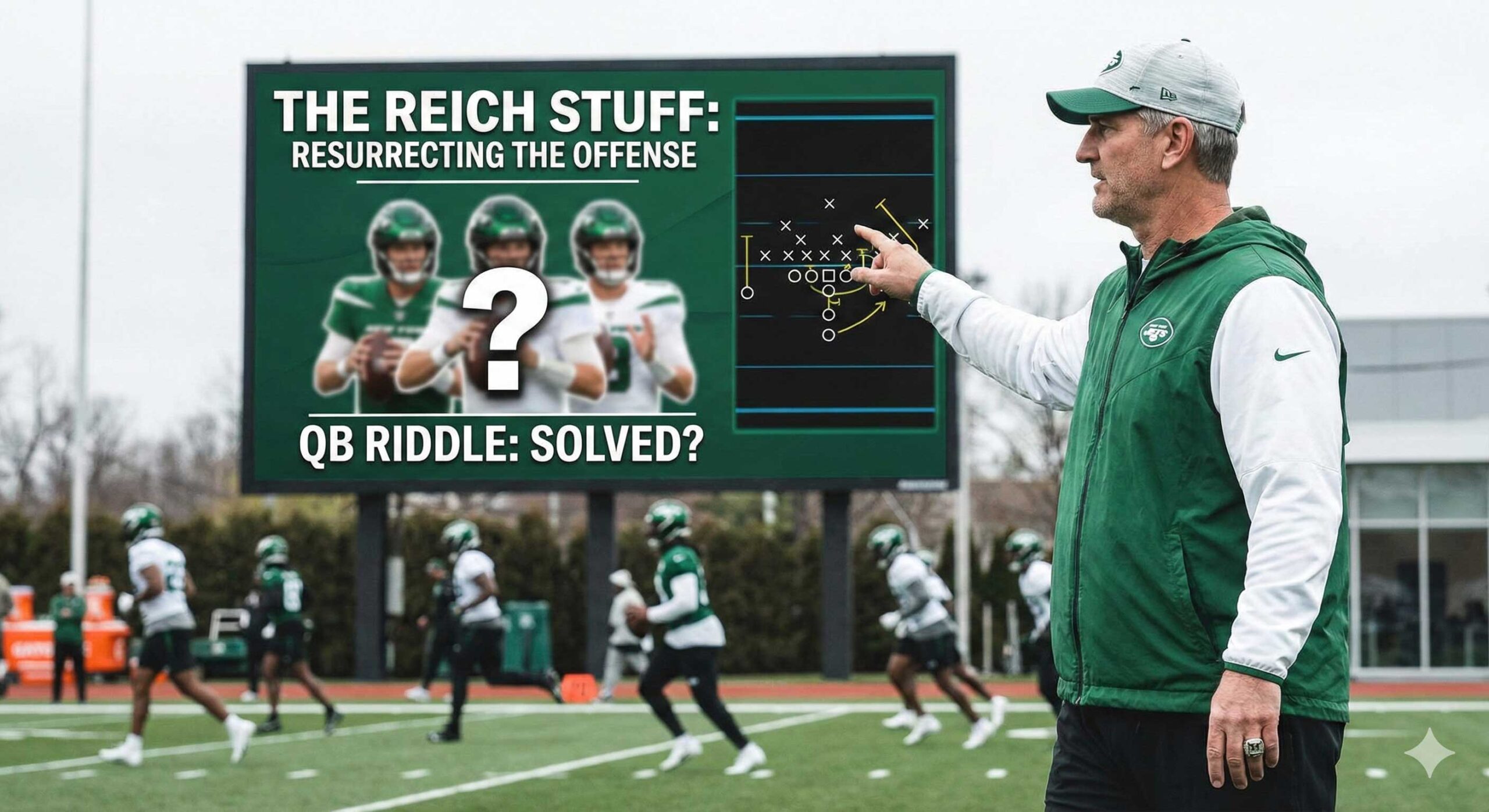
The Reich Stuff: Jets Turn to Super Bowl Winner Frank Reich to Resurrect Offense and Solving the Quarterback Riddle
FLORHAM PARK, N.J. — The New York Jets, a franchise perpetually searching for an offensive identity in a league dominated by scoring, have made their boldest move of the Aaron Glenn era. On Wednesday morning, the team officially announced the hiring of Frank Reich as their new offensive coordinator, a decision that injects a wealth of experience—and a Super Bowl pedigree—into a building desperate for stability.
The move comes just weeks after a surprising and abrupt parting of ways with former offensive coordinator Tanner Engstrand, signaling that head coach Aaron Glenn is not content with mediocrity as he heads into a pivotal 2026 campaign. By hiring Reich, the Jets are not just bringing in a play-caller; they are bringing in a former NFL head coach, a former NFL quarterback, and the architect of one of the most improbable Super Bowl runs in recent history.
“Frank has a rare combination of experience, creativity, and calm under pressure,” Glenn said in a statement released by the team. “He’s lived this game from every angle—as a quarterback in this league and as a coach who’s led offenses at the highest level. He is unique in his ability to see the game for what it is right now and adapt when appropriate.”
For a Jets team that finished 29th in total offense in 2025, “adapting” isn’t just a buzzword; it is a survival requirement.
The Swift Pivot: From Engstrand to Reich
The timeline of this hire reveals the urgency within the Jets’ front office. Late January saw the dismissal of Tanner Engstrand, a move that raised eyebrows across the league due to its timing. Usually, coordinators are fired immediately after the season (Black Monday), not weeks later as the Senior Bowl ramps up. The delay suggested that Glenn and general manager Joe Douglas were perhaps waiting for a specific domino to fall, or that an internal evaluation of the 2025 season revealed fractures that could not be healed with continuity alone.
Once the position was open, the Jets wasted no time. Reports from NFL Network Insiders Ian Rapoport, Mike Garafolo, and Tom Pelissero indicate that the search was focused on experienced hands. The team interviewed former Ravens offensive coordinator Greg Roman and former Jaguars/Lions coordinator Darrell Bevell—both respected veterans. But it was Reich, fresh off a season in the college ranks as a senior advisor and interim head coach at Stanford, who won the day.
This is a homecoming of sorts. Reich, now 64, spent the vast majority of his 13-year playing career backing up Jim Kelly in Buffalo, engineering the greatest comeback in NFL history against the Oilers. But in 1996, he spent a season in green and white, starting seven games for a Jets team that finished 1-15. That season, a young defensive back named Aaron Glenn was his teammate. Three decades later, the cornerback is the head coach, and the quarterback is his lieutenant.
The Resume: Why Reich?
To understand why this hire is significant, one must look past Reich’s turbulent recent history as a head coach and focus on his track record as a coordinator and quarterback developer.
Reich’s reputation as a “quarterback whisperer” was cemented in Philadelphia during the 2017 season. As the offensive coordinator under Doug Pederson, Reich helped orchestrate an MVP-caliber season for Carson Wentz. When Wentz went down with a knee injury, Reich retooled the offense on the fly for Nick Foles, resulting in a shootout victory in Super Bowl LII against Bill Belichick and the New England Patriots. That performance remains the gold standard for offensive adaptability: shifting from a heavy RPO (Run-Pass Option) scheme suited for Wentz to a spread-out, rhythm-based passing attack for Foles.
It was that success that launched Reich into the head coaching ranks. He spent five years leading the Indianapolis Colts (2018-2022), compiling a respectable 40-33-1 record despite a revolving door at quarterback that saw him work with Andrew Luck, Jacoby Brissett, Philip Rivers, Carson Wentz, and Matt Ryan in successive seasons. He made the playoffs twice, but the lack of stability eventually led to his dismissal.
His subsequent stint as the head coach of the Carolina Panthers in 2023 was a disaster, lasting only 11 games (1-10) before owner David Tepper pulled the plug. It was a chaotic situation involving a rookie quarterback (Bryce Young) and a meddling ownership group, arguably making it difficult to judge Reich’s actual coaching acumen during that tenure.
After taking a breath in 2024 and spending 2025 in the collegiate ranks at Stanford—where he eventually stepped in as interim head coach—Reich is returning to the role that made him a star.
“Frank understands offense and how to utilize the strengths of players,” Glenn noted. “I am looking forward to how he will help this team have success.”
The 2025 Disaster: What Reich Inherits
Reich is walking into a situation that requires immediate triage. The 2025 Jets were an offensive catastrophe. Ranking 29th in points and yards, the unit was defined by inconsistency, turnovers, and an inability to sustain drives.
The quarterback room was a carousel of mediocrity. The Jets started the season with high hopes for Justin Fields, the dynamic dual-threat acquired to ignite the ground game. While Fields showed flashes of brilliance, his inconsistencies as a pocket passer limited the team’s ceiling. Injuries and performance issues eventually forced the team to turn to veteran journeyman Tyrod Taylor and rookie Brady Cook.
Cook, a gritty prospect out of Missouri, showed toughness but looked overwhelmed by the speed of the NFL game. The result was a disjointed attack that couldn’t protect the football and couldn’t score in the red zone. The fan base, starved for a franchise quarterback since the days of Joe Namath (or perhaps the brief flicker of Chad Pennington), grew restless.
The offensive line struggled to protect whichever quarterback was under center, and the talented skill position players—often frustrated by the lack of catchable balls—saw their production dip. This is the mess Reich has been hired to clean up.
The Quarterback Quandary: Who Starts in 2026?
The elephant in the room—and the first major decision Reich and Glenn must make—is the quarterback position. The hiring of Reich offers some clues as to which direction the Jets might lean.
Option A: The Reclamation Project (Justin Fields)
Reich has a history of working with big-bodied, mobile quarterbacks, though his greatest successes have come with cerebral pocket passers like Rivers and Luck. However, in his brief time with Indianapolis, he drafted Anthony Richardson, a raw, athletic specimen similar to Fields. Could Reich be the one to finally unlock Fields’ consistency? Reich’s offense heavily utilizes RPOs, which play to Fields’ strengths, but demands quick processing and anticipation over the middle—areas where Fields has historically struggled.
Option B: The Draft
With the Jets likely holding a high draft pick following a poor offensive season, speculation is rampant that they will select a quarterback. Daniel Jeremiah’s Mock Draft 1.0 (released earlier this week) has the Raiders taking a QB at No. 1, but the Jets are firmly in the mix for the top tier of signal-callers. Reich is known for his ability to groom young talent. If the Jets draft a rookie, Reich provides the perfect mentor—a former player who understands the mental rigors of the position and a coach who has developed rookies before.
Option C: The Veteran Bridge
Reich loves a veteran. He squeezed a playoff season out of an aging Philip Rivers in Indy and won a Super Bowl with Nick Foles. If the Jets decide the 2026 draft class is weak, they could look to free agency for a “Reich guy”—a smart, accurate distributor who can execute the scheme while the rest of the roster is built up.
“What comes next for the Jets is the bigger quandary of who will be the team’s starting QB in 2026,” reported NFL Network. “For now, though, Glenn has found his new OC.”
The Scheme: What a Frank Reich Offense Looks Like
Jets fans can expect a distinct shift in philosophy from the Engstrand era. Reich is a disciple of the West Coast Offense, but with modern, aggressive twists.
- The “High-Low” Stretch: Reich’s passing concepts are built on stretching defenses vertically and horizontally. He loves the “triangle read,” giving the quarterback three options in a localized area of the field to simplify decision-making.
- Aggressiveness on Fourth Down: During his time in Philadelphia and Indianapolis, Reich was known as one of the most aggressive play-callers in the league on fourth down. “Scared money don’t make money” was a mantra in Philly. Given Aaron Glenn’s defensive background (and the “defensive head coach creates conservative offense” stereotype), Reich’s aggression could be a welcome counterbalance.
- Tight End Usage: Reich loves tight ends. From Zach Ertz in Philadelphia to Eric Ebron and Jack Doyle in Indianapolis, the TE is the safety valve in his offense. This is good news for the Jets’ tight end room, which was underutilized in 2025.
- Screen Game: To mitigate pass rush issues—a perennial problem for the Jets—Reich utilizes a sophisticated screen game. This isn’t just bubble screens to wide receivers; it’s slow-developing RB screens and TE slips designed to punish aggressive defensive lines.
The “Adult in the Room” Factor
Beyond X’s and O’s, the hiring of Reich signifies a desire for stability. The Jets have been a franchise of high drama and erratic behavior. Reich, often described as stoic and cerebral (Glenn called him “calm under pressure”), brings a gravitas that the offensive meeting room has lacked.
He has seen it all. He has been the backup who saved the season. He has been the coordinator who won the Super Bowl. He has been the head coach fired mid-season. He has been the college advisor. There is very little an NFL season can throw at Frank Reich that he hasn’t encountered.
For a young offensive roster that may have lost confidence during the struggles of 2025, Reich’s steady hand is arguably as valuable as his playbook. He is known for his emotional intelligence and his ability to connect with quarterbacks on a human level—a trait that was reportedly frayed between the previous staff and the QB room.
The Aaron Glenn Dynamic
The relationship between Aaron Glenn and Frank Reich will be fascinating to watch. Glenn, a defensive-minded head coach, is entering a critical year. Defensive coaches often live or die by their offensive coordinator hires (see: Mike Zimmer, Vic Fangio, Robert Saleh). If the offense fails, the head coach usually takes the fall.
By hiring a former head coach, Glenn is showing a lack of ego. He is effectively handing the keys of the offense to someone who has sat in the big chair. This “CEO Head Coach” model, where the HC manages the team culture and defense while a seasoned OC runs the offense autonomously, has worked for teams like the Buffalo Bills (McDermott/Daboll) and the Pittsburgh Steelers (Tomlin/Haley).
It also provides Glenn with a sounding board. Being an NFL head coach is a lonely job. Having a former head coach on staff allows for peer-to-peer mentorship on game management, roster construction, and handling the media—areas where Reich is well-versed.
The Ripple Effect: A New Staff Takes Shape
Reich isn’t the only new face in Florham Park. The Jets also announced the hiring of Brian Duker as defensive coordinator, signaling a massive overhaul of the coaching staff. With new coordinators on both sides of the ball, 2026 is shaping up to be a soft reboot of the Aaron Glenn regime.
The hiring of Duker, a rising star in the coaching ranks, alongside the veteran Reich, creates a balanced staff: youthful innovation on defense, seasoned wisdom on offense.
The Road Ahead
The honeymoon period for Reich will be short. The New York media market is unforgiving, and the Jets fan base is exhausted. The team begins its offseason program in April, but the real work begins now. Reich and Glenn must evaluate the roster, decide on free agency targets, and build a draft board that aligns with the new offensive vision.
Can Reich fix Justin Fields? Will they draft a savior? Can an offense that ranked 29th be transformed into a playoff-caliber unit in one offseason?
History suggests it’s possible. In 2017, the Eagles went from 7-9 to Super Bowl champions with Reich calling the plays. In 2018, the Colts went from 4-12 to 10-6 in Reich’s first year. He specializes in turnarounds.
But the Jets are a different beast. They are a franchise where offensive coordinators go to fade away. Frank Reich is betting his reputation that he can break the curse. Aaron Glenn is betting his job on it.
As the snow melts in New Jersey and the 2026 season approaches, the Jets finally have an offensive leader with a ring. Now, they just need the points to match the pedigree.
Analysis: The “Reich Effect” on the AFC East
The hiring of Frank Reich doesn’t just impact the Jets; it sends ripples through the AFC East. For years, the division has been an arms race. The Buffalo Bills have Josh Allen. The Miami Dolphins have their track-meet offense. Even the Patriots have shown signs of life. The Jets have consistently been the team bringing a knife to a gunfight.
Reich’s arrival signals an end to the “defensive-first, hide-the-quarterback” mentality. You don’t hire the architect of the “Philly Special” to run the ball into the line three times and punt.
1. Developing a Counter-Punch:
The AFC East features some of the best defensive minds in football. To survive, the Jets need an offense that can adjust in-game. Engstrand’s offense was often criticized for being rigid; if Plan A failed, there was no Plan B. Reich’s greatest strength is in-game adjustment. His ability to diagnose defensive coverages from the sideline—something he honed as a backup QB holding the clipboard for Jim Kelly—is elite.
2. Attracting Free Agents:
Players want to play for coaches who can get them paid. Wide receivers and tight ends know that in a Frank Reich offense, the ball gets distributed. The Jets have struggled to attract top-tier offensive free agents because of the uncertainty at QB and play-caller. Reich’s name carries weight. A veteran wide receiver might look at the Jets differently now, knowing there is a competent architect drawing up the routes.
The Stanford Detour: What Did He Learn?
It is worth noting Reich’s 2025 season at Stanford. While college football and the NFL are vastly different games, the gap is narrowing. College concepts—RPOs, tempo, spread formations—are now NFL staples.
Spending a year in the Pac-12 (or what remains of college conferences in 2026) likely exposed Reich to the newest trends in offensive innovation. The “senior advisor” role allowed him to step back and observe the game from a macro level, free from the week-to-week grind of the NFL. When he took over as interim head coach, he got his hands dirty again with player development.
This sabbatical might have been exactly what Reich needed. Coaches who take a step back often return with a refreshed perspective (see: Sean Payton, Mike McCarthy). If Reich has integrated some modern collegiate concepts into his West Coast foundation, the Jets offense could look surprisingly modern.
Conclusion: A defining Moment for 2026
February 4, 2026, might be remembered as the day the Jets finally got serious about their offense. Or, it could be another footnote in a long history of failed experiments. But the process behind the decision is sound.
They identified a weakness (inexperience and rigidity). They fired the problem (Engstrand). They hired the solution (Experience and adaptability).
Frank Reich is not a magician. He cannot throw the passes or block the defensive ends. But he offers the Jets something they haven’t had in a long time: Credibility. When Frank Reich walks into the offensive meeting room and tells the quarterback what to do, the quarterback will listen, because Reich has the Super Bowl ring to back it up.
For Aaron Glenn and the New York Jets, the hiring of Frank Reich is a declaration: The rebuilding is over. It’s time to score.